


Nvidia 2026. aasta visioon: autonoomse tehisintellekti viimine tänavatele ja tähtede juurde

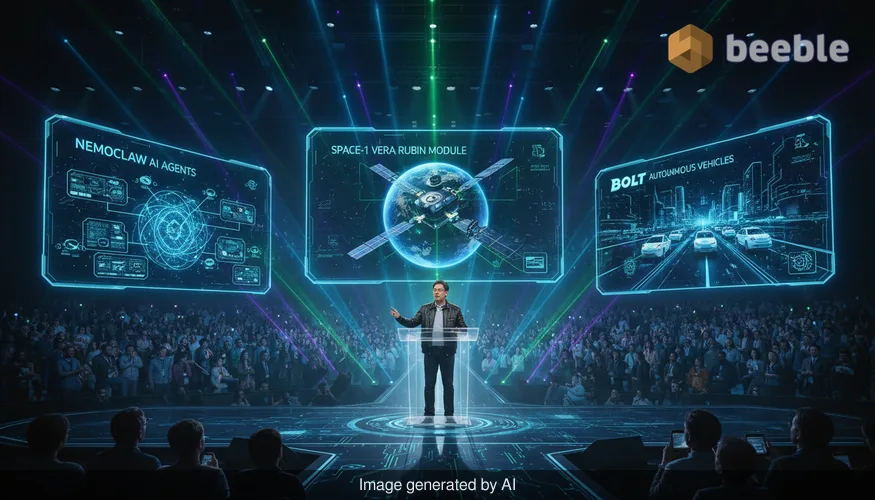
In a marathon three-hour keynote that felt more like a glimpse into a sci-fi future than a standard corporate update, Nvidia CEO Jensen Huang took the stage in San Jose to redefine the company’s trajectory. While the tech world has spent the last few years obsessed with Large Language Models (LLMs) and chatbots, Huang’s presentation at the 2026 annual conference signaled a decisive pivot. Nvidia is no longer just building the engines of AI; it is building the agents that will drive our cars, manage our businesses, and even process data in the silent vacuum of space.
The theme of the night was clear: autonomy. From the open-source software that empowers digital workers to specialized hardware designed for the harsh environment of Earth’s orbit, Nvidia is positioning itself as the foundational layer for a world where AI doesn't just talk, but acts.
NemoClaw: The Open-Source Brain for AI Agents
One of the most significant announcements for developers and enterprise leaders was the unveiling of NemoClaw. For years, Nvidia’s Nemo framework has been a staple for building and deploying LLMs. NemoClaw represents the next evolution—an open-source platform specifically designed for the creation of AI agents.
Unlike a standard chatbot that waits for a prompt to provide an answer, an AI agent built on NemoClaw is designed to execute multi-step workflows autonomously. Imagine a digital assistant that doesn't just tell you your supply chain is delayed, but proactively contacts alternative vendors, negotiates a shipping rate within your pre-set budget, and updates the inventory log—all without human intervention. By making this platform open-source, Nvidia is attempting to standardize the way these agents communicate and operate, effectively creating a "common language" for autonomous software.
Space-1: Computing at the Edge of the Atmosphere
Perhaps the most ambitious reveal of the evening was the Space-1 Vera Rubin Module. Named after the pioneering astronomer who provided evidence for dark matter, this hardware module is designed to run high-performance AI directly in orbit.
Traditionally, satellites act as "dumb" collectors of data. They capture high-resolution imagery or sensor data and beam it back to Earth for processing. This creates a massive bottleneck due to limited bandwidth and high latency. The Vera Rubin Module changes the equation by allowing for "orbital edge computing."
By processing data in space, a satellite could, for example, detect a wildfire or a methane leak in real-time and send an immediate alert, rather than waiting hours for a ground station to crunch the numbers. Huang described this as the ultimate edge-computing challenge, requiring hardware that can withstand extreme radiation and temperature fluctuations while maintaining the power efficiency required for solar-powered platforms.
From the Cloud to the Curb: The Bolt Partnership
Nvidia’s influence is also expanding on the ground through a new strategic partnership with Bolt, the European rideshare giant. While autonomous vehicle (AV) development has seen its share of setbacks, the collaboration aims to accelerate the deployment of robotaxis across Europe using Nvidia’s latest DRIVE Thor chips.
This partnership is particularly noteworthy because it focuses on the complex, high-density urban environments of European cities, which often feature narrower streets and more unpredictable pedestrian traffic than the wide grids of North American test sites. By integrating Nvidia’s full-stack autonomous software with Bolt’s massive fleet and user base, the two companies hope to create a scalable model for autonomous ride-sharing that can be exported globally.
Hardware Comparison: The Evolution of Autonomy
To support these software breakthroughs, Nvidia introduced new iterations of its silicon. The following table illustrates how the new specialized modules compare to previous general-purpose AI hardware.
| Feature | H100/H200 Series (2024-25) | Space-1 Vera Rubin (2026) | DRIVE Thor (Bolt Integration) |
|---|---|---|---|
| Primary Environment | Data Centers / Cloud | Low Earth Orbit (LEO) | Automotive / Edge |
| Focus | Model Training | Real-time Inference | Safety-Critical Autonomy |
| Power Profile | High (Liquid Cooled) | Ultra-Low (Solar Optimized) | Balanced (Active Cooling) |
| Key Innovation | Raw Throughput | Radiation Shielding | Redundant Safety Logic |
Why This Matters for the Enterprise
For the average business leader, the takeaway from Huang’s keynote is that the "experimental" phase of AI is ending. We are entering the era of deployment. The introduction of NemoClaw suggests that the competitive advantage of the future won't just be having the best data, but having the most efficient agents to act on that data.
Furthermore, the move into space and autonomous transit shows that Nvidia is looking for growth far beyond the data center. By providing the tools to make every physical and digital asset "smart," they are making their ecosystem indispensable to the global economy.
Practical Takeaways: What to Do Next
As these technologies begin to roll out over the coming year, here is how organizations should prepare:
- Audit Your Workflows: Identify repetitive, multi-step processes that could be handled by autonomous agents. NemoClaw will likely be the tool of choice for these integrations.
- Evaluate Edge Needs: If your business relies on geospatial data or remote sensors, investigate how orbital or edge processing could reduce your latency and data costs.
- Prepare for Autonomous Logistics: With the Bolt partnership signaling a new wave of AV adoption, companies in the logistics and transport sectors should begin modeling how autonomous fleets will impact their bottom line.
- Stay Open-Source Aware: The shift toward open-source agent platforms means that vendor lock-in might be less of a risk than it was with proprietary LLMs, but it requires a team capable of managing and securing these open frameworks.
Nvidia’s 2026 conference proved that the company’s ambitions are no longer tethered to the ground. Whether it is an agent living in your company’s server or a module orbiting 500 kilometers above your head, the future of computing is autonomous, and it is already here.
Sources
Nvidia Official Newsroom: GTC 2026 Keynote Highlights
- Bolt Press Office: Autonomous Future in Europe
- SpaceX & Nvidia: Collaborating on Orbital Computing Standards
- Open Source Initiative: Review of NemoClaw Framework



Kohtumiseni teisel poolel.
Meie läbivalt krüpteeritud e-posti ja pilvesalvestuse lahendus pakub kõige võimsamaid vahendeid turvaliseks andmevahetuseks, tagades teie andmete turvalisuse ja privaatsuse.
/ Tasuta konto loomin
