


6G Is Coming: Beyond Speed to a World of Sensing and Intelligence

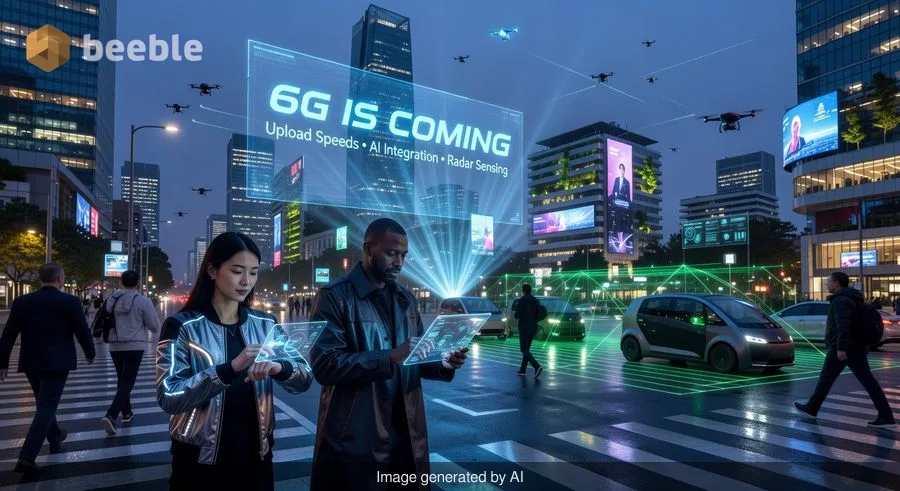
As we navigate the early months of 2026, the mobile industry is no longer just talking about the theoretical possibilities of 5G-Advanced. We are living them. Yet, even as the current generation of connectivity matures, the horizon is shifting toward 2030—the year 6G is expected to make its commercial debut.
While 4G was about the mobile internet and 5G was about connecting the Internet of Things (IoT), 6G represents a fundamental shift in how we perceive the physical world. It is moving beyond the simple transmission of data to become a fabric of "integrated sensing and communication." In this next era, the network won't just carry your messages; it will see, feel, and predict the environment around it.
The Shift from Connectivity to Sensing
Perhaps the most radical departure from previous generations is a concept known as Integrated Sensing and Communication (ISAC). In 5G, radio waves are used primarily to carry data from point A to point B. In 6G, those same radio waves will function similarly to radar.
By analyzing how signals bounce off objects, 6G base stations and devices will be able to detect the position, shape, and movement of people and things without the need for cameras. Imagine a smart city where the cellular network can detect a pedestrian stepping into a blind spot and instantly alert a nearby autonomous vehicle. This "network as a sensor" capability provides a layer of environmental awareness that could revolutionize public safety, healthcare monitoring, and industrial automation.
AI-Native: The Intelligence in the Air
In the 5G era, Artificial Intelligence (AI) was often treated as an "add-on"—an optimization tool used to manage traffic or predict maintenance needs. 6G is being designed from the ground up as an AI-native technology.
This means the air interface itself—the way the phone talks to the tower—will be managed by machine learning. Instead of relying on rigid, pre-defined protocols, 6G networks will dynamically adapt to their environment in real-time. This allows for unprecedented efficiency in spectrum usage and power consumption. For the user, this translates to a connection that is far more resilient in crowded areas and significantly more energy-efficient for mobile devices.
The Upload Revolution and Sub-THz Speeds
While 5G focused heavily on download speeds to support streaming and gaming, 6G is pivoting toward the "uplink." As spatial computing and high-fidelity digital twins become more common, the need to send massive amounts of data from a device to the cloud is skyrocketing.
6G aims to utilize the sub-Terahertz (sub-THz) spectrum—frequencies between 100 GHz and 300 GHz. These bands offer massive amounts of bandwidth, potentially pushing peak data rates toward 1 Terabit per second (Tbps). While these high frequencies have a short range, they are perfect for short-distance, high-capacity links, such as those required for holographic communication or real-time synchronization of robotic manufacturing lines.
Comparing the Generations: 5G vs. 6G
| Feature | 5G / 5G-Advanced (Current) | 6G (Expected 2030) |
|---|---|---|
| Peak Data Rate | 10–20 Gbps | 100 Gbps – 1 Tbps |
| Latency | ~1 millisecond | < 0.1 millisecond |
| Primary Goal | Connecting things (IoT) | Intelligence and Sensing |
| AI Integration | Optimization add-on | AI-Native architecture |
| Spectrum | Sub-6 GHz, mmWave | Sub-THz and Visible Light |
| Sensing | Limited/Experimental | Integrated Radar-like Sensing |
Sustainability as a Core Metric
For the first time in cellular history, energy efficiency is being treated as a primary performance indicator, equal in importance to speed. The goal for 6G is to achieve "zero-energy" devices—sensors that can harvest energy from ambient radio waves or light, eliminating the need for batteries in billions of small IoT nodes.
On the infrastructure side, 6G base stations will use advanced sleep modes and AI-driven power management to ensure that energy is only consumed when and where it is needed. This focus on sustainability is essential as the number of connected devices is expected to grow exponentially by the end of the decade.
What to Expect Next: The Roadmap to 2030
We are currently in the "requirements and vision" phase of 6G development. Organizations like the ITU (International Telecommunication Union) and 3GPP are working to define the global standards that will ensure your 6G phone works whether you are in Tokyo, London, or New York.
Practical Takeaways for Businesses and Consumers:
- Don't wait for 6G to innovate: Most of the foundational technologies for 6G, such as edge computing and basic AI optimization, are being introduced now via 5G-Advanced (Release 18 and 19).
- Watch the Spectrum: Keep an eye on regulatory decisions regarding the 7 GHz and 13 GHz bands, as these will likely be the "workhorse" frequencies for early 6G deployments.
- Prepare for Spatial Data: If your business relies on data, start thinking about how "sensing" data could change your operations. The ability to track assets or people without cameras or tags will be a competitive advantage.
- Privacy by Design: As the network gains the ability to "see" through sensing, privacy discussions will become more intense. Future-proof your strategy by prioritizing data ethics and transparent privacy policies now.
6G is not just a faster version of the internet we have today. It is a bridge between the digital and physical worlds, turning the very air around us into an intelligent, sensing medium.
Sources
- ITU-R: Framework and terrestrial IMT for 2030 and beyond
- 3GPP: Release 18 and 19 (5G-Advanced) Specifications
- Nokia Bell Labs: The 6G Era Vision
- Ericsson: 6G – Connecting a cyber-physical world
- Samsung Research: The 6G White Paper



See you on the other side.
Our end-to-end encrypted email and cloud storage solution provides the most powerful means of secure data exchange, ensuring the safety and privacy of your data.
/ Create a free account
