


A Solar Powered Pizza Box Just Changed the Economics of Outer Space

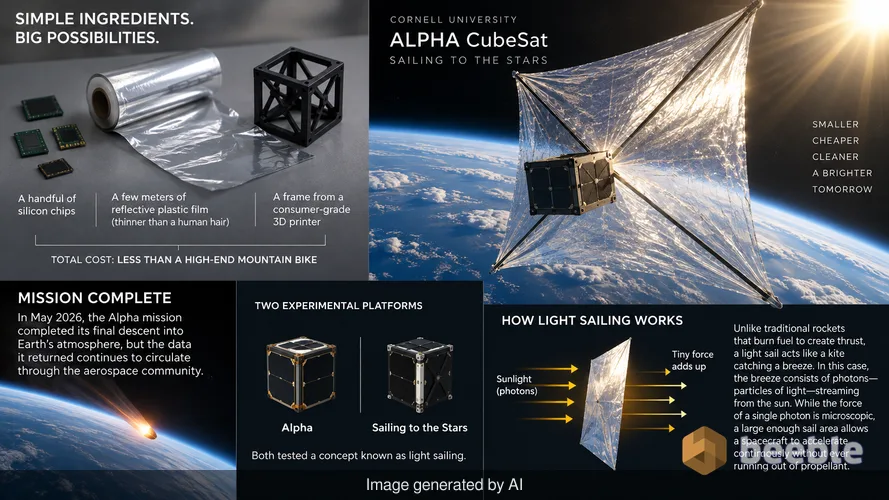
Start with a handful of silicon chips no larger than a postage stamp. Add a few meters of reflective plastic film thinner than a human hair and a frame produced on a consumer-grade 3D printer. These materials, which cost less than a high-end mountain bike, are the core components of Cornell University’s latest successful orbital mission. By trading heavy chemical engines for the gentle pressure of sunlight, the Alpha CubeSat and Sailing to the Stars projects prove that space exploration is no longer the exclusive playground of nation-states or billionaire-backed corporations.
In May 2026, the Alpha mission completed its final descent into Earth’s atmosphere, but the data it returned continues to circulate through the aerospace community. This project utilized two distinct experimental platforms to test a concept known as light sailing. Unlike traditional rockets that burn fuel to create thrust, a light sail acts like a kite catching a breeze. In this case, the breeze consists of photons—particles of light—streaming from the sun. While the force of a single photon is microscopic, a large enough sail area allows a spacecraft to accelerate continuously without ever running out of propellant.
The anatomy of a gram-scale spacecraft
The mission relied on a technology called ChipSats. These are functional spacecraft reduced to the size of a cracker, containing all the necessary sensors, power systems, and communication hardware on a single circuit board. Historically, putting a satellite into orbit required a bus-sized machine weighing several tons. The Cornell team bypassed this mass requirement by folding their light sails into a 1U CubeSat, a modular box roughly the size of a large mug.
Under the hood, the Alpha CubeSat functioned as a carrier. Once it reached low Earth orbit, it deployed the sail and released the ChipSats. This separation allowed the tiny devices to become free-flyers. Because the sails are incredibly light, they achieve a high area-to-mass ratio. This is the secret to their speed. Even the weak pressure of sunlight can push these sails to velocities that would be difficult for traditional chemical rockets to maintain over long durations.
Practicality drove the design of the internal hardware. The team used a RockBLOCK Iridium modem to handle communications. This is the first time this specific commercial modem traveled into orbit to provide data links. Usually, space agencies spend millions developing custom radios that take years to certify. By using off-the-shelf parts, the students slashed both the cost and the development time. This approach turns space hardware into something resembling a decentralized network of IoT devices rather than a monolithic government project.
Crowdsourcing data from the backyard
One of the most striking results of the Alpha mission involves how the team stayed in touch with the spacecraft. Instead of relying solely on expensive government ground stations, they utilized the TinyGS network. This is a global community of amateur radio enthusiasts who set up small, inexpensive stations in their backyards and balconies.
As the Alpha sail orbited the planet, these hobbyists picked up data packets from the ChipSat and uploaded them to a central server. Joshua Umansky-Castro, the mission lead, confirmed that this was the first time a spacecraft this small transmitted complete data packets from orbit to ground. This success validates a new model for space communication. It suggests that a fleet of thousands of tiny sensors could monitor Earth’s climate or space weather by beaming data to a global web of low-cost receivers owned by regular citizens.
Even as atmospheric drag eventually pulled the sail down, the mission provided a wealth of data on secondary systems. The CubeSat tested a spin-stabilization algorithm that used only magnetorquers—coils of wire that interact with the Earth’s magnetic field to orient the satellite. It also carried the first holographic-image message plaques sent to space, a small but symbolic step toward the democratization of orbital payloads.
Testing physics with TV remotes and LEGO parts
While Alpha was busy in low Earth orbit, a second experiment called Sailing to the Stars operated aboard the International Space Station (ISS). This project focused on the mechanics of deployment. In the weightless environment of the ISS, the team tested how six different sails unfurled from their containers.
Curiously, the hardware for this experiment looked more like a high school robotics project than a NASA laboratory. The deployment mechanisms were 3D-printed using a modular system the students compared to LEGO bricks. To control the release of the sails, the team used standard TV remotes. They even repurposed reaction wheels from old laptop hard disk drives to keep the deployers stable during the process.
This scrappy engineering served a serious purpose. The team needed to see which design allowed the sails to open without tangling or spinning out of control. The microgravity environment of the ISS provided the perfect testbed to observe these kinematics. The footage and sensor data collected from these tests now serve as a blueprint for future missions. The bottom line is that if a mechanism works when triggered by a TV remote in a 3D-printed box, it removes the need for the expensive, over-engineered deployment systems that currently drive up mission costs.
The economic shift in orbital access
From a consumer standpoint, the Cornell missions represent a systemic shift in how we value space. We are moving away from the era of the "digital crude oil" where every gram of weight in orbit costs tens of thousands of dollars. When spacecraft become as light as a slice of pizza and as cheap as a smartphone, the barrier to entry collapses.
| Feature | Traditional Satellite | Cornell Light Sail Experiment |
|---|---|---|
| Mass | 500kg - 6,000kg | Less than 2kg |
| Propulsion | Chemical Fuel (Limited) | Solar Photons (Infinite) |
| Hardware | Custom Aerospace Grade | COTS (Off-the-shelf) & 3D Printed |
| Ground Control | Deep Space Network | Amateur Radio (TinyGS) |
| Cost Tier | Hundreds of Millions | Low Six Figures |
Looking at the big picture, this democratization leads to a more resilient orbital infrastructure. If one giant weather satellite fails, it creates a massive gap in data. If a swarm of a thousand ChipSats is monitoring the same area, the loss of ten or even a hundred units has almost no impact on the overall mission. This redundancy is foundational for future applications like real-time global environmental monitoring or providing emergency internet coverage during natural disasters.
Reaching for the stars on a laser beam
The ultimate goal of this research extends far beyond Earth’s backyard. Organizations like Breakthrough Starshot are already looking at these light sails as the only viable path for interstellar travel. A chemical rocket would take tens of thousands of years to reach Proxima Centauri, our nearest stellar neighbor. A light sail, pushed by a massive ground-based laser instead of just sunlight, could potentially reach 20% of the speed of light. This would cut the travel time to just 20 years.
The Cornell missions are the proof-of-concept for the hardware that will eventually carry out these journeys. They show that the electronics can survive the launch, the sails can deploy in microgravity, and the communications systems can function even when scaled down to the size of a fingernail.
Why the average user should care
Practically speaking, you probably won't be buying a light sail to launch from your backyard anytime soon. However, you will likely benefit from the industrial shift these missions accelerate. The move toward 3D-printed, modular, and off-the-shelf space hardware means that the services we rely on—like GPS, weather forecasting, and global telecommunications—will become cheaper to maintain and harder to disrupt.
As the aerospace industry adopts these student-led innovations, we will see a surge in the number of objects in orbit. This creates a need for better traffic management and more sustainable materials, but it also opens the door for a new generation of engineers. Over half of the students who worked on these projects have already moved into the aerospace workforce. They are taking this culture of "fail fast, build cheap" into companies that were once defined by slow, expensive bureaucracy.
Ultimately, the success of Alpha and Sailing to the Stars suggests that the next great leap in space won't come from a bigger engine. It will come from a smarter use of physics and a willingness to use everyday tools to solve extraordinary problems. Pay attention to the next time a technology seems too small or too cheap to matter. In the vacuum of space, those are often the traits that allow a project to truly take flight.
Sources
- Cornell University Space Systems Design Studio (SSDS) Mission Reports, 2026.
- NASA CubeSat Launch Initiative (CSLI) Project Summary: Alpha CubeSat.
- ISS National Laboratory Technical Review: Sailing to the Stars Deployment Data.
- TinyGS Open Source Satellite Network Mission Logs.
- Breakthrough Starshot Initiative Theoretical Framework for Laser-Propelled Gram-Scale Spacecraft.



See you on the other side.
Our end-to-end encrypted email and cloud storage solution provides the most powerful means of secure data exchange, ensuring the safety and privacy of your data.
/ Create a free account
