


AMD is Betting $4,000 That You’re Tired of Paying Rent to the AI Cloud

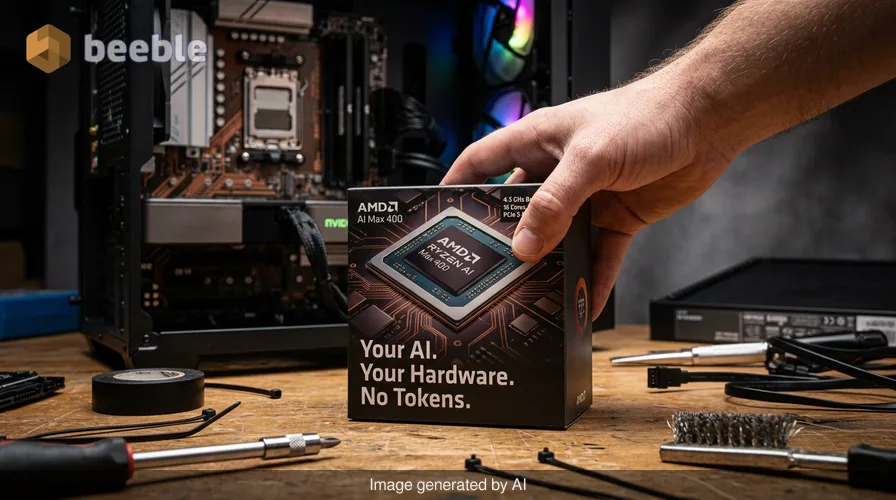
For the last few years, the narrative surrounding artificial intelligence has been almost entirely focused on the cloud. If you wanted to run a powerful Large Language Model (LLM) or generate high-fidelity images, the common wisdom suggested you had to rent time on someone else’s massive server farm. You paid by the month or, more precisely, by the "token"—a digital unit of measurement roughly equivalent to a few syllables. While this subscription model made AI accessible to the masses, it also created a new form of digital dependency.
AMD is now attempting to disrupt this status quo. With the official pricing of its Ryzen AI Halo PC at $3,999 and the unveiling of the next-generation Ryzen AI Max 400 chips, the company is making a bold, contrarian argument: the most cost-effective way to use AI isn't to rent it, but to own the hardware that runs it. By moving the heavy lifting from a remote data center to a device that sits on your desk, AMD isn't just selling a computer; it's selling an exit strategy from the recurring costs of the AI revolution.
The Move Toward Local Sovereignty
Looking at the big picture, the Ryzen AI Halo PC is a Mac Mini-sized powerhouse designed to function as a self-contained AI workstation. At $3,999, it certainly isn’t a budget-friendly impulse buy for a casual user. However, for the developers and researchers who are currently the invisible backbone of the tech industry, this price tag represents a calculated investment.
Historically, high-end AI work required either a room full of server racks or a steep monthly bill from a cloud provider. AMD’s pitch for 2026 is centered on local processing. By packing immense power into a small form factor, they are targeting the emerging class of professional "AI tinkerers" who need to iterate quickly without worrying about data privacy or latency. Essentially, if the cloud is like a high-end temp agency for AI labor, the Halo PC is like hiring a tireless intern and giving them a permanent desk in your office. Once you pay the upfront cost, the "intern" works for free.
Breaking Down the Digital Crude Oil: The Specs
Under the hood, the Halo PC is powered by the Ryzen AI Max 300 series, but the real buzz surrounds the newly announced Max 400 chips arriving later this year. To understand why these chips matter, we have to look past the jargon of clock speeds and cores.
The flagship AI Max+ Pro 495 features a 16-core CPU and a 55 TOPS NPU. "TOPS" stands for Trillions of Operations Per Second, a metric that has become the standard yardstick for AI performance. While 55 TOPS on the NPU (Neural Processing Unit) is impressive for specialized tasks like background blurring or voice recognition, the real heavy lifting happens in the Radeon GPU, which features 40 compute units.
Perhaps the most foundational feature, however, is the support for up to 192GB of unified memory. In a typical computer, the system memory (RAM) and the graphics memory (VRAM) are separate. In an AI context, this separation creates a bottleneck. Large AI models are like massive, complex encyclopedias that the computer needs to keep open all at once. If the "encyclopedia" is too big to fit in the graphics memory, the system slows to a crawl. By offering 192GB of unified memory, AMD allows the system to dedicate up to 160GB specifically to the GPU. This is an unprecedented amount of breathing room for a desktop system, easily eclipsing what is currently available in professional-grade Apple Silicon Macs.
The $4,000 Math Class: ROI vs. Subscriptions
To the average user, $4,000 for a compact PC sounds exorbitant. But in the world of professional development, AMD is positioning this as a bargain. Let’s look at the math that underpins this disruptive pricing strategy.
Many developers currently use about 6 million AI tokens a day to test and run their applications. At current market rates, that level of usage can cost roughly $773 per month in cloud fees. At that rate, the Ryzen AI Halo PC pays for itself in just over five months. For more intensive users spending $2,253 a month for 18 million daily tokens, a higher-end configuration using an R9700 Pro GPU could reach a break-even point in just three months.
What this means is that for a small startup or an independent developer, the Halo PC isn't just a luxury; it's a way to stabilize a volatile budget. Instead of being subject to the price hikes and usage limits of cloud providers, the user gains a resilient piece of infrastructure that they own outright.
AMD vs. NVIDIA: A Clash of Philosophies
AMD is launching this system into a market that has been dominated by NVIDIA. On the surface, the Halo PC is a direct competitor to NVIDIA’s DGX Spark AI PC. However, the two companies are taking very different approaches to how an AI workstation should function.
NVIDIA’s DGX Spark, which has seen its price creep up to $4,699, relies almost entirely on its Blackwell GPU architecture. It is a specialized tool that primarily runs Linux, catering to a very specific niche of data scientists. Conversely, AMD’s Halo PC is built on an x64 architecture, meaning it can run both Windows and Linux with ease.
Curiously, this makes the AMD system far more versatile. It can be a high-end gaming machine in the morning, a video editing suite in the afternoon, and an AI training hub overnight. While NVIDIA is building a high-speed racing car meant for a single track, AMD is building a powerful SUV that can handle the highway and the off-road trails alike. This flexibility is a tangible advantage for users who don't want to be locked into a single operating system or a single type of workload.
Looking Toward the Horizon: The Max 400 Series
While the current Halo PC is a formidable machine, the announcement of the Ryzen AI Max 400 chips suggests that AMD is already looking at the next cyclical shift in hardware. These chips, slated for the third quarter of 2026, offer a streamlined path toward even larger AI models.
The AI Max+ Pro 495’s ability to support 160GB of VRAM is the real headline here. As AI models grow more complex, they require more "spatial awareness" within the hardware. A system that can hold a massive model entirely within its high-speed memory is inherently more robust and faster than one that has to constantly swap data back and forth. For the consumer, this translates to AI tools that feel instantaneous rather than lagging.
The Bottom Line for You
Practically speaking, you probably don't need a $4,000 AI PC to write emails or browse the web. But the release of the Ryzen AI Halo and the Max 400 chips matters to you because it signals the "trickle-down" of AI independence.
When high-end hardware becomes more capable and cost-effective for developers, the software they build becomes better for everyone. We are moving toward a future where the AI features in your favorite apps won't need an internet connection to function. They will be faster, more private, and won't require a monthly subscription fee hidden inside your app store bill.
AMD's move is a reminder that in the tech world, the pendulum often swings between centralized power (the cloud) and decentralized ownership (your desk). By pricing the Halo PC at $3,999, AMD is betting that the pendulum is about to swing back toward the individual.
Ultimately, this isn't just about a new computer; it’s about a shift in the digital economy. It urges us to look at our digital habits and ask: Are we okay with renting our intelligence, or is it time we started owning the tools that create it? As we move into the second half of 2026, the answer to that question will likely define the next decade of personal computing.
Sources:
- AMD Official Product Brief: Ryzen AI Halo PC Systems (2026)
- NVIDIA Investor Relations: DGX Spark Pricing and Specifications Update
- Market Analysis Report: AI Token Economics and Cloud vs. Local ROI (Q2 2026)
- TechPowerUp: Ryzen AI Max 400 Series Architecture Deep Dive



See you on the other side.
Our end-to-end encrypted email and cloud storage solution provides the most powerful means of secure data exchange, ensuring the safety and privacy of your data.
/ Create a free account
