


AMD is moving the heart of the data center to your desk

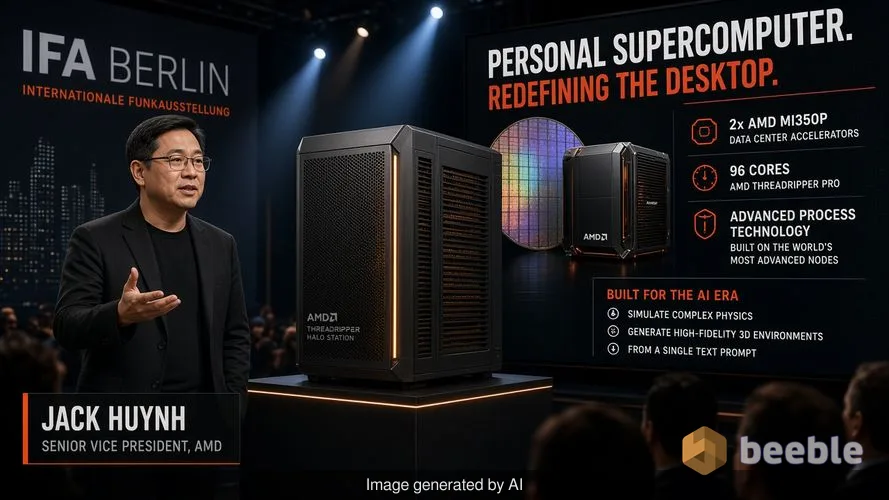
The sleek black chassis sitting on the stage at the Internationale Funkausstellung in Berlin looks like a standard high-end workstation. However, this machine, named the Threadripper Halo Station, is a dense collection of the most expensive and rare materials in the modern technology world. AMD Senior Vice President Jack Huynh introduced the device as a personal supercomputer, a label that shifts the definition of what a desktop machine can do. By placing components usually reserved for massive server farms into a single box, AMD is attempting to change how businesses buy and use artificial intelligence.
To understand why a single computer might cost more than a luxury sedan, you have to trace the materials back to the silicon wafer. Under the hood, the Halo Station has two MI350P data center accelerators. These are not standard graphics cards for gaming. They are specialized processors designed to crunch the mathematical weights of large language models. These chips are the digital crude oil of the current economy. They require advanced manufacturing processes that few factories in the world can provide. When you add 96 cores of a Threadripper Pro processor, the machine has enough raw math power to simulate complex physics or generate high-fidelity 3D environments from a single text prompt.
The memory bottleneck and the high speed solution
The most expensive physical material in this machine is likely the memory. The Halo Station has 576 gigabytes of high bandwidth memory, specifically the HBM3E variety. In everyday terms, think of standard computer memory as a narrow hallway where data must wait its turn to reach the processor. HBM3E is a massive, multi-lane highway built directly on top of the chip. This design allows data to move at speeds that standard desktop memory cannot match. The machine also has two terabytes of system memory, providing a massive workspace for the computer to hold information.
This volume of memory is the reason the Halo Station can run AI models with more than a trillion parameters locally. A parameter is essentially a connection in an AI's brain. The more parameters a model has, the more nuanced and capable it is. Most home computers struggle to run models with 70 billion parameters because they lack the space to store the data while the processor works on it. By offering more than three times the memory capacity of its closest rival, the Nvidia DGX Station, AMD is providing a larger workspace for the AI. This means a company can run a massive, private version of a tool like GPT-4 without sending a single byte of data to an outside server.
Breaking the cycle of cloud subscriptions
Looking at the big picture, the push for local supercomputers is a reaction to the rising costs of the cloud. For the past decade, the tech industry moved everything to remote servers owned by Amazon, Microsoft, or Google. However, running large AI models on these platforms is expensive. Companies pay a subscription or a per-use fee that never ends. These costs are like a slow leak in a tire that eventually leaves a business stranded. A firm spending €5,000 a month on AI cloud fees will spend €180,000 over three years.
AMD is betting that institutions will prefer to pay €100,000 upfront to own the hardware. This shift represents a move toward decentralized power. When a company owns the Halo Station, they have a tireless intern that works for the cost of electricity. They do not have to worry about a cloud provider raising prices or changing the terms of service. This is particularly attractive to sectors like healthcare, defense, or legal services, where data privacy is a legal requirement. Keeping the data inside the building on a physical machine is the most secure way to handle sensitive information.
A comparison of desktop giants
AMD is entering a market that Nvidia has occupied for several years. The Nvidia DGX Station is the current standard for local AI development. On the market side, Nvidia has a significant advantage because its software is the industry standard. Most AI researchers write code that works best on Nvidia hardware. Nvidia also makes it easy to move work from a local desktop to a massive cloud cluster. This seamless transition is a major selling point for developers who start small and scale up.
| Feature | AMD Threadripper Halo Station | Nvidia DGX Station (Current Gen) |
|---|---|---|
| Core Count | 96 Cores (Threadripper Pro) | Variable (Intel/AMD Host) |
| High Bandwidth Memory | 576GB HBM3E | 160GB - 320GB HBM |
| System Memory | Up to 2TB | Up to 512GB - 1TB |
| AI Model Capacity | 1 Trillion+ Parameters | ~500 Billion Parameters |
| Cooling | Liquid Cooled | Liquid Cooled |
| Software Ecosystem | Growing (ROCm) | Mature (CUDA) |
AMD's strategy is to win on raw capacity. By offering significantly more memory, they allow users to run larger models than the Nvidia machine can handle. If a researcher needs to work on a trillion-parameter model, the AMD machine is currently the only desktop option that can fit that model into its memory. However, the success of this hardware will depend on AMD's software platform, called ROCm. Historically, AMD has struggled to match Nvidia's software ease-of-use. For the average user in a corporate environment, the hardware is only as good as the applications that run on it.
The reality for the everyday consumer
Practically speaking, most individuals will not buy a €100,000 computer. The Threadripper Halo Station is an industrial tool, not a home appliance. You should view this machine the same way you view a heavy-duty crane or a specialized surgical robot. It is the invisible backbone that will help create the software you use on your phone next year. When a developer has this much power on their desk, they can experiment faster. They can train smaller, more efficient AI agents that will eventually run on cheaper consumer laptops.
From a consumer standpoint, this release signals that the era of relying entirely on the cloud is ending. We are seeing a cyclical return to local processing. As the components inside these supercomputers become cheaper and easier to manufacture, the technology will trickle down. The high bandwidth memory that makes the Halo Station so expensive today will likely be standard in mid-range gaming PCs by 2030. This is how tech democratization works. The luxury tools of today become the foundational components of tomorrow's budget devices.
Observing the shifting digital economy
The launch of the Halo Station is a tangible sign that the AI industry is maturing. We are moving past the hype phase where every company simply rents space on a server. Businesses are now looking for scalable, resilient solutions that they can control. AMD is providing the physical infrastructure for this independence. While the price tag is high, the potential for long-term savings and data security is a powerful incentive for large institutions.
Ultimately, you should watch how your own workplace handles data over the next year. If your company starts talking about "on-premise AI" or "local inference," they are talking about machines like the Halo Station. This shift toward local power will change how software is developed and how your personal data is protected. You are witnessing a moment where the digital crude oil of processing power is being packaged for the office, making the complex world of AI a little more grounded in physical reality.
Sources:
- AMD Official Press Release, Berlin IFA 2026
- International Data Corporation (IDC) Semi-Annual AI Systems Tracker 2026
- High Bandwidth Memory Supply Chain Report 2026



See you on the other side.
Our end-to-end encrypted email and cloud storage solution provides the most powerful means of secure data exchange, ensuring the safety and privacy of your data.
/ Create a free account
