


Anthropic’s Claude Design Is the AI Intern You Didn’t Know You Needed

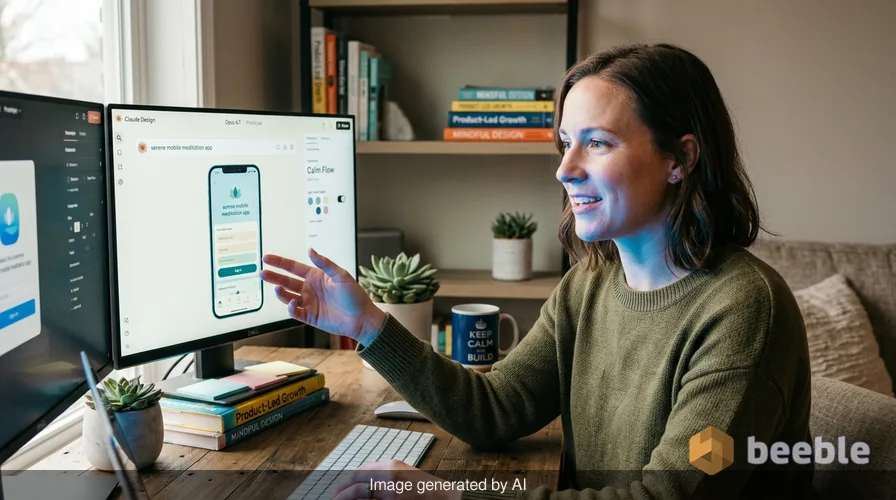
Is the era of the blank slide deck finally over? For anyone who has ever stared down a deadline with nothing but a vague idea and a distinct lack of graphic design skills, the answer might finally be yes. On Friday, Anthropic announced the launch of Claude Design, a new experimental product that aims to bridge the terrifying gap between a rough concept and a polished visual.
While the tech world is currently flooded with AI image generators that create surreal artwork or hyper-realistic photos, Claude Design is targeting a much more practical—and arguably more lucrative—market. It isn't trying to win an art contest; it’s trying to save your job presentation. The tool allows users to generate prototypes, slides, one-pagers, and diagrams simply by describing them, effectively acting as an on-demand junior designer who works at the speed of light.
Not Another Canva Clone
At first glance, one might assume Anthropic is stepping into the ring with Canva, the graphic design giant that has become synonymous with easy-to-make marketing materials. However, looking at the big picture, Anthropic is quick to clarify that this isn’t a cage match. According to the company, Claude Design is intended to complement existing tools rather than replace them.
Think of it this way: Canva is a fully stocked kitchen where you chop, mix, and bake your ingredients to create a meal. Claude Design, by contrast, is more like a prep cook who hands you a completed mise en place. It is built for the “blank page” problem—the moment when you have an idea but no visual foundation. A product manager might need a quick wireframe for a meditation app, complete with “calming typography” and “nature-inspired colors,” but lacks the time or skill to build it from scratch. Claude Design generates that initial draft, which can then be exported to Canva for final touches.
This integration is a smart, pragmatic move. Rather than trying to unseat a market leader, Anthropic is positioning its AI as the ignition switch for the creative process.
Under the Hood: How It Works
So, how does an AI go from writing poetry to designing a mobile app interface? The new product is powered by Claude Opus 4.7, the latest iteration of Anthropic’s large language model. While the company hasn't released the full technical specifications, the behavior suggests a shift toward multimodal capabilities—where the AI understands both text instructions and visual spatial reasoning.
Practically speaking, the workflow is straightforward. You type a prompt, such as, “Create a one-pager for a new coffee subscription service targeting remote workers.” Claude Design then renders a visual layout. But the real utility lies in the refinement. Unlike static AI images that require complex re-prompting to fix a single element, this tool allows for direct edits. You can ask it to tweak a font size, change a color palette, or add a “dark mode” toggle, and it adjusts the specific component without reinventing the entire wheel.
For the average user, this removes the friction of traditional design software. There is no hunting for the right layer in a toolbar or figuring out how to align objects perfectly. The interface becomes a conversation.
The Enterprise Play: Consistency at Scale
For individual users, this is a convenience. For businesses, it could be a revolution. One of the persistent headaches in corporate design is brand consistency. Every department creates its own decks and docs, and inevitably, the logo gets stretched, the colors drift, and the fonts go rogue.
Curiously, Claude Design offers a solution that reads a company’s codebase and design files to apply a specific design system to every project it creates. This means that if your company uses a specific shade of blue and a proprietary typeface, the AI will enforce those rules automatically. It ensures that a quick prototype generated by a founder looks like it belongs to the same family as a presentation created by the marketing team.
This feature highlights Anthropic’s ongoing push into the enterprise sector. By embedding these systemic guardrails, they are offering something that consumer-grade design tools often lack: structural discipline.
The $800 Billion Context
This launch does not exist in a vacuum. It comes at a time when the stakes in the AI industry have never been higher. Just days ago, Bloomberg reported that venture capitalists have been offering Anthropic a preemptive funding round that would value the company at a staggering $800 billion or more. To put that number in perspective, that valuation would rival or even surpass OpenAI, the maker of ChatGPT.
While Anthropic has reportedly brushed off these offers for now, the sheer magnitude of the figure signals where the market believes the future lies. Investors are betting big on “agentic” AI—systems that don’t just chat but actually do things. In January, Anthropic rolled out Claude Cowork, an agentic assistant for complex tasks, and later added plug-ins to automate specialized departmental work. Claude Design is the next logical step in this evolution.
The metaphor often used for AI is that of a copilot. But as these tools become more capable of executing complex, multi-step workflows—like building a slide deck from a text prompt—we might need a new analogy. AI is starting to look less like a copilot and more like a tireless intern who never sleeps, doesn't ask for a raise, and can instantly adopt your company’s style guide.
What This Means for You
For the everyday consumer or the solo entrepreneur, the implications are tangible. The barrier to entry for looking professional has just been lowered significantly. You no longer need to hire a freelancer to visualize a pitch deck for a side hustle, nor do you need to spend hours learning the intricacies of design software.
However, this democratization comes with the usual caveats. As AI tools become the default for quick visuals, the standard for “good” design will inevitably rise. If everyone can generate a polished prototype in seconds, the value of truly original, human-centric creativity may actually increase. The tool can handle the layout, but it cannot yet invent a compelling narrative or a unique brand identity from scratch.
Sources
Anthropic Official Announcement; TechCrunch Interview; Bloomberg Funding Report; Industry Analysis of AI Workplace Tools.



See you on the other side.
Our end-to-end encrypted email and cloud storage solution provides the most powerful means of secure data exchange, ensuring the safety and privacy of your data.
/ Create a free account
