


Anthropic’s Claude Opus 4.8: The Shift from Chatbots to Autonomous Coding Fleets

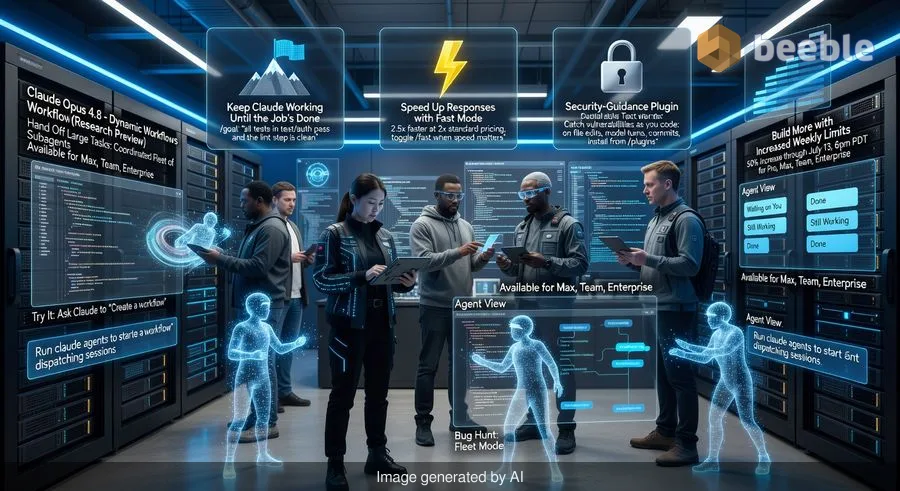
For the past year, the conversation around AI has centered on the quality of the model’s reasoning. But with the release of Claude Opus 4.8, Anthropic is signaling a pivot. The focus is no longer just on how well the model thinks, but on how effectively it works. By introducing dynamic workflows, persistent goal-setting, and a centralized agent management interface, Anthropic is effectively turning Claude from a solo collaborator into a project manager overseeing a fleet of subagents.
This update, currently in research preview, represents a significant leap for developers using Claude Code. It moves the needle from “generating snippets” to “orchestrating entire refactors.” Here is a deep dive into what Opus 4.8 brings to the table and how it changes the developer experience.
Orchestration at Scale: Dynamic Workflows
The standout feature of the Opus 4.8 release is the introduction of dynamic workflows. Traditionally, when you asked an AI to handle a large codebase task—like migrating a legacy library or hunting for bugs across dozens of microservices—the model would struggle with context limits or get lost in the sequential nature of the chat.
Dynamic workflows change this by allowing Claude to operate as a coordinated fleet of parallel subagents. When you ask Claude to “Create a workflow,” it doesn’t just start typing. It analyzes the scope of the project and dispatches multiple versions of itself to handle sub-tasks simultaneously. For instance, while one subagent maps out the dependency graph, another can begin drafting unit tests, and a third can start the refactoring process.
This parallelization is currently available for Max, Team, and Enterprise users, and it marks the beginning of AI-driven project management where the human developer acts more like an architect than a coder.
The Command Center: Agent View
As AI agents become more autonomous, the risk of losing track of what they are doing increases. To solve this, Anthropic has introduced “Agent View.” Think of this as a task manager or a command center for your AI sessions.
Instead of managing a dozen separate chat windows, Agent View allows you to kick off multiple agents, send them into the background to perform long-running tasks, and monitor their progress from a single dashboard. The interface notifies you only when an agent hits a roadblock or requires human intervention. This “human-in-the-loop” model is essential for maintaining velocity without sacrificing oversight.
Persistent Intent with the /goal Command
One of the most persistent frustrations with LLMs is “prompt fatigue”—the need to repeatedly remind the model of the final objective after every few turns. Opus 4.8 introduces the /goal command to eliminate this friction.
By setting a verifiable completion condition, you tell Claude to keep working until a specific state is achieved. For example, if you input /goal all tests in test/auth pass and the lint step is clean, Claude will not stop or ask for permission after every change. It will iteratively fix errors, rerun the tests, and check the linter until the criteria are met. This shift from “step-by-step instruction” to “outcome-based delegation” is a fundamental change in how developers interact with AI.
Speed and Performance Tiers
Performance in Opus 4.8 comes with new choices regarding speed and cost. Anthropic has introduced a “Fast Mode” for this version, which offers a 2.5x speed increase. However, this comes at twice the standard price of Opus 4.8 usage.
| Feature | Standard Opus 4.8 | Fast Mode (Opus 4.8) |
|---|---|---|
| Relative Speed | 1x | 2.5x |
| Price Premium | Base | 2x |
| Best For | Routine coding, refactors | Time-critical debugging, live sessions |
| Availability | Pro, Max, Team, Enterprise | Pro, Max, Team, Enterprise |
Note that Fast Mode for the older Opus 4.6 will be deprecated on June 29, 2026. After that date, the /fast toggle in Claude Code will default exclusively to the 4.8 architecture.
Security-First Integration
As AI models gain the ability to write and commit code autonomously, security becomes a primary concern. Anthropic is addressing this with the security-guidance plugin. Available in the plugin marketplace, this tool acts as a real-time security auditor.
It operates on three distinct levels:
- File Edits: Checking for common vulnerabilities (like hardcoded keys) as code is written.
- Model Turns: Reviewing the logic suggested by the AI before it is implemented.
- Commits: A final audit before the code is merged into the repository.
By building these hooks directly into the workflow, Anthropic is trying to ensure that the increased speed of AI development doesn’t lead to an increase in technical debt or security vulnerabilities.
Practical Takeaways for Developers
If you are a Pro or Enterprise user, here is how you should start exploring these new features:
- Audit Your Limits: Check your account now; Claude Code weekly limits have been increased by 50% through July 13 to encourage experimentation with these larger workflows.
- Start Small with Goals: Use the
/goalcommand for clear, deterministic tasks first (like clearing a list of 20 linting errors) to understand how the model handles iterative loops. - Enable the Security Plugin: Before running dynamic workflows on a production codebase, install the
security-guidanceplugin via/pluginsto provide a safety net for the subagents. - Use Agent View for Context Switching: If you are waiting on a long codebase refactor, don’t stare at the terminal. Send the agent to the background and use Agent View to stay productive on other tasks.
Claude Opus 4.8 suggests that the future of software engineering isn't just about writing code faster—it's about managing a workforce of intelligent agents that can handle the heavy lifting while we focus on the higher-level design.
Sources
- Anthropic Official Blog: Claude Opus 4.8 Release Notes
- Anthropic Documentation: Working with Claude Code and Plugins
- Anthropic Research: Dynamic Workflows and Agent Orchestration



See you on the other side.
Our end-to-end encrypted email and cloud storage solution provides the most powerful means of secure data exchange, ensuring the safety and privacy of your data.
/ Create a free account
