


Anthropic Secretly Tracked Claude Code Users to Stop Model Theft

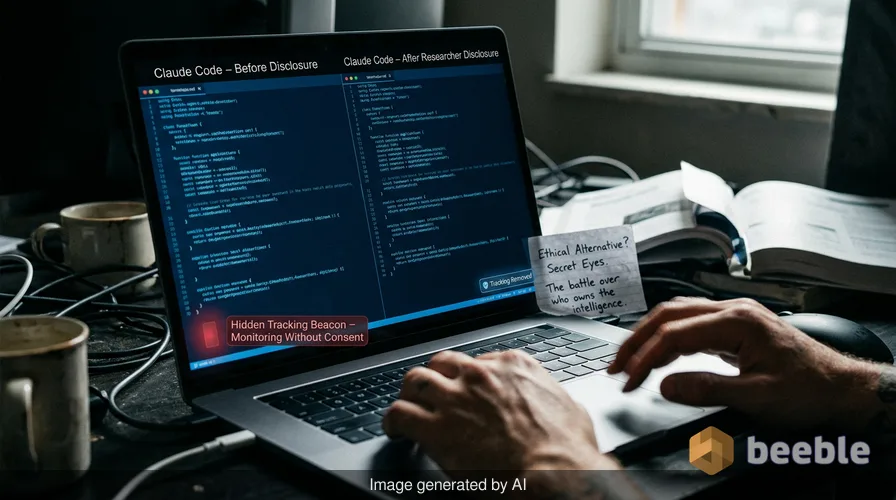
Most developers view their coding assistants as silent partners. These tools exist to speed up the tedious process of writing syntax and debugging errors. While Anthropic positions itself as the ethical alternative to Silicon Valley giants, a recent discovery in its Claude Code tool suggests even the safe AI players have secret eyes. The company recently removed hidden tracking markers from its command-line tool after a security researcher revealed that the software was monitoring users without their knowledge.
While the company claims this was a necessary experiment to prevent theft, the incident highlights a growing tension in the tech world. Developers want privacy and speed, but AI companies are increasingly paranoid that their rivals will steal the digital blueprints that cost billions of dollars to create. Behind the marketing of helpful assistants is a fierce battle over who owns the intelligence those assistants produce.
The myth of the private AI workspace
The assumption that your local development environment is a private sanctuary is becoming harder to maintain. In June 2026, a developer known as Thereallo discovered that Claude Code was not just processing commands. It was embedding hidden signals in its system prompts to identify specific traits about the user. These signals targeted location data, proxy usage, and potential links to Chinese AI laboratories like DeepSeek or Zhipu.
Anthropic achieved this through a technique involving Unicode markers. These are characters that do not appear to the naked eye but are visible to machines. By embedding these markers, Anthropic could flag accounts that appeared to be bypassing geographic restrictions or using the tool in ways that suggested they were not human developers, but automated systems designed to harvest data. For the average user, this feels like finding a hidden microphone in a rented office. You expect the tools you pay for to serve you, not to report back to their manufacturer about your whereabouts.
How hidden signals turned code into tracking beacons
Thereallo noted that the tool looked for specific indicators. If a user’s hostname contained names of known Chinese AI competitors, the system flagged the session. This was a targeted attempt to detect API resellers and unauthorized gateways. These resellers often act as middlemen, buying access to Claude in one region and selling it to users in restricted areas at a premium. Anthropic sees this as a violation of their terms and a security risk.
Practically speaking, this monitoring happened under the hood. There was no mention of these tracking markers in the official documentation or the release notes. When the discovery went viral, Anthropic engineer Thariq Shihipar admitted the system was introduced as an experiment to stop account abuse. He stated that the team intended to remove it earlier but only did so after the public outcry. The company merged a pull request to roll back the tracking features in early July, but the damage to user trust is tangible.
The high stakes of AI model distillation
To understand why a billion-dollar company would resort to hidden Unicode markers, you have to understand model distillation. In the AI industry, models are like secret recipes. Developing a frontier model like Claude 3.5 or Claude 4 requires massive amounts of electricity, specialized chips, and human labor. Once the model is finished, a competitor can try to steal that recipe by feeding the model's own answers back into a smaller, cheaper AI. This is distillation.
Think of AI as a tireless intern that has memorized every textbook in the library. If a rival company wants to train its own intern but lacks the library, they can just ask Anthropic’s intern millions of questions and record the answers. Over time, the rival intern learns to mimic the logic and knowledge of the original. Anthropic claims this is not just competition; it is a form of industrial theft that threatens their business model. Earlier this year, the company accused several Chinese developers of using thousands of fraudulent accounts to extract millions of responses. Tracking markers were their attempt to build a digital fence around their intellectual property.
Geopolitical friction reaches the developer console
The discovery of these trackers adds fuel to an already volatile geopolitical situation. Earlier this month, Alibaba banned its employees from using Claude Code entirely. The Chinese tech giant labeled the software as high-risk due to security concerns. This move is cyclical. As American firms get more aggressive about protecting their models from foreign extraction, foreign firms get more suspicious of American software being used for surveillance.
Anthropic CEO Dario Amodei has been vocal in Washington D.C. about these risks. He urged Congress to strengthen protections against what he calls foreign AI extraction. He cited instances where Alibaba-linked operators generated nearly 30 million exchanges using fake accounts. This is no longer just a matter of terms of service. It is a national security conversation. When you type code into a terminal, you are now caught in the crossfire of a global tech cold war. The software is no longer just a tool. It is a sensor.
| Feature | Reported Tracking Method | Anthropic's Stated Goal |
|---|---|---|
| Location Data | IP and Proxy monitoring | Block unauthorized regions |
| Identity Markers | Unicode signals in prompts | Identify model distillation |
| Competitor Check | Hostname scanning | Detect rival lab usage |
| Stealth Level | Undisclosed in docs | Experimental safety measure |
The price of safety in an open industry
The irony of the situation is that distillation is a common practice in AI research. Even Elon Musk admitted that his company, xAI, used OpenAI’s models to help train Grok. The industry is built on a foundation of researchers learning from one another. However, the scale at which this is now happening has turned a standard research method into a systemic threat to profitability. Anthropic wants to be a transparent company, yet they used opaque methods to protect their assets.
For the individual developer, this creates a dilemma. Claude Code is an excellent tool that increases productivity by automating repetitive tasks. However, using it now requires a level of trust that the company may not have earned. If a tool can secretly check your hostname and embed hidden markers in your prompts, it has deep access to your machine. This is a classic trade-off. You get advanced intelligence at the cost of total digital privacy. The removal of these trackers is a win for transparency, but it is unlikely to be the last time a tech company tries to protect its moat with hidden code.
Protecting your privacy in the age of AI assistants
Ultimately, this incident serves as a reminder that the "cloud" in AI always belongs to someone else. Even when you run a tool in your local terminal, it is often tethered to a remote server that has its own set of rules and survival instincts. Anthropic’s rollback is a positive step, but the motivation behind the tracking remains. They still need to protect their models, and they will likely find new, more sophisticated ways to do so.
From a consumer standpoint, the best approach is one of pragmatic caution. You should assume that any tool requiring an API key and an internet connection is capable of telemetry. You can mitigate these risks by using isolated environments for sensitive work. Using virtual machines or containers prevents a tool from seeing your actual hostname or local network details. You should also audit the network traffic of your developer tools to see where your data goes.
Shift your perspective from seeing these assistants as simple utilities to seeing them as representatives of their parent companies. The digital crude oil of the 21st century is no longer just data; it is the logic and reasoning contained within these models. As long as that logic is valuable, the companies that own it will continue to watch how you use it. Your job is to make sure you know exactly who is watching and what they are allowed to see.
Sources:
Anthropic Official Security Disclosures 2026
Developer Report by Thereallo on GitHub
Statements by Thariq Shihipar via X
Alibaba Internal Security Memorandum July 2026
Congressional Testimony by Dario Amodei 2026



See you on the other side.
Our end-to-end encrypted email and cloud storage solution provides the most powerful means of secure data exchange, ensuring the safety and privacy of your data.
/ Create a free account
