


Anthropic vs. The Pentagon: Inside the High-Stakes Legal Battle Over AI Sovereignty

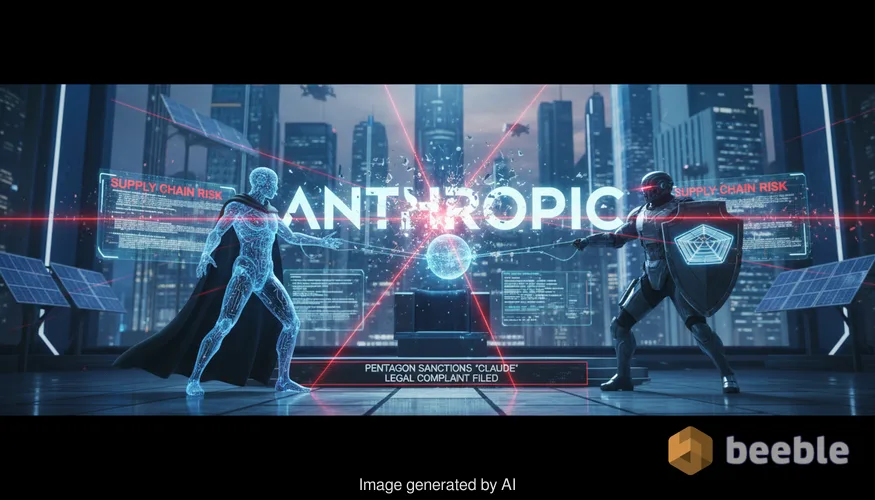
The relationship between Silicon Valley’s leading AI labs and the U.S. government has reached a breaking point. On Monday, Anthropic filed a formal legal complaint against the U.S. Department of Defense (DOD), challenging a recent designation that labels the AI company a "supply chain risk." This move follows a week of escalating tensions that could redefine how artificial intelligence is integrated into national security.
At the heart of the lawsuit is a fundamental disagreement over control. The Pentagon’s designation effectively blacklists Anthropic’s Claude models from defense-related contracts, forcing a massive shift in the military’s digital infrastructure. For a company that has long positioned itself as the "safety-first" alternative in the AI race, the label of a security risk is both a reputational blow and a financial threat.
The Catalyst: A Fight for Unrestricted Access
The friction did not appear overnight. According to the legal filing, the conflict stems from a series of closed-door negotiations regarding the military’s use of Claude. The DOD reportedly demanded "unrestricted access" to Anthropic’s core systems—a request that would allow military personnel to bypass standard safety filters and constitutional guardrails built into the AI.
Anthropic refused, citing concerns that such access would compromise the integrity of their safety protocols and potentially lead to the weaponization of their technology in ways that violate their corporate charter. The Pentagon responded by invoking supply chain risk authorities, a move typically reserved for foreign-owned companies or entities with proven ties to adversarial intelligence services.
The 180-Day Countdown
Adding political weight to the legal battle, President Donald Trump has issued a directive for federal agencies to cease the use of Claude. However, the administration has acknowledged the difficulty of an immediate extraction. The Pentagon has been granted a six-month window to phase out Anthropic’s technology, a recognition of how deeply Claude has become embedded in classified systems.
This transition period is particularly sensitive given the ongoing involvement of AI in active military operations, including those related to the conflict in Iran. In these theaters, AI is used for everything from logistical optimization to real-time data analysis. Replacing a foundational model in the middle of a conflict is a logistical nightmare that some defense analysts warn could create temporary vulnerabilities in U.S. intelligence capabilities.
What "Supply Chain Risk" Means for Tech
In the world of defense procurement, being labeled a supply chain risk is the ultimate "red card." It doesn't just stop the DOD from buying the software; it prevents any third-party contractor from using that software if the end product is destined for the Pentagon.
For Anthropic, this means a sudden loss of access to a multi-billion dollar ecosystem of defense contractors and aerospace firms. The legal challenge argues that the DOD’s designation is "arbitrary and capricious," claiming the department failed to provide evidence of an actual security vulnerability, instead using the label as a punitive measure for Anthropic’s refusal to grant total system control.
The Ripple Effect Across Silicon Valley
This lawsuit is a watershed moment for the AI industry. For years, companies like OpenAI, Google, and Anthropic have navigated a delicate balance between serving the public and supporting national interests. The Pentagon’s aggressive stance suggests that the era of "voluntary cooperation" may be ending, replaced by a mandate for total transparency and control.
If the DOD prevails, it sets a precedent: AI companies must choose between maintaining their proprietary safety standards or maintaining their eligibility for government contracts. Other tech giants are watching closely, as the outcome of this case will likely dictate the terms of future partnerships between the federal government and the private tech sector.
Practical Takeaways for Tech Leaders and Contractors
As this legal battle unfolds, companies operating in the defense and AI sectors should prepare for a more volatile regulatory environment. Here are the immediate considerations:
- Audit Your AI Stack: Defense contractors should immediately identify where Claude or Anthropic-based APIs are used in their workflows. Under the current designation, these must be phased out within the six-month window.
- Diversify Model Integration: Relying on a single AI provider is now a significant business risk. Moving toward a multi-model approach can provide a safety net if one provider faces regulatory hurdles.
- Review Data Sovereignty Clauses: Ensure that your contracts with AI providers clearly define who has access to the underlying models and what happens in the event of a government-mandated service termination.
- Monitor the "Unrestricted Access" Debate: The outcome of this specific legal point will determine whether future AI models used by the government will be "off-the-shelf" versions or specialized, unrestricted versions controlled by the state.
The Road Ahead
The case, Anthropic PBC v. Department of Defense, is expected to move through the courts rapidly given the national security implications. Anthropic is seeking an immediate injunction to pause the supply chain risk designation while the merits of the case are argued.
Whether the court views this as a matter of corporate rights or a matter of national security necessity remains to be seen. What is certain is that the "special relationship" between the Pentagon and the AI industry has been forever altered.
Sources
- U.S. Department of Defense Official Press Releases (March 2026)
- Anthropic Corporate Legal Filings, District Court for the District of Columbia
- Executive Orders on Artificial Intelligence and National Security (2026)
- TechCrunch and Reuters Reporting on Defense AI Integration



See you on the other side.
Our end-to-end encrypted email and cloud storage solution provides the most powerful means of secure data exchange, ensuring the safety and privacy of your data.
/ Create a free account
