


Anthropic wants the government to regulate its biggest AI models

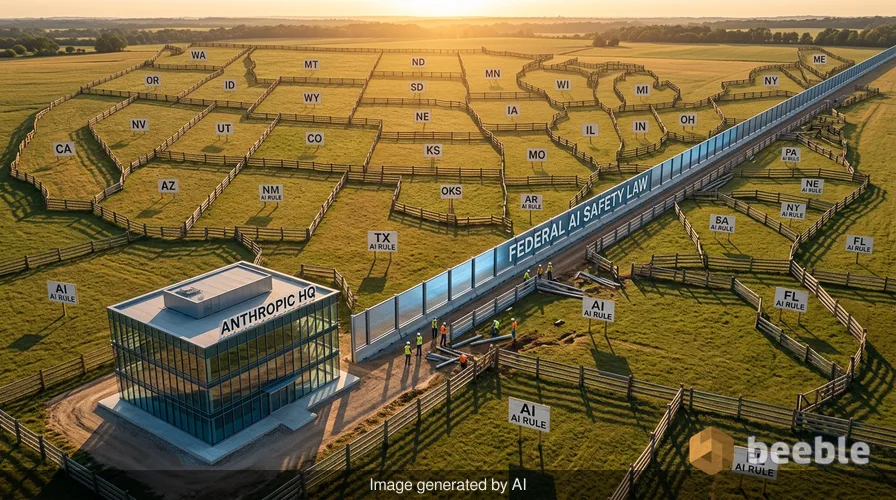
The prevailing narrative in Silicon Valley suggests that tech founders stay awake at night dreaming of a world without government oversight. We often imagine these companies as digital pioneers who view every new regulation as a tether on their innovation. Anthropic just upended that story. On Wednesday, the AI safety startup made a public plea to the U.S. Congress. They are not asking for a hands-off approach. Instead, they want federal lawmakers to enact a rigorous law that mandates safety tests for the most capable AI models. To put it another way, one of the biggest players in the industry is asking the government to build the very fence that will restrict its own movement.
This shift in strategy is not a sudden burst of corporate altruism. Anthropic is currently preparing for an initial public offering (IPO). For any company heading toward a stock market debut, uncertainty is the primary enemy. In the current environment, several states are already drafting their own AI rules. California is at the forefront of this movement. For a company like Anthropic, a patchwork of 50 different state laws is a logistical nightmare that threatens its valuation. By calling for a federal law that overrides state-level regulations, Anthropic is looking for a single, predictable set of rules. Looking at the big picture, this is a move to stabilize the ground before they invite Wall Street to the table.
Why federal rules are better for the balance sheet
When a company prepares for an IPO, it needs to show investors a clear path forward. If Anthropic must comply with a strict law in New York and a completely different one in Texas, its operating costs skyrocket. Engineers have to build different versions of the same product. Legal teams must grow to handle conflicting compliance standards. This fragmented approach creates a systemic drag on growth. Essentially, Anthropic is asking for a federal law to serve as a shield against the chaos of state-level politics.
Behind the jargon of regulatory frameworks, this is about market entry. If Congress sets a high bar for safety testing, it creates a standard that every company has to meet. For an incumbent like Anthropic, which already has billions in funding from partners like Amazon and Google, meeting these standards is manageable. For a small startup in a garage, the cost of independent safety tests is a massive barrier. Historically, high regulatory hurdles often help the largest companies by making it too expensive for new competitors to enter the space. In simple terms, Anthropic is advocating for a rulebook that it can afford to follow but its future rivals might not.
The mechanics of independent safety tests
Anthropic wants the government to require third-party audits for models that reach a certain threshold of power. For the average user, this sounds like an abstract concept. Under the hood, it functions similarly to how the government treats the automotive industry. Before a car reaches the showroom, it undergoes crash tests conducted by independent bodies. We do not just take the manufacturer’s word that the airbags work. Anthropic suggests that AI needs a similar process.
These tests focus on catastrophic AI risks. We are not talking about an AI giving a wrong recipe for chocolate cake. These risks include the ability of a model to help a person create a biological weapon or launch a large-scale cyberattack on a power grid. Currently, AI safety is a self-policed sector. Companies run their own internal evaluations and release reports that say they are safe. Anthropic is arguing that the industry is now too powerful for the honor system. This is a foundational shift in how we think about digital products. If the government agrees, it would mean that the most advanced AI models are no longer treated like simple software, but like heavy machinery or pharmaceuticals.
What this means for your digital habits
For a consumer, these regulations will have a tangible impact on the tools you use every day. If safety testing becomes a federal requirement, the pace of AI releases will slow down. The days of a new, earth-shaking update every two weeks will likely end. This is a cyclical pattern in tech. First, there is a period of rapid, unchecked growth. Then, there is a period of consolidation and safety.
Practically speaking, you might find that certain features are delayed or never reach the public because they failed a safety audit. There is also the issue of price. High-end AI models are already expensive to build. Adding the cost of mandatory, independent testing will likely push those costs onto the user. Your monthly subscription for a top-tier AI assistant has a high probability of increasing as companies pass these compliance costs down the chain. Conversely, you gain a level of transparency that does not exist today. You would know that the model you are using has passed a government-approved stress test. For many users, that peace of mind is worth a few extra dollars a month.
The stock market as a global mood ring
On the market side, Anthropic’s push for regulation is a signal to investors. The upcoming IPO is poised to be one of the most consequential debuts in recent history. If Anthropic successfully shapes federal law, it becomes a more resilient company. It reduces the risk of a sudden government shutdown or a massive lawsuit that could tank its stock price after it goes public. This listing has the potential to reshape benchmark indexes. Many traditional tech companies have seen their growth stall, and investors are hungry for a fresh narrative.
When Anthropic hits the public market, it will likely influence investor flows across the entire sector. A regulated Anthropic is a safer bet for pension funds and conservative institutional investors. If the most powerful AI companies are under federal oversight, the volatile nature of the AI trade might stabilize. This transition from a wild-west startup to a regulated utility is a standard part of a maturing industry. It happened with the railroads, it happened with telecommunications, and now it is happening with intelligence.
The friction between states and the federal government
There is a specific tension in Anthropic’s request. They explicitly asked Congress not to block state laws unless they replace them with a federal law that is just as rigorous. This is a calculated risk. California’s proposed AI laws are some of the strictest in the world. They include provisions that would hold developers liable if their AI causes a massive disaster. By asking for a rigorous federal law, Anthropic is trying to avoid a scenario where the federal government passes a weak law that states then ignore or supplement with their own stricter rules.
From a consumer standpoint, a single federal standard is usually better for privacy and security. When companies only have to answer to one set of federal regulators, it is easier for the public to track who is responsible for failures. If the responsibility is split between the Federal Trade Commission and 50 different state attorneys general, accountability becomes opaque. Zooming out, the goal is to create a streamlined system where the rules are clear for everyone involved.
Practical foresight for the AI era
As this debate moves into the halls of Congress, you should prepare for a change in how you interact with technology. We are moving away from the era of move fast and break things. The era of move carefully and test everything is arriving. You should start to look at your AI tools through the same lens you use for your car or your bank. These are no longer just toys or novelties. They are becoming part of the infrastructure of modern life.
Ultimately, you should pay attention to who is writing the rules. Anthropic is a company, not a government agency. While their call for safety is welcome, they are also looking out for their own bottom line. As a user, you should support transparency, but you should also remain skeptical of any company that tries to lock in its market lead through regulation. The best outcome for the average person is a market where AI is safe, but where the barriers to entry remain low enough for the next great idea to find a way to the surface.
Sources: Anthropic public statement (June 2026), Congressional testimony on AI risk, Market analysis of 2026 tech IPOs.



See you on the other side.
Our end-to-end encrypted email and cloud storage solution provides the most powerful means of secure data exchange, ensuring the safety and privacy of your data.
/ Create a free account
