


Apple at 50: How a Near-Failure Became Tech’s Long-Game Master

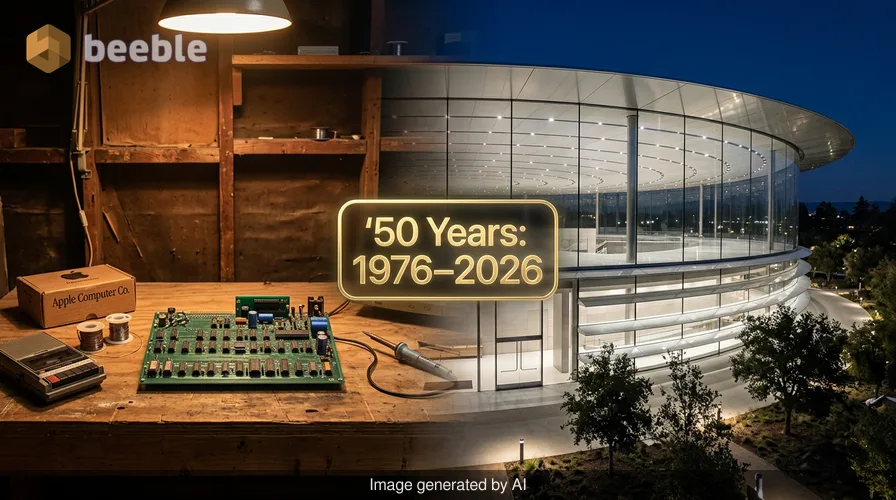
Why does Apple still matter at 50?
What does it take for a company founded in 1976 to stay culturally central in 2026? In tech, that is roughly the equivalent of a houseplant surviving in a server room: possible, but unusual.
Apple turned 50 on April 1, 2026. The anniversary is more than a nostalgic milestone. It is a useful moment to examine how a company that nearly unraveled in the 1990s built one of the most durable business machines in modern capitalism. Apple did not usually invent the category. It rarely arrived first. Nevertheless, it kept showing up with products that felt complete out of the box, intuitive in practice, and polished enough to make rival devices look like prototypes with a shipping label.
That long game is the real story. Apple’s rise was not a straight line from garage myth to trillion-dollar glory. It was a volatile sequence of bold bets, painful misfires, operational discipline, and a remarkably consistent belief that design is not decoration. It is strategy.
From garage hardware to the first real hit
Apple traces its founding to April 1, 1976, when Steve Jobs, Steve Wozniak, and Ronald Wayne started the company. Wayne, the often-forgotten third co-founder, exited almost immediately, selling his stake back to Jobs and Wozniak. The first machine, the Apple I, was sold essentially as a bare board rather than a fully finished consumer computer. It did not ship as the sort of all-in-one device modern buyers would recognize, and that detail matters because it shows how early Apple still was: half hobbyist project, half business experiment.
The bigger breakthrough came with the Apple II in 1977. This was the machine that turned Apple from an ambitious startup into a serious player. The Apple II was marketed as a computer for ordinary people, not just electronics enthusiasts. Later additions such as the floppy disk drive and the spreadsheet VisiCalc helped make it genuinely useful, especially for business users. In other words, the Apple II was not merely clever hardware. It was an early ecosystem.
I have always found that point important when writing about technology from the perspective of ordinary people rather than Silicon Valley mythology. Growing up in a small hometown where infrastructure problems were often painfully visible, I learned to judge innovation less by technical novelty and more by whether it solves a real problem for non-experts. The Apple II did exactly that. It lowered the friction.
Success, overreach, and the first big fall
Apple’s early momentum did not make it immune to bad bets. In the early 1980s, the company aimed at the business market with the Lisa, released in 1983. The machine was advanced for its time, featuring a graphical user interface, but it was also very expensive and commercially weak. Britannica notes that its nearly $10,000 price made it dramatically costlier than an IBM PC, and hardware limitations hurt its appeal.
Then came the Macintosh in 1984, launched with one of the most famous Super Bowl ads ever made. The ad worked brilliantly as narrative theater. It framed Apple as the rebel in a computing world drifting toward conformity. Curiously, the cultural impact outpaced the commercial one. The Macintosh was important, even transformative in the long run, but its initial sales disappointed.
That disappointment fed a boardroom struggle. By September 1985, Jobs had been pushed out after clashes with CEO John Sculley, and Wozniak had also left. Jobs went on to found NeXT, a company that looked peripheral at the time but would later become central to Apple’s survival.
The 1990s: when Apple looked vulnerable
For readers who know Apple mainly as the iPhone company, it is easy to forget how precarious things became in the 1990s. Apple faced mounting pressure from Microsoft’s Windows ecosystem and from cheaper PC makers that were better suited to a mass market increasingly focused on price and software compatibility. Meanwhile, Apple’s own product lineup had become cluttered and confusing.
The financial picture was ugly. Apple’s 1997 annual report shows quarterly net losses of $120 million, $708 million, $56 million, and $161 million across fiscal 1997. That is not a minor wobble. That is a company taking on water from multiple sides at once.
Oddly enough, Apple’s rescue came from revisiting its own unfinished past. In late 1996, Apple agreed to acquire NeXT, and Steve Jobs returned. He became interim CEO in 1997, cut complexity, refocused the company, and began rebuilding both the product strategy and the operating model. To put it another way, Apple stopped behaving like a distracted catalog and started acting like a disciplined product company again.
The long game clicks into place
The first clear symbol of the turnaround was the iMac in 1998, a machine that looked nothing like the beige boxes dominating office desks. It was playful, sleek, and unmistakably consumer-friendly. More important, it signaled that Apple understood something many rivals did not: design could organize the entire customer experience, from industrial hardware to setup friction to brand identity.
That philosophy carried into Mac OS X, which drew on NeXT technology, and then into the iPod in 2001. Apple’s original iPod launch positioned the device around a simple promise: up to 1,000 songs in your pocket. MP3 players already existed, of course. Apple’s move was not category invention but category refinement. The company made the experience cohesive.
That pattern became Apple’s signature. The iPhone arrived in 2007 and reset expectations for smartphones. The App Store followed in 2008, opening with 500 apps and creating a scalable software marketplace that changed how mobile computing works. The iPad, introduced in 2010, extended that model again. Apple was building bridges between hardware, software, services, and developers, and each bridge made the ecosystem harder to leave.
In my reporting, I often compare technology platforms to city planning. A good product can attract attention, but an integrated platform creates neighborhoods, transport links, and public utilities. Apple became exceptionally good at that kind of planning.
Apple at 50: still huge, but not invincible
Today, Apple remains one of the world’s most valuable companies. As of April 2026, its market capitalization was roughly $3.7 trillion, after finishing 2025 above the $4 trillion mark by some market trackers. That scale is astonishing, but it should not obscure the more interesting point: Apple’s staying power comes from consistency more than spectacle.
The company’s own 50th-anniversary messaging emphasizes a familiar formula, blending powerful technology with intuitive design while pushing further into custom silicon, software, services, privacy, accessibility, and environmental goals. In corporate language, that can sound tidy. Under the hood, though, it reflects a strategy Apple has spent decades refining: control the key layers, reduce user friction, and make the technology feel more human than technical.
Even so, the next chapter is not guaranteed. Apple faces regulatory scrutiny, fierce AI competition, and the challenge that haunts every mature giant: how to keep shipping products that feel fresh when your installed base is enormous and your standards are self-imposedly high. A company this large cannot pivot like a startup. It turns more like a cargo ship. But if Apple’s history teaches anything, it is that the company is unusually patient when it believes a platform shift is real.
What readers and founders can learn from Apple’s first 50 years
Apple’s story offers a few practical takeaways.
First, being first is overrated. Being usable matters more.
Second, design is not just about aesthetics. It is how a product behaves, how clearly it communicates, and how much work it asks the user to do.
Third, a near-death experience can be clarifying. Apple’s 1990s crisis forced ruthless simplification, and because of this, the company rebuilt around focus rather than sprawl.
Finally, ecosystems win at scale. A standalone gadget can be copied. A tightly integrated stack is much harder to replicate.
That may be the most useful lens for understanding Apple at 50. This was never just a hardware company and never simply a lifestyle brand. It became a resilient system, one that treats products, software, chips, retail, services, and support as interconnected building blocks.
And that is why Apple’s long game paid off. Not because it always guessed the future first, but because when it moved, it moved with unusual coherence.
If you are evaluating the next wave of AI devices, wearables, spatial computing, or health tech, borrow that lens. Ask not just what a product does on day one, but what ecosystem it is quietly building for year ten.
Sources
- Apple Newsroom anniversary announcement, March 2026
- Apple historical product announcements and company materials
- Apple 1997 Annual Report
- Computer History Museum materials on Apple II and VisiCalc
- Britannica company history overview



See you on the other side.
Our end-to-end encrypted email and cloud storage solution provides the most powerful means of secure data exchange, ensuring the safety and privacy of your data.
/ Create a free account
