


Apple has finally traded its privacy crown for a seat at the table in China

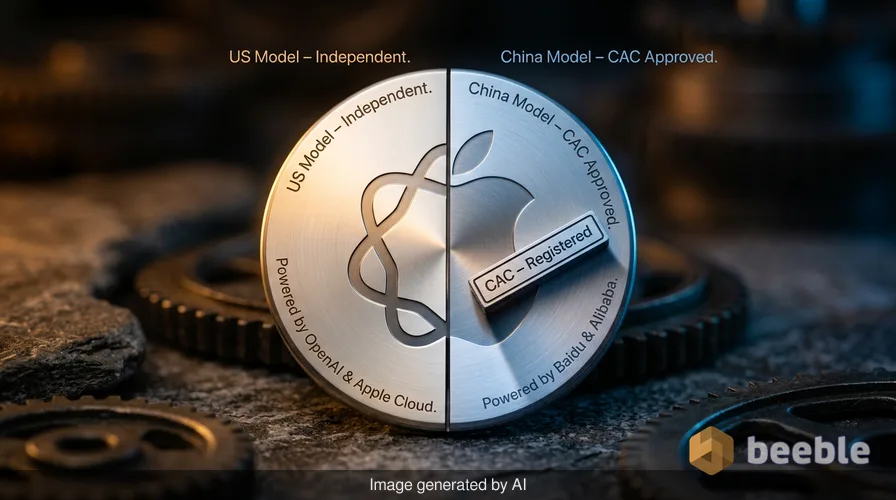
Can a smartphone truly be personal if its most advanced features answer to a government regulator? This question is no longer a hypothetical exercise for the millions of iPhone users in China. After two years of negotiations and technical adjustments, Apple Intelligence has finally cleared the regulatory hurdles required to operate in the world’s largest mobile market. The Cyberspace Administration of China (CAC) has registered the service, allowing Apple to roll out its AI suite to a population that has been waiting since the technology first debuted in the US.
For the average user, this news signals the end of a long digital drought. While users in other regions have spent the last two years using AI to summarize emails, generate images, and navigate an overhauled Siri, Chinese customers have held devices with dormant silicon. The approval is a victory for Apple’s bottom line, but it comes with a structural shift in how the company operates. To satisfy local laws, Apple is not using its own proprietary cloud models or its partnership with OpenAI. Instead, the Chinese version of Apple Intelligence is a hybrid machine powered by local tech giants Baidu and Alibaba.
The green light from Beijing changes everything for the iPhone
Registration with the CAC is the final gate for any generative AI service in China. Unlike the European Union or the United States, where regulations often focus on consumer rights or competition, Chinese law requires AI models to undergo a strict vetting process for content and data security. The government must approve the data used to train the models and the logic the AI uses to generate answers. Apple has spent the last eighteen months navigating these requirements to ensure the iPhone remains a viable product in a region that accounts for nearly 20% of its total revenue.
This approval is the result of a significant pivot in Apple’s engineering strategy. Historically, Apple prefers to own every part of the user experience, from the glass on the screen to the code in the cloud. However, the Chinese market operates under a different set of physics. The regulator requires that all AI processing for domestic users stays within national borders. Furthermore, the large language models (LLMs) that provide the brains for the system must be locally developed and approved. As a result, Apple had to find partners that already had the regulator's blessing.
How a localized brain powers the Chinese Siri
Under the hood, the Chinese version of Apple Intelligence functions like a digital diplomat. When you ask your iPhone to rewrite a text message or summarize a long meeting, the device first tries to handle the request using its own internal processor. If the task is too complex for the phone to solve alone, it usually sends that data to a cloud server. In the US, that server is Apple’s own Private Cloud Compute. In China, that task goes to Alibaba’s Qwen model or Baidu’s Ernie Bot.
Alibaba has confirmed that its Qwen model is integrated into the system for compatible iPhone, iPad, Mac, and Vision Pro models. Think of this as a restaurant where Apple owns the dining room and the waitstaff, but the kitchen is run by a local chef. You still see the Apple interface and use the familiar Siri voice, but the actual processing of your request happens on servers owned and managed by Alibaba or Baidu. This arrangement allows Apple to offer modern features without building a massive, government-sanctioned server farm from scratch.
Practically speaking, this means Siri might feel different in Shanghai than it does in San Francisco. Because Baidu and Alibaba use different training data than Apple, the way the AI interprets nuance, slang, or cultural references will be distinct. The system is designed to be seamless, yet the underlying logic is entirely domestic.
The compromise between privacy and performance
Apple has long marketed itself as a fortress of privacy. The company famously uses end-to-end encryption and claims that even its own employees cannot see your data. When it launched Apple Intelligence in 2024, it introduced Private Cloud Compute to maintain this standard in the age of AI. However, the partnership with Alibaba and Baidu introduces a new variable. While Apple maintains that data sent to these partners is anonymized and stripped of personal identifiers, the infrastructure belongs to third parties.
From a consumer standpoint, the trade-off is clear. You get the latest features, but your data travels through a pipeline regulated by the Chinese state. For many users in China, this is already the reality of using any digital service. Every major local smartphone brand, from Huawei to Xiaomi, already uses similar domestic AI integrations. Apple is simply following the established path to remain competitive. The company is betting that users value a smarter phone more than the theoretical purity of a closed-loop privacy system.
Why Apple chose local giants over its own cloud
Looking at the big picture, Apple had little choice in this matter. Building a custom AI model specifically for one country is a monumental task that requires vast amounts of localized data. More importantly, the Chinese government is hesitant to allow foreign AI models to operate freely due to concerns about information control. By partnering with Baidu and Alibaba, Apple gains immediate access to models that are already optimized for the Chinese language and compliant with local censorship laws.
| Feature | US/Global Version | China Version |
|---|---|---|
| Core AI Model | Apple / OpenAI | Baidu Ernie / Alibaba Qwen |
| Cloud Processing | Private Cloud Compute | Local Partner Servers |
| Regulatory Body | FTC / EU Commission | Cyberspace Administration of China |
| Key Device Support | iPhone 15 Pro and newer | iPhone 15 Pro and newer |
| Language Support | English and regional | Mandarin and regional dialects |
This table shows the stark divide in the technical foundation of the same product. On the market side, this move is a defensive play. Apple has seen its market share in China erode as local rivals launch sophisticated AI features. Huawei’s HarmonyOS has become a formidable competitor, offering deep AI integration that makes the standard iPhone look dated. By launching Apple Intelligence now, Apple is trying to stop the migration of high-end users to domestic brands.
The long road to catching up with domestic rivals
Apple is entering a crowded room. In the two years it took for Apple to secure this approval, Chinese manufacturers have not stayed still. Companies like Oppo and Vivo have already integrated AI into their camera software and battery management systems. These companies have a home-field advantage because their AI models are built specifically for the habits of Chinese consumers, such as deep integration with WeChat and local payment apps.
Apple’s advantage remains its ecosystem. If you own an iPad and a Mac, having a Siri that can finally talk to your local apps in China is a major convenience. The overhauled Siri is powered by Apple Intelligence. It can now understand context across different apps, such as finding a flight number in an email and adding it to a calendar event. Previously, these features were blocked in China. With the new regulatory approval, the iPhone finally becomes the "tireless intern" it was promised to be in 2024.
What this means for your data and your wallet
For the reader, the bottom line is that the iPhone is finally whole again in China. If you are planning to buy a new device in the region, you no longer have to worry about missing out on the primary selling point of the current generation. However, there are three practical things to keep in mind:
- Hardware requirements: You still need a device with enough horsepower. Only the iPhone 15 Pro and the subsequent iPhone 16 and 17 series have the memory required to run these local models. Older devices will not see these improvements.
- Feature parity: Some features available in the US may be delayed or modified in China to comply with local laws. The version of AI that generates images or summarizes news might have stricter guardrails than the global version.
- Privacy settings: Users should review their privacy settings once the update arrives. While Apple promises anonymity, it is always wise to see what data the phone shares with cloud partners for "enhanced processing."
Ultimately, this development shows that even the world’s most powerful tech company must bend to the reality of local politics. Apple is no longer just a hardware maker. It is a company that must constantly recalibrate its values to keep its place in a volatile global market. Appreciate the invisible industrial mechanics that allow a piece of glass in your pocket to speak the local language of both the people and the government.
Sources
- Reuters Report on CAC AI Service Registration
- Alibaba Group Qwen Model Integration Statement
- Baidu Annual Developer Conference Transcript
- Apple Investor Relations Q3 2026 Earnings Report



See you on the other side.
Our end-to-end encrypted email and cloud storage solution provides the most powerful means of secure data exchange, ensuring the safety and privacy of your data.
/ Create a free account
