


Apple just turned the Mac Mini into a personal supercomputer

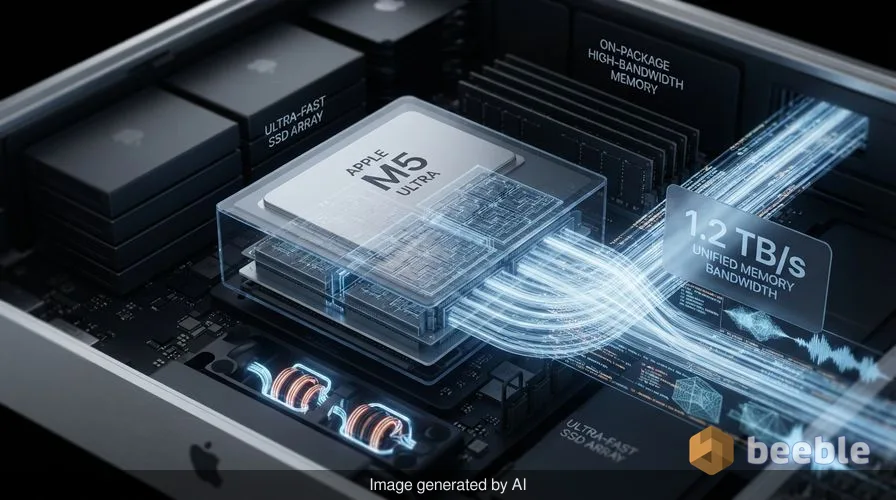
Do you actually need a computer that processes 1.2 terabytes of data every single second? For most people, the answer is a simple no. If your daily digital life involves answering emails, watching 4K video, and managing a dozen browser tabs, your current hardware is likely more than sufficient. However, Apple just changed the stakes for everyone else. The company announced the M5 Ultra and M6 chips on Tuesday, signaling a shift in how personal computers handle the growing demands of artificial intelligence.
These processors are not simple incremental updates. The M5 Ultra is a massive piece of hardware that combines four separate processing units into a single package. The M6 moves to a new manufacturing process that makes transistors almost small enough to measure in atoms. These developments suggest that Apple is no longer just building tools for office work. The company is now building the infrastructure for a world where AI runs on your desk rather than in a distant data center. Understanding what these chips do requires looking past the marketing slogans and into the physical reality of how computers process information.
The quad-die architecture of the M5 Ultra
The M5 Ultra is the most powerful chip Apple has ever built. To understand why, you have to look at its physical layout. Most computer chips are a single piece of silicon, known as a die. To increase power, engineers usually make the die larger or the components smaller. Apple took a different path with the Ultra series. The M5 Ultra is a quad-die chip. It fuses two dual-die M5 Max chips together.
In simple terms, this is like bolting four engines together to power one car. This design allows for a 36-core CPU and an 80-core GPU. The most important number, however, is the 1.2 TB/s of unified memory bandwidth. This is a 50% increase over the M3 Ultra. In everyday life, memory bandwidth is the width of the highway connecting your computer's brain to its short-term memory. If the highway is narrow, data gets stuck in traffic. With 1.2 TB/s, the highway is so wide that even the most massive AI models can move data back and forth without slowing down.
This architecture targets professionals who do 3D rendering and visual effects. When a designer works on a complex scene for a movie, the computer has to calculate how light hits millions of different points simultaneously. Historically, this work required massive server farms. The M5 Ultra brings that level of power to the Mac Studio. For the hobbyist AI developer, this means the ability to run large language models locally. You no longer have to send your data to a corporate server to get a sophisticated response from an AI.
The M6 and the move to 2nm manufacturing
While the M5 Ultra is a brute-force solution for professionals, the M6 chip is the foundational piece for the average user. The M6 is built using a 2nm process. In the world of semiconductors, microchips are the digital crude oil of the modern economy, and the 2nm process is the most advanced refinery available. A nanometer is one-billionth of a meter. By shrinking the components to this scale, Apple fits more transistors into the same amount of space.
This shrink has a tangible impact on energy efficiency. The M6 has a 12-core CPU, which is two more cores than the previous M5. Despite the extra cores, the chip uses less power to perform the same tasks. Apple claims a 30% increase in peak GPU compute for AI compared to the M5. For a student or a remote worker, this translates to a laptop or a Mac Mini that stays cool and quiet even when it performs complex tasks.
Practically speaking, the M6 is designed to handle Apple Intelligence. This is Apple's suite of AI features that summarize text, generate images, and help Siri understand context. By moving these tasks to the M6 chip, Apple ensures that your computer does not have to rely on a constant internet connection to be smart. The Dual 16-core Neural Engine in the M6 is a specialized part of the chip that only handles AI math. It is a tireless intern that works in the background to make sure your apps respond instantly to your requests.
Why local AI is a win for privacy
Apple has a complicated relationship with AI. The company was slow to release a proprietary model, and the new Siri upgrade actually uses Google’s Gemini for some tasks. However, Apple has a clear lead in on-device processing. Most AI tools today are cloud-based. When you ask a chatbot a question, your words travel to a server owned by a tech giant, are processed, and then sent back to you. This creates a privacy risk. Your data exists on someone else's hardware.
Apple is using the M5 Ultra and M6 to move that processing back to your desk. Features like Face ID and Touch ID already work this way. Your biometric data never leaves your device. By building chips with massive Neural Engines and high memory bandwidth, Apple allows users to run large AI models locally. Developers can fine-tune these models using their own proprietary data without fear of leaks.
This is a systemic shift in how we interact with software. If the AI is on your chip, it can see your calendar, your emails, and your files to provide better help without ever sharing that information with the outside world. This creates a secure and controlled environment for developers and casual users. It makes the computer a more private space than it has been in years.
The bottom line for your wallet
The new Mac Mini starts at $899 and comes with the M6 chip. This price point is interesting because it places high-end AI capabilities within reach of the average consumer. In the past, hardware this powerful was reserved for people with multi-thousand-dollar budgets. Looking at the big picture, the Mac Mini is now the most affordable way to get a 2nm processor.
For the average user, the M5 Ultra Mac Studio remains a specialized tool. It is overkill for writing documents or browsing the web. However, the M6 Mac Mini is a resilient choice for anyone who wants a computer that will stay fast for the next five to seven years. As software becomes more reliant on AI, older chips will struggle to keep up. The M6 has the headroom to handle these future updates.
Ultimately, Apple is betting that we want our AI to be fast, local, and private. These new chips are the physical manifestation of that bet. You might not need 1.2 terabytes of bandwidth today, but as AI tools become a standard part of every app we use, you will likely be glad the highway is already built.
What this means for you
If you are considering an upgrade, the M6 Mac Mini is the clear winner for value. It offers a significant leap in AI performance and energy efficiency over the M3 and M4 generations. You should choose the M5 Ultra only if your income depends on rendering times or if you are a developer who needs to run the largest AI models available. For everyone else, the M6 represents a new baseline for what a personal computer can do.
Keep an eye on your digital habits over the next few months. If you find yourself using AI tools more frequently, you will notice the limitations of older hardware. The M6 and M5 Ultra are designed to remove those limitations. They ship after September 22, and pre-orders are open now. If you value privacy and want a machine that is ready for the next wave of software, these chips are a foundational upgrade.
Sources:
- Apple Silicon Press Release, August 2026.
- TSMC 2nm Production Roadmap Report.
- Semiconductor Industry Association Market Analysis 2026.



See you on the other side.
Our end-to-end encrypted email and cloud storage solution provides the most powerful means of secure data exchange, ensuring the safety and privacy of your data.
/ Create a free account
