


Apple says OpenAI's new hardware is built on stolen blueprints

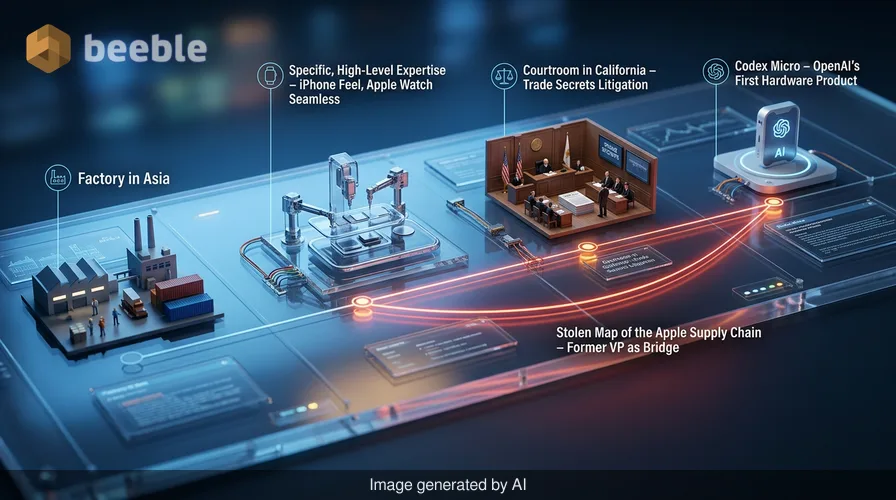
The Codex Micro is a small, programmable keyboard with a handful of keys designed to trigger complex coding sequences. It is a simple piece of plastic and copper. To build it, OpenAI needed more than just a factory in Asia. It needed the specific, high-level expertise that makes an iPhone feel solid and an Apple Watch look seamless. This chain of production leads directly back to a courtroom in California, where Apple claims its own former vice president was the bridge that carried its hardware secrets to its biggest rival.
Looking at the big picture, the lawsuit Apple filed against OpenAI on Friday represents a major shift in the relationship between the two companies. For years, OpenAI was a software company. It built the digital brain. Apple was the hardware company that provided the physical body for that brain through the iPhone. Now, those boundaries are disappearing. OpenAI wants to build its own gadgets, and Apple claims the startup is doing so by using a stolen map of the Apple supply chain.
The paper trail from Cupertino to San Francisco
Apple describes its findings as a pattern of theft that began with individual engineers and eventually reached the highest levels of OpenAI's leadership. The complaint names Chang Liu, a former senior system electrical engineer at Apple, as a central figure. Liu left Apple in January 2026 to join OpenAI. According to the lawsuit, he did not just leave with his experience. He left with a company laptop he refused to return and avoided the standard exit interview that all departing employees must complete.
Apple alleges that Liu later discovered an authentication bug in the company's security system. This flaw allowed him to log back into Apple's internal servers after his employment ended. While inside, he allegedly downloaded dozens of confidential files. These were not just general documents. They were technical specifications and engineering presentations for products that Apple has not yet released to the public. Essentially, Liu had a master key to the workshop where Apple builds its future.
In simple terms, trade secrets are the secret sauce of the tech world. If a rival knows exactly which materials a company uses or which suppliers provide the best parts, they can skip years of expensive trial and error. Apple claims Liu even coached other Apple employees on how to join OpenAI. He reportedly gave them advice on how to copy files without getting caught by security and told them which confidential materials to study so they could ace their interviews at OpenAI.
When interviews turn into corporate espionage
Under the hood of this lawsuit is a much larger name: Tang Yew Tan. For over two decades, Tan was a fixture at Apple. He was the vice president of product design for the iPhone and the Apple Watch. These are the two most important products in the Apple catalog. He had access to the most sensitive projects in the company and knew the intimate details of how Apple interacts with its global network of suppliers.
Tan joined OpenAI as its chief hardware officer, a move that signaled the AI company was serious about moving beyond chatbots. However, Apple claims Tan's transition was far from clean. The lawsuit alleges that in the months before he left, Tan emailed himself internal summaries of the consumer electronics industry and private information about Apple's suppliers. This information is a roadmap for how to build a hardware business from scratch without making the mistakes a new company usually makes.
Curiously, the lawsuit describes a specific tactic Tan allegedly used once he arrived at OpenAI. During the hiring process for new staff, Tan reportedly asked candidates to bring actual Apple parts to their interviews. These show and tell sessions were not for education. Apple claims they were a way for OpenAI to extract physical data and design secrets from Apple hardware that is still under development. This practice suggests an environment where taking a competitor's work is not just an accident but a strategy.
Why the AI giant wants to live in your pocket
For the average user, it might seem strange that a company famous for a chatbot wants to make a keyboard or a handheld device. To understand this, we have to look at AI as a tireless intern. An intern can write emails and organize data, but they are much more useful if they have their own desk and tools. OpenAI wants its AI to be more than a website or an app. It wants its technology to have a physical presence in your life.
OpenAI teased its first major hardware product, the Codex Micro, just last month. It is a small gadget meant to sit on a desk and give developers one-touch access to AI coding shortcuts. While a keyboard seems simple, the electronics inside must be efficient and reliable. Apple argues that OpenAI's hardware business is built on a foundation of misappropriated secrets. The lawsuit calls the Codex Micro the result of an illegal reliance on Apple's hard-earned engineering.
| Feature | Apple's Allegation | OpenAI's Position |
|---|---|---|
| Employee Recruitment | Aggressive poaching and coaching to bypass security | Standard hiring of industry talent |
| Hardware Data | Theft of unreleased product specs and part lists | Focused on building original technology |
| Security | Use of an authentication bug to access files | No interest in other companies' secrets |
| Leadership | Systematic use of Apple data by Tang Yew Tan | Focused on empowering people everywhere |
What this means for your next tech purchase
From a consumer standpoint, these legal battles often feel like two giants fighting in the clouds. However, the result of this lawsuit will eventually reach your pocket. When companies compete fairly, they have to innovate to win your business. When one company allegedly takes a shortcut by using another's research, it can lead to a market where products look and feel the same because they are all using the same stolen blueprints.
Historically, hardware wars are expensive. Apple spends billions of dollars every year on research and development. If that research is easily taken by a startup, Apple may become more secretive and protective. This could mean fewer open standards and more proprietary technology that does not work well with other devices. It can also lead to higher prices. Apple will likely spend millions on this legal fight, and those costs are often passed down to the buyer through the price of the next iPhone or MacBook.
Conversely, if OpenAI is allowed to build hardware using these alleged secrets, it might bring products to market faster. But those products would exist in a legal gray area. A company built on a foundation of legal trouble is often less stable. This affects software updates, customer support, and the long-term viability of the gadgets you buy. If a court decides the Codex Micro uses stolen technology, the product could be banned from sale entirely.
The bottom line for the everyday user
Practically speaking, this lawsuit is a warning that the era of AI and hardware is becoming volatile. The digital crude oil of our time is no longer just data. It is the physical design of the chips and sensors that allow AI to function in the real world. Apple is drawing a line in the sand to protect its physical kingdom from the rising power of AI startups.
Ultimately, you should watch your digital habits and the brands you trust. As AI moves from your screen into physical objects on your desk, the companies behind them will fight harder for your loyalty and your data. This legal battle is just the beginning of a long conflict over who owns the future of the devices we use every day. Shift your perspective to look at your gadgets not just as tools, but as the front line of a global corporate war. Observe the next wave of AI hardware releases with a healthy dose of skepticism regarding where that technology actually originated.
Sources:
- Apple Inc. v. OpenAI LP Legal Complaint, July 2026
- OpenAI Corporate Press Statement, July 2026
- Codex Micro Product Teaser, June 2026
- Apple Internal Security Report on Chang Liu, 2026



See you on the other side.
Our end-to-end encrypted email and cloud storage solution provides the most powerful means of secure data exchange, ensuring the safety and privacy of your data.
/ Create a free account
