


Are Social Media Bans Actually Making Life Harder for the Kids They’re Meant to Protect?

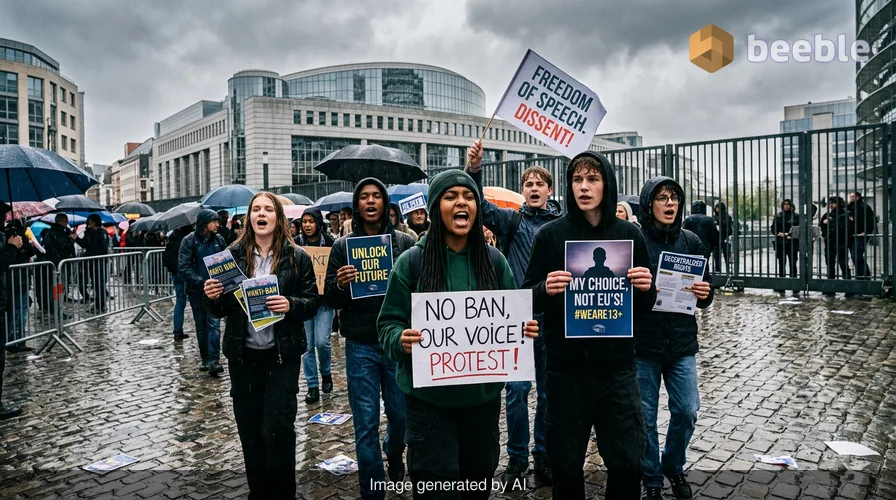
While the prevailing narrative suggests that cutting off social media access is the ultimate cure for the mental health struggles of Gen Z and Gen Alpha, a growing movement of European youth activists is beginning to tell a very different story. To many lawmakers in Brussels and Paris, a blanket ban on social media for those under 16 feels like a sturdy umbrella in a downpour. However, to the young people who actually live their lives online, these bans look less like protection and more like a systemic removal of their digital town square.
Looking at the big picture, the push for restrictive age limits has gained unprecedented momentum across the continent. From France’s 'digital majority' laws to the UK’s tightening Online Safety Act, the regulatory trend is moving toward a locked-gate approach. Yet, the activists standing at the forefront of this pushback argue that these policies are built on a foundational misunderstanding of how the modern world works. They aren't just fighting for the right to scroll through endless feeds; they are fighting for the decentralized spaces where they learn, organize, and find community.
The Blunt Instrument of Legislation
For the average user, the idea of a social media ban sounds like a simple on-off switch. In reality, it is a complex and often messy industrial-scale intervention. Politicians frequently frame these bans as a way to combat the volatile nature of online bullying and the addictive algorithms that keep kids awake at night. On the surface, the logic is hard to argue with: if the environment is toxic, remove the people most vulnerable to the toxins.
Conversely, the activists pushing back suggest that these bans are a clunky, transparent attempt to fix a social problem with a legal hammer. They argue that by banning access, governments are essentially ignoring the underlying issues of mental health and social isolation, choosing instead to hide them behind a digital wall. Looking at it from a consumer standpoint, a ban doesn't teach a teenager how to navigate the internet safely; it simply delays their entry into a world they are eventually required to master.
Behind the jargon of 'digital safety,' there is a tangible concern that these laws will create a two-tiered internet. The wealthy and tech-savvy will likely find workarounds—VPNs and decentralized platforms—while those with fewer resources will be cut off from essential information and peer support. This is where the activists’ argument becomes particularly robust: they view the internet as a foundational utility, not just a playground.
Under the Hood: The Age Verification Dilemma
One of the most opaque aspects of these bans is how they are actually enforced. For a ban to work, platforms like Meta, TikTok, and Snapchat must implement rigorous age verification. Historically, this meant checking a box that said 'I am over 13.' In the current 2026 landscape, however, we are seeing the rise of biometric scanning, AI facial analysis, and government-linked ID checks.
Practically speaking, this creates a massive privacy paradox. To protect children’s safety, we are asking them to hand over more personal data—biological markers or official identity documents—to the very corporations that the bans are supposed to regulate. To put it another way, we are using a digital bouncer that demands your fingerprints before letting you into the library. For many youth activists, this trade-off is unacceptable. They argue that the cure (invasive surveillance) is just as dangerous as the disease (algorithm-driven anxiety).
| Verification Method | How it Works | Privacy Risk Level |
|---|---|---|
| Facial Analysis AI | Scans facial features to estimate age in real-time. | Medium (Data could be stored/misused) |
| Third-Party ID Checks | Links account to a passport or national ID card. | High (Centralized database of user identities) |
| Biometric Tokens | Uses phone's built-in sensors (FaceID/TouchID). | Low to Medium (Depends on local storage vs. cloud) |
| Credit Card Auth | Charges a tiny fee to verify adult status. | Medium (Excludes lower-income households) |
The Market Side: Why Big Tech is Listening
On the market side, these regulations are creating a resilient shift in how platforms are designed. If a platform is banned for a large segment of the population, its scalable growth model takes a hit. We are seeing companies move away from 'engagement at all costs' toward what they call 'curated safety experiences.' Essentially, they are trying to build digital walled gardens that satisfy regulators without losing their future user base.
However, there is a certain amount of skepticism toward these corporate shifts. Historically, tech giants have been slow to change unless forced by the bottom line. Activists argue that these companies are only making these changes to avoid heavy fines under the Digital Services Act (DSA), rather than out of a genuine desire to help. This creates a shifting landscape where the user—the teenager—is caught between a government that wants to block them and a corporation that wants to monetize them.
Disconnection as a Double-Edged Sword
In everyday life, the impact of a ban is felt most acutely in the social fabric. For many young people, especially those in marginalized groups or rural areas, social media is their only link to a wider world. It is their source of news, their creative outlet, and their political platform. Zooming out, we see that the internet has become the digital crude oil of social interaction—it fuels almost everything.
When a teenager is banned from these spaces, they don't necessarily go back to playing in the park or reading physical books. Instead, they often feel a sense of systemic exclusion. Activists point out that the 'loneliness epidemic' isn't just about being on a phone; it's about a lack of physical 'third places' (like community centers and affordable hangouts) for youth to gather. If you take away the digital town square without providing a physical one, you aren't solving loneliness; you're just making it quieter.
The Pragmatic Filter: What This Means for You
If you are a parent, an educator, or even just a concerned citizen, the 'So What?' filter here is straightforward. The debate over social media bans isn't just a political tug-of-war; it's a preview of how our rights to access and privacy will be managed in the future.
From a consumer standpoint, we are moving toward an era of 'Verified Identities.' This means that the anonymity we once took for granted on the web is disappearing. Whether you are 15 or 55, you will likely soon have to prove who you are just to participate in online discourse. This is an interconnected issue: what starts as a way to protect children quickly becomes a template for how the entire population is monitored.
Furthermore, this movement of youth activists suggests a shift in digital literacy. Rather than waiting for a ban to protect them, these young people are demanding the tools to protect themselves. They are advocating for streamlined education on how algorithms work, how to spot misinformation, and how to manage their digital well-being without losing their digital rights.
Observing the Shifting Tides
Ultimately, the pushback against blanket social media bans is a sign of a maturing digital society. We are moving past the early days of 'tech is all good' or 'tech is all bad' into a more nuanced, albeit volatile, middle ground. The youth activists in Europe are essentially acting as the canary in the coal mine, warning us that a society built on exclusion and surveillance is a fragile one.
Instead of viewing social media as a monster to be caged, perhaps it is time to look at it as a complex industrial system that requires better engineering and more transparent oversight. The bottom line is that a ban is a temporary fix for a permanent change in how humans communicate. As we move forward, the most practical approach isn't to turn off the lights, but to teach everyone how to navigate the room in the dark.
As you observe your own digital habits this week, pay attention to how much of your daily life depends on these interconnected platforms. If your access were suddenly restricted by an age gate or a government ID requirement, how would your world change? The activists aren't just fighting for their right to post; they are highlighting the invisible backbone of modern life that we all rely on, often without realizing it.
Sources:
- European Commission: Digital Services Act Compliance Reports (2025-2026)
- Eurostat: Youth Digital Connectivity and Mental Health Trends
- Digital Rights Ireland: Analysis of Age Verification Technologies
- Council of Europe: Recommendation on Protecting the Rights of the Child in the Digital Environment



See you on the other side.
Our end-to-end encrypted email and cloud storage solution provides the most powerful means of secure data exchange, ensuring the safety and privacy of your data.
/ Create a free account
