


Banning smart glasses will not solve the digital surveillance problem

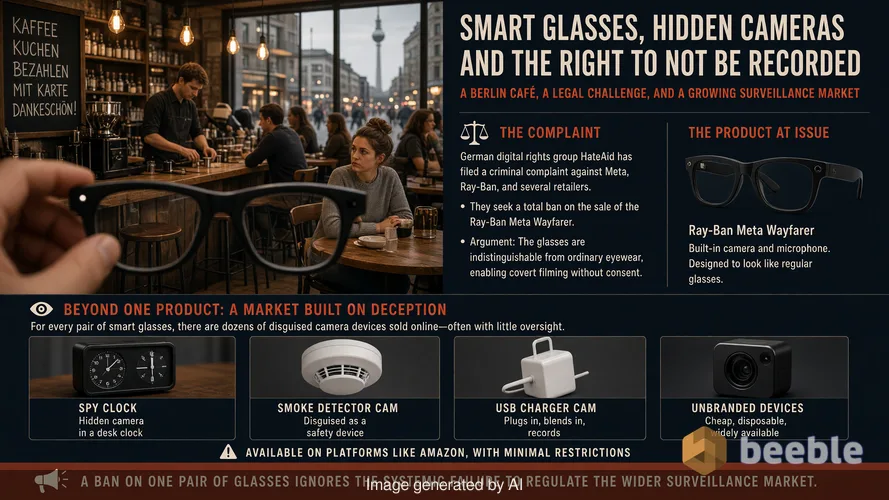
You walk into a crowded café in Berlin and adjust your glasses. To the barista, you are just another customer starting their morning. To the person sitting at the next table, you might be a walking recording studio. This ambiguity is the central tension in the criminal complaint filed by the German digital rights group HateAid. The group is targeting Meta, Ray-Ban, and several retailers, seeking a total ban on the sale of the Ray-Ban Meta Wayfarer. They argue that these smart glasses are indistinguishable from ordinary eyewear, which allows users to film others without their knowledge.
While the legal challenge focuses on Meta, the broader issue of covert surveillance reaches much further than a single pair of high-tech frames. For every pair of smart glasses sold by a major tech corporation, there are dozens of unbranded "spy clocks" and hidden camera devices available on platforms like Amazon. These devices are designed specifically to deceive. A ban on one specific product ignores the systemic failure to regulate the wider market for surveillance tools.
The legal battle against invisible cameras
HateAid filed its complaint with Germany's Central Office for Combating Internet Crime. The group claims the glasses violate the German Telecommunications, Digital Services and Data Protection Act. Their primary concern is that the technology disguises surveillance as an everyday object. In Germany, where roughly 41 million people wear glasses, the potential for inconspicuous recording is vast. The group calls this "image-based digital violence" because it allows individuals to capture footage in spaces where people expect privacy.
The Ray-Ban Meta glasses feature a small white LED light that blinks when the user takes a photo or records a video. HateAid argues this light is insufficient. It is small and easily ignored in bright sunlight or busy environments. The group proposes a "safety by design" approach where the cameras are color-coded or clearly identifiable from a distance. Privacy by design is the foundation of a house in this regulatory context. If the foundation is weak, the entire structure of personal privacy collapses under the weight of new technology.
The paradox of the spying clock
Focusing exclusively on Meta creates a regulatory blind spot. A quick search on major e-commerce platforms reveals a thriving market for hidden cameras. You can buy a functional alarm clock that records 4K video through a pinhole lens. You can find smoke detectors, USB chargers, and even water bottles that contain hidden recording equipment. These devices do not have blinking LED lights to warn bystanders. They are built for one purpose: to record people without their consent.
German law is already quite strict regarding these devices. Section 90 of the German Telecommunications Act (TKG) prohibits the abuse of transmitting equipment. This law specifically bans the production, sale, and possession of recording devices that are disguised as other objects. The Federal Network Agency (Bundesnetzagentur) has previously banned "smart" dolls and watches that allowed parents to listen in on classrooms. Yet, these products remain easily accessible through international shipping and third-party sellers. A ban on Meta's glasses would remove a visible product from store shelves while leaving the invisible market for true spy gear untouched.
A fragmented approach to public photography
The legal challenge highlights the messy reality of privacy laws across the European Union. The EU regulatory landscape is a patchwork quilt of different national standards. Germany maintains some of the most stringent public photography laws in the world. Under the Kunsturhebergesetz (Art Copyright Act), individuals have the "right to one's own image." You generally cannot film or photograph a specific person in public without their permission. This is a contrast to countries like Spain or the Netherlands, where public photography is often permitted as long as it does not serve a malicious or commercial purpose.
This fragmentation creates a compliance nightmare for hardware manufacturers. A device that is legal to wear in Paris might technically facilitate a crime the moment the wearer crosses the border into Berlin. The General Data Protection Regulation (GDPR) provides an overarching framework, but national criminal codes still dictate the specifics of what constitutes illegal surveillance. This lack of harmony makes it difficult for citizens to know their rights when they travel within the single market.
Digital violence and the threat to women
The HateAid complaint emphasizes that digital violence disproportionately targets women. AI-generated deepfakes and non-consensual recordings are rising threats. In 2024, Germany, France, and Sweden reported significant increases in recorded sexual violence. Data shows that 14% of women in Germany have experienced stalking, and 30% have faced psychological violence from a partner. Smart glasses provide a new tool for these behaviors.
The problem is not just the hardware, but the lack of institutional support for victims. A 2025 report from the Economist Intelligence Unit indicates that only 14% of women report online abuse to law enforcement. Furthermore, 78% of women are unaware of the legal options available to fight back against doxing or impersonation. Even if the glasses are banned, the underlying issues of law enforcement training and public awareness remain unaddressed. Privacy protection requires a robust legal framework that individuals actually know how to use.
Practical steps for digital hygiene
Legal bans move slowly, but individuals can take immediate steps to protect their privacy. Understanding the technology in your environment is the first step toward digital hygiene. Most smart wearables and hidden cameras rely on local Wi-Fi networks to stream or upload data. Using a network analyzer app can sometimes reveal the presence of unauthorized devices in private spaces like short-term rentals.
If you believe you have been recorded without your consent in Germany, you have the right to request the immediate deletion of the data under GDPR Article 17. If the recording happened in a private setting, it may also constitute a criminal offense under Section 201a of the German Criminal Code. Documenting the incident and filing a report with the police is the only way to trigger a formal investigation. Silence only benefits those who use technology to exploit others.
The limits of hardware bans
Banning a specific brand of glasses is a symbolic victory that fails to address the technological reality of 2026. The components required to build a hidden camera are now so small and cheap that total prohibition is nearly impossible to enforce. Regulatory efforts should focus on the platforms that facilitate the distribution of this content and the retailers that profit from illegal spy gear. Transparency is the key to accountability.
Safety by design should be a mandatory standard for all wearable tech, not just a suggestion. If a device has a camera, that camera must be visible and obvious to everyone in the room. This does not just protect the public; it also protects the user from accidental legal liability. Until the law catches up with the speed of hardware innovation, the responsibility for privacy will continue to fall on the individual.
Key takeaways for privacy protection
- Verify the device: Look for the indicator light on smart glasses. If you are in a private space, you have the right to ask the user to turn the device off or remove it.
- Know the local law: Photography rules change at the border. In Germany, recording individuals without consent is a serious legal matter.
- Report illegal gear: If you see "spy cameras" disguised as household objects on major retail sites, report them to the national telecommunications regulator.
- Audit your surroundings: Use simple tools to check for unauthorized devices in sensitive areas like dressing rooms or vacation rentals.
- Support legislative updates: Advocate for laws that mandate "safety by design" for all consumer electronics with recording capabilities.
Sources
- General Data Protection Regulation (GDPR), Article 17: The right to erasure (right to be forgotten).
- General Data Protection Regulation (GDPR), Article 25: Data protection by design and by default.
- German Criminal Code (StGB), Section 201a: Violation of the most intimate sphere of life through imaging.
- German Art Copyright Act (KunstUrhG), Section 22: The right to one's own image.
- German Telecommunications Act (TKG), Section 90: Prohibition of abuse of transmitting equipment.
- Economist Intelligence Unit (2025): Report on digital violence and online harassment against women.
Disclaimer: This article is for informational and journalistic purposes only. It does not constitute formal legal advice. Privacy laws vary significantly by jurisdiction and specific circumstances. Consult with a qualified legal professional regarding your specific situation.



See you on the other side.
Our end-to-end encrypted email and cloud storage solution provides the most powerful means of secure data exchange, ensuring the safety and privacy of your data.
/ Create a free account
