


Beyond the Blank Page: Navigating the Teacher-Chatbot Dynamic in 2026

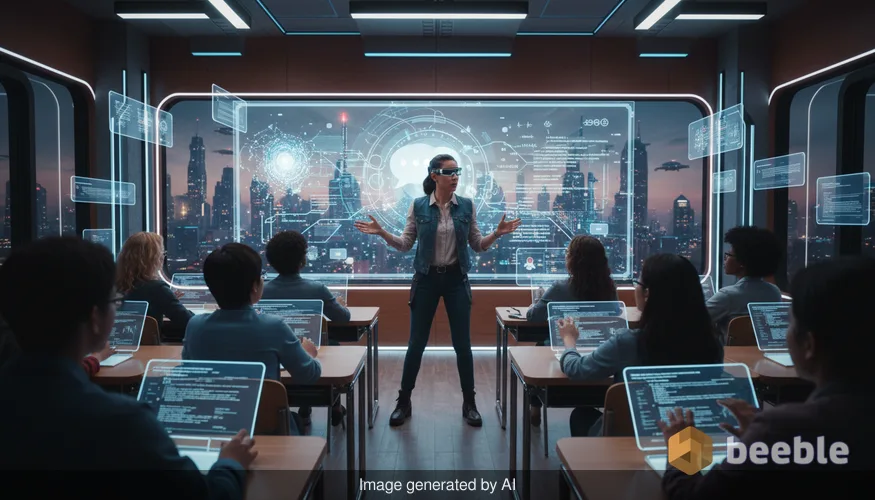
The initial arrival of generative AI in the classroom felt less like a technological milestone and more like a collective panic attack. For decades, the social contract of education was simple: a teacher assigns a prompt, and a student spends hours wrestling with thought and syntax to produce a response. When free, highly capable chatbots began producing fluid, complex prose in seconds, that contract didn’t just bend—it shattered.
By March 2026, the dust has somewhat settled, but the landscape is unrecognizable. We are no longer asking if AI belongs in schools; we are grappling with what it means to be an educator when every pupil carries a PhD-level polymath in their pocket. This journey into the age of AI is not merely about preventing cheating; it is a fundamental reassessment of what we value in human intelligence.
The Death of the 'Take-Home' Essay
For nearly a century, the five-paragraph essay was the bedrock of humanities assessment. Today, it is effectively obsolete as a solo homework assignment. In the early days of the AI boom, schools attempted to use 'AI detectors,' but these proved to be unreliable, often flagging non-native English speakers or students with particularly structured writing styles.
In 2026, the 'product'—the final PDF turned into a portal—has lost its status as the ultimate proof of learning. Educators have shifted their focus toward the 'process.' Assignments now often require students to submit their prompt history, showing how they interrogated an AI, where they corrected its hallucinations, and how they synthesized its output with primary sources. The essay isn't dead, but the idea that it can be written in a vacuum, away from the teacher's eyes, certainly is.
From Information Provider to Learning Architect
If a chatbot can explain the nuances of the Treaty of Versailles or the mechanics of photosynthesis more clearly than a tired teacher at 2:00 PM, what is the teacher’s role? We are seeing a shift from the 'sage on the stage' to the 'architect of experience.'
Teachers are increasingly using AI to differentiate instruction at a scale previously impossible. A single lesson plan can now be instantly adjusted for thirty different reading levels or translated for English Language Learners without adding hours to a teacher's workload. The teacher’s value now lies in mentorship, emotional intelligence, and the ability to spark curiosity—traits that silicon and code have yet to replicate. They are no longer the primary source of facts, but the curators of critical thinking.
The New Assessment Paradigm
How do we measure growth in 2026? The shift has moved toward 'in-person' and 'multimodal' assessments. We are seeing a resurgence of the Socratic method and oral examinations, reminiscent of university vivas. To help visualize this shift, consider how the nature of schoolwork has changed:
| Traditional Task (Pre-AI) | AI-Integrated Task (2026) |
|---|---|
| Write a 1,000-word summary of a novel. | Critique an AI-generated summary for thematic inaccuracies. |
| Solve twenty repetitive calculus problems. | Use AI to model a real-world physics problem and explain the logic. |
| Create a static PowerPoint presentation. | Conduct a live debate against an AI persona representing a historical figure. |
| Memorize dates for a history quiz. | Analyze how different AI models bias the narrative of a historical event. |
The Hallucination Hazard and Critical Literacy
One of the most vital skills taught in the 2026 classroom is 'AI Literacy.' Early fears that AI would make students lazy have been replaced by the realization that AI makes students vulnerable if they are not skeptical. Chatbots still 'hallucinate'—they invent citations, misinterpret data, and confidently assert falsehoods.
Classrooms have become laboratories for fact-checking. Students are taught to treat AI output as a 'first draft' or a 'sophisticated peer' rather than an oracle. This has inadvertently birthed a golden age of critical thinking; students are now required to verify every claim, cross-referencing AI responses with physical archives and verified databases. We are teaching them not just to find answers, but to weigh the reliability of the sources providing those answers.
The Digital Divide 2.0
While the technology is often free, the 'intelligence gap' is widening. There is a significant difference between a student using a basic, ad-supported chatbot and one using a premium, low-latency model integrated with specialized research tools. Furthermore, students with high levels of 'prompt engineering' skills—the ability to communicate effectively with machines—are pulling ahead of those who lack them.
Schools are now the front line in ensuring that AI doesn't become the new gatekeeper of social mobility. The challenge for 2026 is ensuring that 'AI fluency' is taught as a core literacy, as fundamental as reading or basic arithmetic, to prevent a new class of 'AI-underprivileged' citizens.
Practical Takeaways for the Modern Classroom
For educators and parents navigating this transition, the following steps are becoming standard practice:
- Prioritize 'In-Class' Writing: Move high-stakes writing assignments to the classroom where the process can be observed.
- Embrace the 'AI-First' Draft: Allow students to use AI for brainstorming, then require them to track and explain every change they make to that draft.
- Focus on Prompt Engineering: Teach students how to ask better questions. The quality of the AI’s output is a direct reflection of the student’s ability to articulate their needs.
- Oral Defense: Incorporate short, one-on-one check-ins where students must verbally explain the logic behind their submitted work.
- Ethics First: Regularly discuss the environmental cost, data privacy, and inherent biases of the models being used.
The Human Element
Ultimately, the journey into the age of AI has highlighted what is uniquely human. A chatbot can simulate empathy, but it cannot care about a student’s well-being. It can generate a lesson plan, but it cannot sense the shift in energy when a classroom of teenagers finally 'gets' a difficult concept.
We are moving toward a hybrid future where the chatbot handles the cognitive heavy lifting of data retrieval and formatting, leaving the teacher and student free to engage in the much harder, much more rewarding work of human connection and creative synthesis. The panic attack is over; the era of adaptation has begun.
Sources
- UNESCO: Guidance for generative AI in education and research
- International Society for Technology in Education (ISTE): AI standards for educators
- Stanford Graduate School of Education: AI and the Future of Learning report
- Department for Education (UK): Generative AI in education policy paper



See you on the other side.
Our end-to-end encrypted email and cloud storage solution provides the most powerful means of secure data exchange, ensuring the safety and privacy of your data.
/ Create a free account
