


Beyond the Chatbot: Understanding ‘AI Brain Fry’ and the Hidden Cost of Constant Oversight

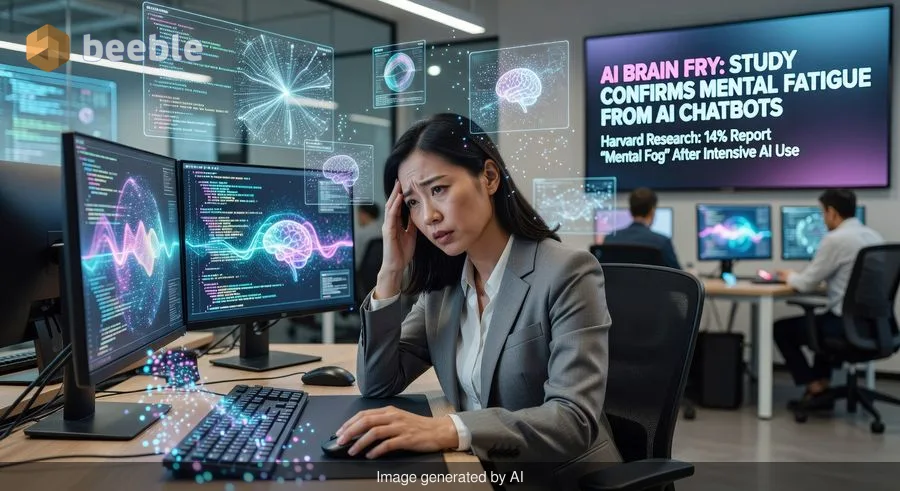
For years, the promise of generative AI was a lighter workload. We were told that large language models and autonomous agents would handle the drudgery, leaving humans to focus on high-level strategy and creative pursuits. However, as 2026 unfolds, a different reality is emerging in the modern office. Instead of feeling liberated, many power users are reporting a distinct, heavy exhaustion that doesn’t quite feel like standard burnout.
Researchers have officially given this phenomenon a name: “AI brain fry.” Grounded in a recent study from Harvard University, the term describes a specific type of cognitive fatigue resulting from intensive, prolonged interaction with AI systems. If you’ve finished a day of prompting and felt like your thoughts were moving through molasses, you aren’t alone.
The Harvard Study: Quantifying the Fog
In a comprehensive survey of over 1,400 full-time employees at large American enterprises, Harvard researchers sought to understand the long-term cognitive effects of the AI-integrated workplace. The results were striking. Approximately 14 percent of respondents reported a recurring “mental fog” directly following intensive sessions with AI chatbots and agents.
This isn't just a case of “Zoom fatigue” rebranded. The symptoms described by participants are visceral: difficulty concentrating on non-AI tasks, significantly slower decision-making, and physical manifestations like tension headaches. The study suggests that as we move from using AI as a novelty to using it as a primary work interface, the mental tax is beginning to compound.
Why AI Interaction is So Taxing
To understand why AI causes this specific brand of exhaustion, we have to look at how our brains process these interactions. Unlike traditional software, where a specific input leads to a predictable output, AI is probabilistic. This creates three distinct cognitive burdens:
1. The Burden of Verification
When you use a calculator, you trust the result. When you use an AI, you must remain in a state of “high-alert skepticism.” Because LLMs can hallucinate or confidently present errors as facts, the human user must constantly fact-check and verify. This persistent vigilance prevents the brain from entering a “flow state,” keeping it instead in a high-stress monitoring mode.
2. The Complexity of Prompt Engineering
Communicating with an AI is an exercise in extreme linguistic precision. To get the best results, users must translate vague human intentions into structured, context-rich prompts. This requires a high level of abstract thinking and semantic density that is far more taxing than chatting with a human colleague who can infer meaning from subtext.
3. The Uncanny Social Loop
Our brains are evolutionarily wired for social interaction. When we engage with a chatbot that mimics human tone, parts of our brain treat it as a social entity. However, because the AI lacks true consciousness, empathy, or shared history, the “social” feedback loop is never actually closed. This creates a cognitive dissonance—a feeling of being socially active while remaining fundamentally isolated.
From Doer to Overseer: The Agentic Shift
As we move into 2026, the workplace is shifting from simple chatbots to “AI agents” that perform multi-step tasks autonomously. Paradoxically, this may be making the brain fry worse.
In the past, an employee might write a report. Now, that employee oversees five AI agents that are each writing different sections of the report. This shifts the human role from “creator” to “editor-in-chief.” While it sounds easier, research in cognitive psychology shows that monitoring multiple automated processes is often more mentally draining than doing a single manual task. The constant context-switching required to jump between different AI outputs prevents deep work and leads to rapid cognitive depletion.
Comparing Workplace Fatigue
To better understand where AI brain fry fits into the spectrum of professional exhaustion, consider the following comparison:
| Feature | Standard Burnout | Digital/Zoom Fatigue | AI Brain Fry |
|---|---|---|---|
| Primary Cause | Long-term stress/overwork | Excessive video calls | Intensive AI oversight/prompting |
| Mental State | Emotional exhaustion | Sensory overload | Cognitive depletion/fog |
| Key Symptom | Cynicism/detachment | Eye strain/social drain | Slower decision-making/headaches |
| Recovery | Extended time off | Screen-free breaks | Task switching to manual work |
How to Combat AI Brain Fry
If you find yourself struggling with mental fog after a day of AI-heavy work, you don't necessarily need to quit the technology. Instead, you need to change how you interface with it. Here are practical steps to protect your cognitive bandwidth:
- Implement the 50/10 Rule: For every 50 minutes of intensive AI interaction (prompting, auditing, or agent management), take 10 minutes of “analog” time. Walk away from the screen, look at a physical object, or engage in a brief face-to-face conversation.
- Batch Your AI Tasks: Avoid sprinkling AI use throughout your entire day. Constant context-switching between human-to-human communication and human-to-AI prompting is a recipe for exhaustion. Set specific blocks for AI-assisted work.
- Prioritize Manual Creativity: Once a day, perform a task without any AI assistance. Whether it’s sketching an idea on paper or drafting an email from scratch, engaging your brain’s creative muscles without the “crutch” of AI helps maintain cognitive agility.
- The “Verification Buffer”: Don't fact-check AI outputs in real-time. Collect the AI’s work, then take a break before returning to verify it with a fresh, rested mind. This separates the “creative” prompting phase from the “analytical” auditing phase.
The Path Forward
AI is a tool, not a replacement for the human mind. The emergence of “AI brain fry” is a vital reminder that our cognitive resources are finite. As these systems become more integrated into our professional lives, the most valuable skill won't just be knowing how to talk to the machine—it will be knowing when to turn it off.
Protecting your mental clarity is no longer just about work-life balance; it’s about maintaining the very cognitive edge that makes you more valuable than the algorithms you’re managing.
Sources
- Harvard Business Review: The Cognitive Cost of Generative AI
- Journal of Applied Psychology: Human-AI Interaction and Mental Fatigue
- Stanford Human-Centered AI (HAI) Research Reports 2025-2026
- MIT Sloan Management Review: Managing the AI-Human Loop



See you on the other side.
Our end-to-end encrypted email and cloud storage solution provides the most powerful means of secure data exchange, ensuring the safety and privacy of your data.
/ Create a free account
