


Beyond the Curb: Why Amazon Just Put Four Legs on Your Next Package

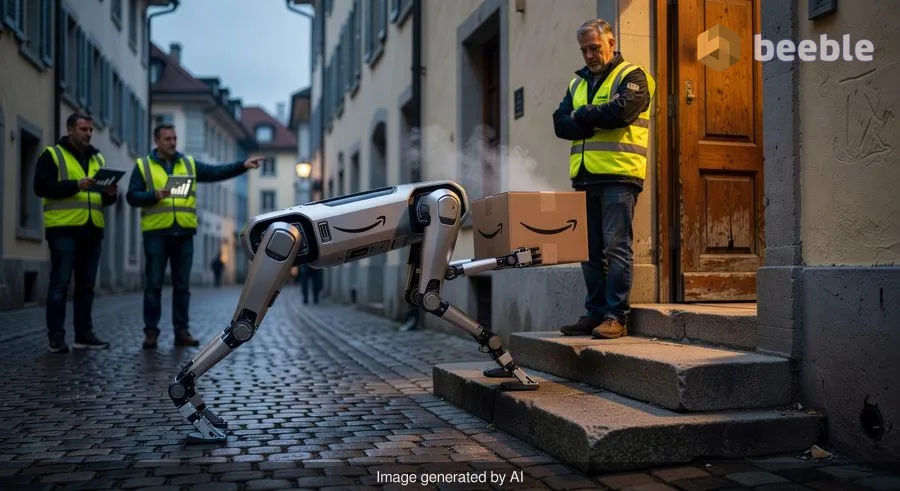
The Final Fifty Feet
Have you ever watched a delivery driver struggle to navigate a steep driveway, a set of crumbling concrete stairs, or a porch guarded by a precariously placed collection of potted plants? While Amazon has mastered the art of moving millions of items across oceans and continents, the final fifty feet—from the van to your doorstep—remains the most expensive and logistically complex segment of the journey.
In a move that signals a transformative shift in its logistics ecosystem, Amazon has officially acquired the Swiss robotics startup Rivr. This isn’t just another addition to a corporate portfolio; it is a calculated bet on four-legged machines designed to conquer the unpredictable terrain of the suburban landscape. By integrating Rivr’s quadrupedal technology, Amazon aims to assist delivery associates in the physically demanding task of carrying packages directly to the door.
Why Legs Trump Wheels
For years, the tech industry’s vision of autonomous delivery involved cute, cooler-shaped robots rolling along sidewalks. Nevertheless, wheels have a fundamental flaw: they are allergic to curbs and stairs. Curiously, nature solved this problem millions of years ago with limbs. Rivr’s machines are built to mimic this biological efficiency, allowing them to navigate uneven terrain that would leave a wheeled robot spinning its gears.
To put it another way, if the delivery network is a living organism, these robots are the specialized cells designed to navigate the intricate capillaries of residential neighborhoods. During my time working with tech startups in Zurich, I often saw early prototypes of similar Swiss-engineered machines. The precision is remarkable; they don’t just walk, they calculate every footfall with a nuanced understanding of friction and balance. This acquisition suggests that Amazon is tired of waiting for the world to become more wheelchair-accessible and has decided to build robots that can handle the world as it is.
A Precarious Balance: Automation vs. Human Labor
This news comes at a delicate time for the retail giant. Earlier this year, Amazon laid off 16,000 white-collar employees, followed by a reduction of 100 roles within its own robotics division. These moves might seem contradictory to an acquisition, but they reflect a broader corporate transition. CEO Andy Jassy has been vocal about weaving artificial intelligence and automation into “virtually every corner of the company.”
In contrast to the traditional fear that robots are coming to replace humans entirely, Amazon frames the Rivr acquisition as a collaborative effort. The goal is to have these machines act as mechanical mules, offloading the heavy lifting from delivery associates. This allows the human worker to focus on the more complex aspects of the route, such as navigating gated communities or interacting with customers. However, the optics of cutting staff while investing in high-end robotics remain a point of contention for many industry observers.
The Swiss Engineering Edge
Why Rivr? Switzerland has quietly become the Silicon Valley of robotics, particularly in the field of legged locomotion. The engineering culture there treats hardware like a fine timepiece—every joint and sensor is part of a deeply integrated system. Rivr’s technology stands out because of its ability to operate in inclement weather, a must-have for any global delivery service.
| Feature | Rivr Quadruped | Standard Wheeled Bot |
|---|---|---|
| Stair Navigation | Fully Capable | Limited/Impossible |
| Payload Stability | High (Active Balancing) | Moderate |
| Terrain Versatility | Mud, Snow, Gravel | Paved Surfaces Only |
| Human Interaction | Side-by-side Assistance | Independent/Remote |
As a result of this acquisition, we can expect to see a more robust integration of computer vision and tactile sensing in Amazon’s fleet. These robots aren't just following a GPS line; they are “seeing” the porch and deciding where to safely place a package to avoid theft or weather damage.
The Ecosystem Metaphor
Think of Amazon’s logistics network not as a rigid assembly line, but as an evolving ecosystem. In this environment, the Rivr robots are an invasive species that has been introduced to fill a specific niche. They represent the building blocks of a future where the friction of physical distance is almost entirely removed.
Managing remote teams in the tech space has taught me that the most successful tools are those that disappear into the background of our lives. We don’t think about the intricate protocols that make a Zoom call possible; we just talk. Similarly, Amazon’s goal is for the delivery robot to become so commonplace that we stop peering out the window in curiosity when a four-legged machine trots up our driveway.
What This Means for the Future
For the average consumer, the immediate impact will be subtle. You might notice your packages being handled with a bit more mechanical precision, or perhaps you’ll see these quadrupeds being tested in select urban hubs. For the industry, however, the message is clear: the “last mile” is no longer the final frontier—it’s the next battlefield for AI integration.
Key Takeaways for Tech Observers:
- Watch the Integration: Look for how Rivr’s tech is merged with Amazon’s existing "Proteus" warehouse robots.
- Regulatory Hurdles: Keep an eye on local ordinances regarding autonomous machines on public sidewalks.
- Labor Shifts: Observe whether this tech actually reduces physical strain for drivers or simply increases the expected pace of delivery.
As we move toward a more automated world, the question remains: how will we balance the efficiency of the machine with the necessity of the human touch?
Sources
- Amazon Corporate Newsroom (Official Statement on Rivr Acquisition)
- Annual Shareholder Letter by CEO Andy Jassy (2025-2026)
- Swiss Federal Institute of Technology (ETH Zurich) Robotics Research Archives
- Industry Report: The State of Last-Mile Delivery Automation 2026



See you on the other side.
Our end-to-end encrypted email and cloud storage solution provides the most powerful means of secure data exchange, ensuring the safety and privacy of your data.
/ Create a free account
