


Beyond the Digital Dark Age: How 5D Glass Storage Could Preserve Humanity Forever

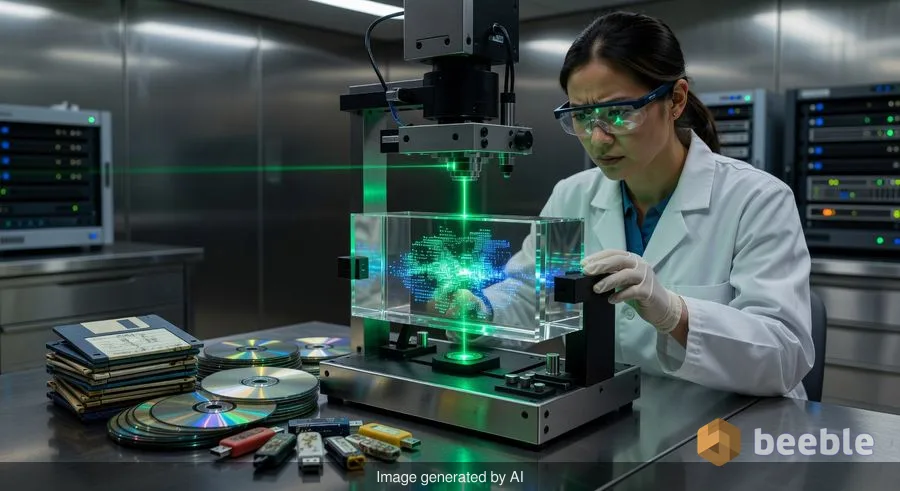
In the basement of the University of Southampton, a small disc of quartz glass sits under a microscope. It is no larger than a coin, yet it holds the potential to outlast the very planet it was created on. While our current digital world relies on hard drives that fail within a decade and magnetic tapes that degrade in thirty years, scientists have perfected a method of '5D' optical data storage that can remain stable for billions of years.
This technology represents a pivotal shift in how we view information. We are currently living in what historians call the 'Digital Dark Age'—a period where the sheer volume of data we produce is matched only by the fragility of the mediums we use to store it. From the loss of early internet forums to the degradation of family photos stored on cheap DVDs, our collective memory is fading. Laser-etched glass offers a permanent solution.
The Science of Five Dimensions
To understand how glass can store 360 terabytes of data, we have to look past the three dimensions of physical space. Standard optical discs, like CDs or Blu-rays, store data on the surface. If the surface is scratched, the data is lost. 5D storage, however, uses a femtosecond laser to create nanostructures within the bulk of the silica glass.
These structures are defined by five distinct variables: the three-dimensional position within the glass (X, Y, and Z) plus two additional optical dimensions—the size and the orientation of the nanostructure. When light passes through the glass, these nanostructures change the polarization of the light. A specialized reader decodes these changes back into binary data.
Think of it like a traditional book where the information isn't just in the words, but also in the thickness of the paper and the angle at which the ink is dried. This density allows for staggering amounts of information to be packed into a space the size of a postage stamp.
Built to Outlast Civilizations
What truly sets 5D memory crystals apart is their sheer resilience. Most storage media are susceptible to heat, moisture, and magnetic fields. A hard drive is a mechanical delicate, and an SSD relies on electrical charges that eventually leak away. Silica glass, by contrast, is one of the most chemically and thermally stable materials on Earth.
Testing has shown that these glass discs can withstand temperatures of up to 1,000°C without data loss. At room temperature, the data is estimated to remain readable for 13.8 billion years—roughly the current age of the universe. This makes the technology the ultimate 'time capsule' for human knowledge.
Comparing the Generations of Storage
To see where 5D glass fits into the current landscape, we must compare it against the industry standards for archival and consumer use.
| Feature | Hard Disk Drive (HDD) | LTO Magnetic Tape | 5D Glass Storage |
|---|---|---|---|
| Lifespan | 3–5 Years | 15–30 Years | 10+ Billion Years |
| Capacity | Up to 24TB | Up to 18TB (Native) | 360TB (Theoretical) |
| Durability | Low (Mechanical) | Moderate (Sensitive) | Extreme (Heat/EMP) |
| Energy Cost | High (Spinning) | Low (Cold Storage) | Zero (Passive) |
| Write Speed | Fast | Moderate | Very Slow |
From Research Lab to Project Silica
While the University of Southampton pioneered the 'memory crystal' concept, tech giants like Microsoft have taken the baton with 'Project Silica.' Microsoft’s goal is to rethink the cloud from the ground up. In current data centers, 'cold' data—information that is rarely accessed but must be kept—requires massive amounts of electricity for cooling and constant 'scrubbing' to ensure the drives haven't failed.
By moving archival data to glass, companies could eliminate the need for energy-intensive climate control. Once the data is written into the glass, it requires zero power to maintain. It can sit on a shelf in a standard warehouse for centuries, waiting for a laser to read it back.
The Practical Hurdles: Why It’s Not in Your Laptop Yet
Despite its promise, you won't be replacing your thumb drive with a glass crystal this year. The technology currently faces two major hurdles: cost and write speed. Writing data with femtosecond lasers is a slow, painstaking process that requires expensive, high-precision laboratory equipment. While reading the data is relatively simple using a microscope and a polarizer, writing it remains a bottleneck.
Furthermore, 5D glass is a 'Write Once, Read Many' (WORM) medium. You cannot erase and rewrite a section of the glass once the nanostructures are formed. This makes it perfect for the Human Genome, the Magna Carta, or your permanent medical records, but useless for a working operating system or a temporary download folder.
What This Means for the Future
As we move further into the 21st century, the preservation of our digital heritage becomes a matter of cultural survival. We are currently at risk of leaving behind less physical evidence of our existence than the ancient Egyptians did with their stone carvings. 5D glass storage changes that equation.
For organizations and individuals looking toward the future, here is what to watch for:
- Institutional Adoption: Expect national libraries and museums to be the first to adopt glass storage for 'golden copies' of historical records.
- The End of Migration: Currently, IT departments must migrate data to new tapes every decade. Glass storage promises an 'archive and forget' workflow.
- Space Exploration: Because glass is resistant to the intense radiation of space, it is the ideal medium for sending the sum of human knowledge on long-duration interstellar missions.
We are finally moving away from the era of 'temporary' tech. For the first time in history, we have a way to ensure that the stories, discoveries, and data of today will be available to whoever—or whatever—inhabits the Earth millions of years from now.
Sources
- University of Southampton: Optoelectronics Research Centre (ORC) official reports.
- Microsoft Research: Project Silica development logs.
- International Journal of Applied Glass Science: Studies on thermal stability of nanostructured silica.



See you on the other side.
Our end-to-end encrypted email and cloud storage solution provides the most powerful means of secure data exchange, ensuring the safety and privacy of your data.
/ Create a free account
