


Beyond the Ghost: Why the ‘Dead Internet’ Theory is Rebranding as Web 4.0

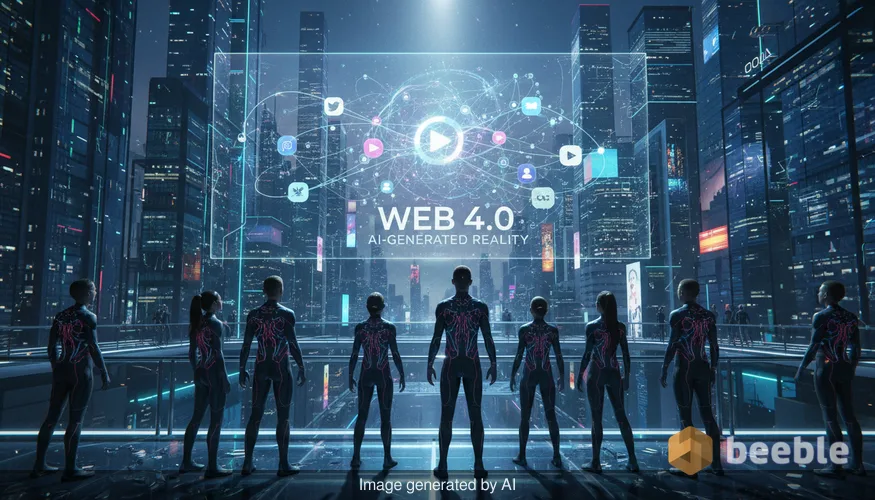
For years, the ‘dead internet’ theory lived in the dark corners of message boards and fringe forums. It was a classic creepypasta: the idea that the vibrant, human-centric internet we once knew died somewhere around 2016, replaced by a hollow shell of bot-generated content, algorithmic loops, and artificial engagement.
In 2026, we no longer call it a conspiracy. We call it Web 4.0.
As we navigate a digital landscape where the line between human creativity and synthetic output has effectively vanished, the industry is shifting its perspective. What was once viewed as a haunting decay of digital culture is now being framed as the next logical step in technological evolution. But as the internet becomes more ‘autonomous’ than ‘social,’ we have to ask: what is left for the humans?
The Evolution of the Ghost in the Machine
The original dead internet theory suggested that the majority of web traffic and content was being produced by AI to manipulate public opinion and consumer behavior. While the 2016 timeline was likely an exaggeration, the underlying mechanics have become undeniably true.
Data from early 2024 already showed signs of this inflection point. Reports from cybersecurity firm CHEQ indicated that during peak periods, nearly 76% of traffic on platforms like X (formerly Twitter) was driven by bot networks and AI agents. Other platforms saw similar trends, with non-human traffic consistently hovering between 30% and 40%.
By 2026, these numbers have only climbed. We have moved past simple spam bots into the era of ‘Agentic AI’—sophisticated programs that don’t just post text, but manage entire digital personas, engage in complex debates, and curate aesthetic feeds that are indistinguishable from human influencers.
Defining Web 4.0: The Symbiotic Web
To understand the rebrand, we need to look at the progression of the internet’s architecture. If Web 2.0 was the era of social connection and Web 3.0 was the push for decentralization, Web 4.0 is the era of autonomous intelligence.
| Era | Primary Characteristic | Key Interaction |
|---|---|---|
| Web 1.0 | Static / Read-Only | Directories and personal homepages |
| Web 2.0 | Social / Read-Write | User-generated content and platforms |
| Web 3.0 | Decentralized / Read-Write-Own | Blockchain, DAOs, and digital assets |
| Web 4.0 | Autonomous / Read-Write-Execute | AI agents, synthetic media, and bot-to-bot commerce |
In Web 4.0, the internet is no longer a library or a town square; it is an ecosystem of agents. Your personal AI assistant talks to a brand’s AI representative to negotiate a purchase, while a third AI generates a custom video review to help ‘you’ (or your agent) make a decision. The ‘dead’ part of the theory refers to the absence of direct human-to-human contact, but the ‘Web 4.0’ rebrand views this as a peak efficiency milestone.
The Rise of the Synthetic Social
The most visible shift is occurring in our social feeds. We are entering the age of the ‘Synthetic Social.’ Previously, algorithms merely curated what humans made. Today, the algorithm is the creator.
This creates a feedback loop that theorists call ‘Model Collapse.’ When AI begins to train on content generated by other AI, the digital environment can become repetitive and uncanny. However, for many users, the convenience of perfectly tailored, AI-generated entertainment outweighs the desire for authentic human connection. The internet hasn't died; it has simply transitioned into a personalized simulation where the ‘other people’ on your screen are increasingly just sophisticated lines of code designed to keep you engaged.
The Economic Reality of a Bot-First Web
Why is this happening? The answer, as always, is incentives. In a digital economy built on attention, AI is the ultimate scale hack.
For advertisers, bot traffic used to be a nuisance—a form of fraud. In the Web 4.0 era, the definition of a ‘consumer’ is changing. If an AI agent has the authority to spend a user’s budget on a subscription or a product, then marketing to that bot becomes a legitimate business strategy. This ‘Bot-to-Bot’ (B2B) commerce is a cornerstone of the new economy, rendering the old metrics of ‘clicks’ and ‘views’ by humans secondary to ‘conversions’ by agents.
Finding the Human in the Machine: A Survival Guide
As Web 4.0 becomes the standard, navigating the internet requires a new set of skills. The ‘dead’ internet is only a problem if you are looking for life in the wrong places. Here is how to maintain a human-centric digital experience:
- Prioritize Proof of Personhood: Look for platforms that utilize biometric verification or ‘human-only’ protocols. The value of a verified human identity is becoming the most precious commodity online.
- Seek Out ‘Analog’ Digital Spaces: Small, gated communities, private Discords, and subscription-based newsletters are becoming the new ‘underground’ where human conversation still thrives away from the reach of scraping bots.
- Audit Your Agents: Be aware of how much of your digital life you have outsourced. If your AI is doing all your talking, you aren't participating in the web; you’re just a spectator to your own data.
- Verify with Multi-Modal Sources: When consuming news, don’t rely on a single feed. AI can hallucinate or be programmed to create ‘consensus’ where none exists. Cross-reference digital information with physical-world reporting whenever possible.
The Path Forward
The ‘dead internet’ theory was a warning about the loss of the human soul in digital spaces. Web 4.0 is the corporate and technical acceptance of that reality. We are moving toward an internet that is faster, smarter, and more efficient than ever before, but it is also an internet that no longer needs us to function.
Whether this is a technological utopia or a digital graveyard depends entirely on how we choose to interact with the agents we’ve created. The internet isn't dead—it’s just no longer just for humans.
Sources
- CHEQ: The State of Fake Traffic 2024
- World Wide Web Foundation: The Evolution of the Web
- Gartner: Top Strategic Technology Trends for 2025 and 2026
- Journal of Cyber Policy: The Impact of Generative AI on Social Media Ecosystems



See you on the other side.
Our end-to-end encrypted email and cloud storage solution provides the most powerful means of secure data exchange, ensuring the safety and privacy of your data.
/ Create a free account
