


Beyond the Performance: What China’s Martial Arts Humanoids Reveal About the Future of Robotics

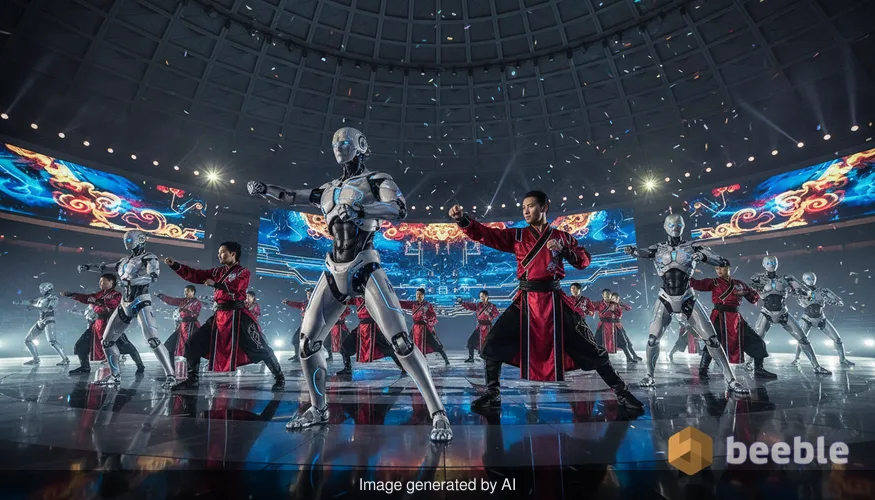
The visual was as striking as it was surreal. During the recent high-profile gala celebrations in Beijing, dozens of humanoid robots moved in perfect synchronicity with human martial artists. They didn’t just shuffle or wave; they performed complex Tai Chi sequences, balanced on one leg, and executed fluid transitions that, until recently, were considered the exclusive domain of biological joints and muscles.
For the casual viewer, it was a feat of entertainment. For the global tech community, it was a loud declaration of intent. As we move into early 2026, the question has shifted from "Can China build a humanoid?" to "How should the rest of the world respond to their scale and speed?"
The Engineering Behind the Dance
To understand why a dancing robot is a technical milestone, we have to look past the choreography. Performing martial arts requires what roboticists call "dynamic stability." Unlike a vacuuming robot that stays on a flat plane, a humanoid performing Tai Chi must constantly calculate its center of mass while managing high-torque movements in its "knees" and "ankles."
Most of the robots seen in recent Chinese demonstrations, such as the latest iterations from Unitree and Fourier Intelligence, have moved away from the clunky, hydraulic systems of the past. Instead, they utilize high-density electric actuators. These motors allow for the "explosive" force needed for a jump or a kick, while maintaining the precision required to mimic the soft movements of a human hand.
When a robot performs a martial arts routine, it is essentially a stress test for latency. The onboard sensors must process balance data thousands of times per second to ensure the machine doesn't topple. If a robot can handle the unpredictable shifts of a dance floor, it can likely handle the uneven terrain of a construction site or the busy aisles of a logistics warehouse.
From the Stage to the Factory Floor
While the gala performances capture headlines, the real work is happening in the industrial hubs of Shenzhen and Hangzhou. China has designated humanoid robots as a "future industry" of strategic importance, similar to electric vehicles (EVs).
We are currently seeing a transition from "showbots" to "workbots." Companies like UBTECH are already trialing their Walker S series on automotive assembly lines, working alongside human staff to inspect tires or test locks. The goal is not just to make a robot that looks like a person, but one that can use the same tools and navigate the same spaces designed for humans. This eliminates the need to redesign entire factories to accommodate traditional, stationary automation.
The Cost Disruption: The $16,000 Humanoid
Perhaps the most significant reason for international competitors to be "worried" isn't the technology itself, but the price point. In late 2024 and throughout 2025, Chinese manufacturers began announcing humanoid models with price tags ranging from $16,000 to $40,000.
To put this in perspective, many high-end industrial robot arms—which can’t walk or interact with their environment—cost significantly more. By leveraging the same supply chains that made China a leader in smartphones and EVs, these firms are commoditizing complex robotics.
| Feature | Typical Western Research Humanoid | Emerging Chinese Mass-Market Humanoid |
|---|---|---|
| Estimated Cost | $100,000 - $250,000+ | $16,000 - $50,000 |
| Primary Goal | R&D / General Intelligence | Rapid Deployment / Industrial Tasks |
| Actuation | Custom/High-End Hydraulics or Electric | Mass-Produced Electric Actuators |
| Software | Proprietary / Closed Ecosystems | Often Compatible with Open-Source (ROS2) |
Should We Be Worried? The Dual-Use Dilemma
When the public asks if they should be "worried," the concern usually splits into two categories: economic and security.
On the economic front, the worry is labor displacement. However, China’s push into robotics is largely driven by its own demographic crisis—a shrinking working-age population. The "worry" for the West is less about losing jobs to Chinese robots and more about losing the market for robotics. If China becomes the "factory of the world" for the robots that will power the next industrial revolution, they will set the standards for the next century of hardware.
On the security front, the "dual-use" nature of these machines is undeniable. A robot that can perform martial arts has the balance and dexterity required for reconnaissance or carrying payloads in difficult terrain. While we are far from "Terminator" scenarios, the integration of AI-driven vision and autonomous navigation into agile hardware does raise valid questions about export controls and international safety standards.
The Role of AI: The Robot's Brain
The physical grace of these robots is now being paired with "Large Behavior Models." Much like ChatGPT was trained on the internet's text, these robots are being trained in massive simulations on how to move. This allows them to learn from millions of virtual falls before they ever take a step on a real stage.
This "embodied AI" means the robots are becoming more adaptable. They are moving away from pre-programmed scripts (like the gala dances) and toward real-time problem-solving. If you push a 2026-era humanoid, it doesn't just follow a recovery script; it calculates the best way to catch itself based on its current environment.
Practical Takeaways: Navigating the Humanoid Era
Whether you are a business leader or a tech enthusiast, the rapid rise of these machines suggests a few clear steps for the near future:
- Watch the Supply Chain: The real story isn't the robot; it's the components. Keep an eye on the manufacturers of sensors (LiDAR) and specialized motors (harmonic drives). These are the building blocks of the industry.
- Focus on Software Integration: Hardware is becoming a commodity. The value is shifting to the software layers that allow these robots to understand commands and perform tasks safely around humans.
- Evaluate Task Suitability: If your business involves repetitive, physically demanding tasks in spaces designed for humans, humanoid pilots are no longer science fiction. 2026 is the year to begin small-scale testing of "General Purpose" robots rather than single-use machines.
- Stay Informed on Regulation: As these robots enter the public sphere, expect a wave of new safety and privacy regulations regarding how they collect data and interact with bystanders.
Final Thoughts
China’s dancing robots are a spectacle, yes, but they are also a symptom of a massive, well-funded leap in engineering. We shouldn't necessarily be "worried" in a fearful sense, but we should be intensely focused. The gala performance was a curtain-raiser for an era where the line between the digital and physical worlds finally disappears. The robots are no longer just coming; they’ve learned to dance, and soon, they’ll be ready to work.
Sources:
- Unitree Robotics Official - G1 Humanoid Progress
- International Federation of Robotics - World Robotics Report 2025
- MIT Technology Review - China's Humanoid Ambitions
- IEEE Spectrum - The Mechanics of Humanoid Balance



See you on the other side.
Our end-to-end encrypted email and cloud storage solution provides the most powerful means of secure data exchange, ensuring the safety and privacy of your data.
/ Create a free account
