


Beyond the Single Brain: Why Microsoft’s Multi-Model AI Shift Actually Matters for Your Workday

Ever wonder why your AI assistant occasionally insists on facts that feel just a little off, or why it seems to hit a creative wall just when you need it to be most insightful? For the last few years, we have been living in the era of the monolithic model—a world where you picked a side, whether it was OpenAI’s GPT, Google’s Gemini, or Anthropic’s Claude, and lived with that specific model’s quirks and biases.
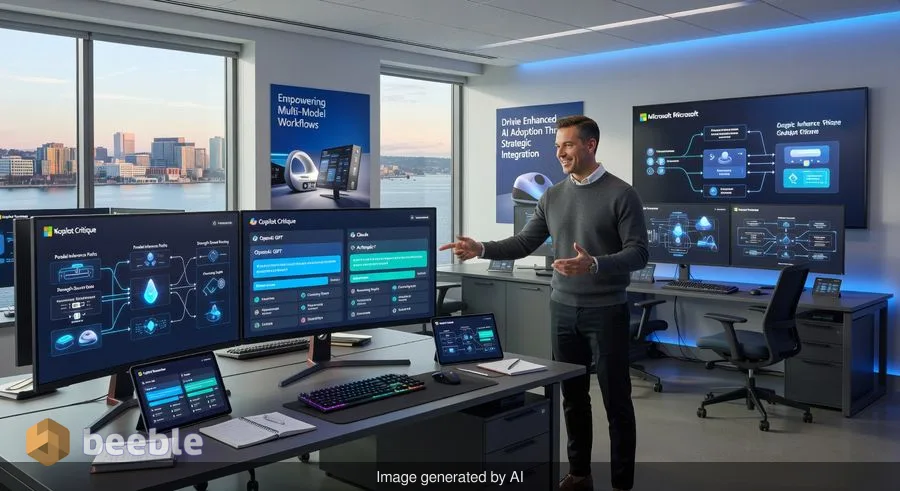
On Monday, Microsoft signaled a foundational shift in this dynamic. By unveiling new features in its Copilot research assistant, the tech giant is moving away from the idea of a single AI "brain." Instead, it is rolling out a multi-model workflow that allows different AI systems to work in tandem. The most disruptive element of this update is a feature called "Critique," which enables Copilot’s Researcher agent to cross-reference outputs from both OpenAI’s GPT and Anthropic’s Claude simultaneously.
The End of the Monolithic Assistant
To put it another way, we are moving from a world of solo performers to a digital orchestra. Historically, using an AI tool felt like hiring a single, very fast, but occasionally overconfident intern. You could get great results, but you always had to be the one to double-check the work.
Under the hood, the new "Critique" feature changes the internal logic of how an answer is generated. Instead of simply asking GPT-4 or GPT-5 to summarize a topic, Copilot now asks one model to generate a draft and another to find the holes in it. This systemic approach to verification is designed to reduce hallucinations—those moments where AI confidently invents a legal precedent or a historical date that never existed.
For the average user, this means the "trust but verify" stage of using AI is increasingly being handled by the software itself. It is a streamlined way to ensure that the information you are putting into a report or a presentation has been vetted by more than one set of digital eyes.
Comparing the Workflow: Single vs. Multi-Model
| Feature | Traditional AI Workflow | Microsoft's Multi-Model "Critique" |
|---|---|---|
| Source Logic | Single model (e.g., GPT-4o only) | Cross-model (GPT + Claude) |
| Verification | User-dependent | Automated cross-examination |
| Response Quality | High, but prone to specific model bias | Balanced and more resilient |
| Speed | Faster (single pass) | Slightly slower (multi-pass verification) |
| Reliability | Variable | Robust and foundational |
Copilot Cowork: From Tool to Teammate
Alongside the Researcher upgrades, Microsoft has begun rolling out "Copilot Cowork" to early-access customers. While the name sounds like corporate jargon, the practical application is quite tangible. Essentially, Cowork is designed to move AI from a sidebar chat box into the center of a collaborative workspace.
Imagine a digital Swiss Army knife that doesn't just sit in your pocket but actually helps you hold the wood while you saw it. Cowork is intended to track long-term projects, remember context across different meetings, and proactively suggest next steps based on the collective input of a human team. Looking at the big picture, this is Microsoft’s attempt to solve the "attention economy" problem—the constant context-switching that drains our productivity. By having an AI that understands the overarching goals of a team, the hope is to reduce the administrative overhead that plagues modern office life.
Why Microsoft is Inviting the Competition to the Party
On the market side, there is a curious strategic move happening here. Microsoft has invested billions into OpenAI, yet they are now highlighting Anthropic’s Claude as a core part of their "Critique" feature. Why would they give a platform to their primary competitor's model?
From a consumer standpoint, this is a win for transparency and quality. Microsoft is acknowledging that no single model is perfect. By becoming a platform that orchestrates multiple models, Microsoft makes its ecosystem more resilient. They are no longer just selling you OpenAI's tech; they are selling you the best possible output, regardless of which lab's math produced it. This is a scalable strategy that positions Microsoft as the essential layer between complex AI research and the practical needs of a business.
The Human Impact: A Tireless Intern with a Supervisor
Practically speaking, we should view these upgrades through the lens of the "tireless intern" metaphor. If the first generation of AI was an intern who worked at lightning speed but sometimes made things up to please the boss, this new version is that same intern working alongside a skeptical editor.
In everyday life, this reduces the cognitive load on the human user. When you ask Copilot to analyze a volatile market trend or a complex supply chain disruption, you aren't just getting a one-sided perspective. You are getting a synthesized view that has already survived a digital debate. This doesn't mean we should stop being critical thinkers, but it does mean the baseline of the information we receive is becoming significantly more reliable.
What This Means for You
As these tools move from early access to general availability, here is how you should shift your perspective:
- Expect Accuracy, Not Just Speed: Stop judging AI solely on how fast it generates text. Start looking for the "Critique" or "Source Verification" markers. The value is now in the correctness, not the velocity.
- Rethink Your Workflow: With Copilot Cowork, the AI can handle the "connective tissue" of a project—scheduling, follow-ups, and context-keeping. This frees you up to focus on the intuitive, creative decisions that models still struggle with.
- Observe the Model Mix: Pay attention to which models are being used for which tasks. You might find that for creative writing, the Claude-influenced outputs feel more natural, while for data-heavy tasks, the GPT-driven logic remains the backbone.
Ultimately, Microsoft’s latest move is a reality check for the AI industry. It’s an admission that the path to truly useful artificial intelligence isn't found in building one "god-like" model, but in creating a transparent, interconnected system where different models check and balance one another. For the rest of us, it means our digital tools are finally starting to grow up.
Sources:
- Microsoft Official News: Copilot Research and AI Innovations (March 2026)
- Industry Analysis: The Shift to Multi-Model Orchestration in Enterprise Software
- Tech Media Reports: Early Access Feedback on Copilot Cowork and Researcher Critique



See you on the other side.
Our end-to-end encrypted email and cloud storage solution provides the most powerful means of secure data exchange, ensuring the safety and privacy of your data.
/ Create a free account
