


Beyond the Wrapper: Why Google and Accel’s Latest India Cohort Signals a New Era for AI Startups

In the early days of the generative AI boom, the barrier to entry for founders seemed deceptively low. With a sleek user interface and an API key from OpenAI or Google, an entrepreneur could launch a 'revolutionary' product in a weekend. These products, colloquially known as 'AI wrappers,' dominated the market for a time, offering simplified access to large language models (LLMs) for specific tasks like copywriting or basic image generation.
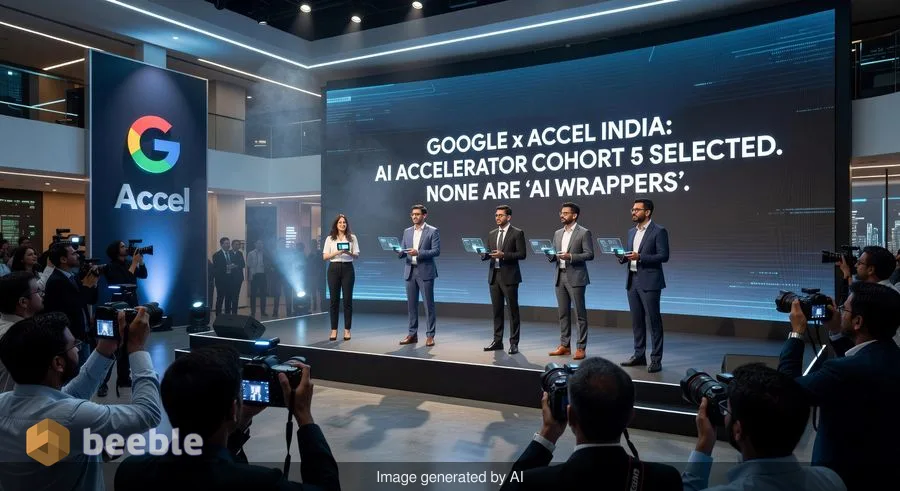
However, as the industry matures in 2026, the tide has officially turned. The recent conclusion of the joint AI accelerator program run by Google and venture capital firm Accel in India has sent a clear message to the ecosystem: the era of the thin wrapper is over. Out of more than 4,000 applications, only five startups were selected for the cohort. Notably, not one of them is a wrapper.
The Problem with Being 'Thin'
To understand why investors are cooling on wrapper startups, one must look at the concept of 'defensibility.' In venture capital terms, a moat is what protects a business from being easily disrupted by competitors or the platform it relies upon.
Wrappers suffer from extreme platform risk. When a startup builds a feature that is essentially just a specialized prompt for an LLM, they are at the mercy of the model provider. If Google or OpenAI releases an update that incorporates that specific functionality directly into the base model—often referred to as 'being Sherlocked'—the startup’s value proposition evaporates overnight.
Investors have grown weary of funding companies that could be rendered obsolete by a single Monday morning software update from Silicon Valley. The Google-Accel selection process highlights a shift toward 'Vertical AI'—startups that own their data, fine-tune their own models, or solve complex, industry-specific problems that general-purpose LLMs cannot touch.
The 4,000-to-5 Filter
The sheer volume of applications for the Google-Accel accelerator—over 4,000—underscores the intensity of the AI gold rush in India. Yet, the fact that only 0.125% of applicants made the cut suggests a rigorous vetting process that prioritized depth over hype.
According to program mentors, the vast majority of the 4,000 applications fell into the wrapper category. These were often 'GPT for X' or 'Midjourney for Y' ideas that lacked a proprietary data advantage or a unique technical breakthrough. By passing over these thousands of entries, Google and Accel are signaling that they are looking for 'sovereign' innovation—technology that can stand on its own feet even as the underlying base models evolve.
Meet the New Guard: Depth Over Surface
The five startups selected for the cohort represent a cross-section of what 'Deep AI' looks like in the current landscape. Rather than just using AI, these companies are integrating it into complex workflows or specialized domains where general models struggle.
For example, the cohort includes companies focusing on areas like agriculture-specific LLMs (Dhenu), which require deep domain expertise and localized data that a general model lacks. Others, like AuraML, focus on synthetic data for retail, solving the 'cold start' problem for brands needing high-quality visual content without expensive photoshoots.
These startups share a common thread: they use AI as a component of a larger, more complex solution rather than the solution itself. They are building systems of record, not just interfaces.
The Indian Context: A Testing Ground for Real-World AI
India has emerged as a unique laboratory for AI because of its scale and the complexity of its data environments. Unlike the Western market, where AI is often used for productivity gains in white-collar environments, the Indian startups selected by Google and Accel are tackling 'messy' real-world problems.
Whether it is optimizing supply chains in fragmented markets or providing design automation that understands local cultural nuances, these startups are building moats through data gravity. Once a startup integrates deeply into a company’s supply chain or design workflow, it becomes much harder to replace than a simple chat interface.
Practical Takeaways for AI Founders
For founders looking to navigate this new landscape, the Google-Accel cohort provides a roadmap for what 'investable' AI looks like today. If you are building in the AI space, consider these strategic shifts:
- Move from Horizontal to Vertical: Don't try to be everything to everyone. Solve a deep, specific problem for a single industry (e.g., legal, healthcare, or manufacturing).
- Own the Data Loop: A wrapper uses public data. A defensible startup creates a feedback loop where user interactions improve a proprietary model that no one else can replicate.
- Focus on Workflow Integration: The goal should be to become the 'operating system' for a specific task. If your tool is just a tab in a browser, it’s a feature. If it’s where the work actually happens, it’s a business.
- Anticipate the 'Base Model' Growth: Always ask: 'If GPT-5 or Gemini 2.0 is 10x better at reasoning, does my product become more valuable or more useless?' If the answer is 'useless,' you are building a wrapper.
Conclusion: The Maturity of the Market
The exclusion of wrappers from the latest Google-Accel cohort isn't a sign that the AI bubble is bursting; rather, it's a sign that the market is maturing. We are moving past the 'toy' phase of generative AI and into the 'tool' phase. For the startups that survived the 4,000-applicant cull, the reward is more than just funding—it is a validation that they are building the infrastructure of the future, not just a thin layer on top of someone else's foundation.
Sources:
- Accel India Official Blog
- Google for Startups Accelerator: India
- TechCrunch: The Rise of Vertical AI
- Economic Times: Google-Accel AI Startup Selection



See you on the other side.
Our end-to-end encrypted email and cloud storage solution provides the most powerful means of secure data exchange, ensuring the safety and privacy of your data.
/ Create a free account
