


Big tech is ready to split the check with China's most controversial AI startup

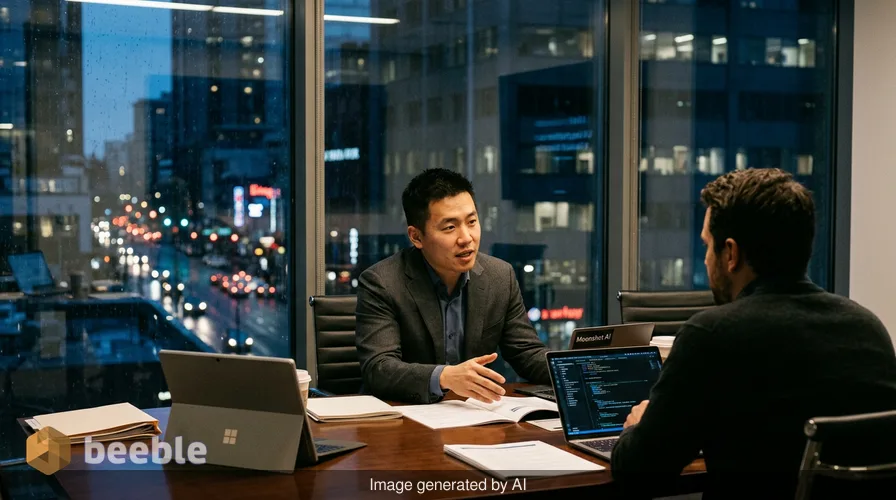
While Washington builds walls to keep Chinese technology out, the world's biggest cloud companies are building bridges to bring it in. The popular narrative suggests a clean break between the American and Chinese artificial intelligence sectors. The reality is far messier and driven by the cold logic of the balance sheet. Moonshot AI, a Beijing-based startup that just two years ago was a small team of researchers, is now sitting at the negotiating table with Microsoft, Amazon, and Google. These talks do not focus on acquisitions or standard software licenses. Instead, they center on a revenue-sharing model that could change how American enterprises access the most powerful AI tools in the world.
Moonshot is seeking a 30% cut of the revenue generated when customers use its flagship Kimi K3 model on U.S. cloud platforms. This arrangement mirrors the fees that Apple and Google collect from their respective app stores. For the average user, this means the AI tools you use at work might soon have a Chinese engine under the hood, even if the brand on the dashboard belongs to a Seattle-based tech giant. These discussions are happening despite public warnings from U.S. Treasury Secretary Scott Bessent, who recently suggested that Moonshot belongs on a trade blacklist. The tension between national security concerns and the corporate hunger for the best possible software is reaching a boiling point.
The skyscraper blueprint and the heavy machinery
To understand why Microsoft or Google would even talk to a company under such heavy fire, we have to look at the architecture of the Kimi K3 model. In the AI world, we often talk about open-weight models as if they are free gifts to the public. You can download the code and the parameters, which are essentially the settings that tell the AI how to think. However, having the blueprint for a skyscraper is not the same as owning the skyscraper.
Kimi K3 has 2.8 trillion parameters. For context, that makes it one of the largest and most complex digital structures ever built. While you can download the model for free, you cannot run it on a standard laptop or even a high-end server in a corporate basement. It requires thousands of specialized chips working in perfect synchronization to process a single request. Practically speaking, only a few companies on Earth—Microsoft, Amazon, and Google—own the digital cranes and steel needed to build and operate this structure.
This creates a unique dependency. Moonshot has the intellectual property, but they lack the global hardware to reach every business user. The U.S. cloud giants have the hardware, but they are constantly looking for the next breakthrough to keep their customers paying. By hosting Kimi K3 and sharing the revenue, the cloud providers get to offer a top-tier product without having to build it themselves, and Moonshot gets a global distribution network that bypasses traditional trade barriers.
How Kimi K3 stacks up against the competition
The reason these U.S. companies are interested is that Moonshot is no longer just a local player. Recent benchmarks from Artificial Analysis and Arena.ai place Kimi K3 in the same league as OpenAI's GPT-5.5 and Anthropic's Claude 4.8. In some specific tests, such as building complex web interfaces or handling multi-step reasoning tasks, the Chinese model actually takes the lead.
| Feature | Moonshot Kimi K3 | OpenAI GPT-5.5 | Anthropic Claude 4.8 |
|---|---|---|---|
| Parameter Count | 2.8 Trillion | Undisclosed (Est. 2T+) | Undisclosed |
| Architecture Type | Open-weight | Closed | Closed |
| Core Strength | Multi-step reasoning | Creative synthesis | Coding and Logic |
| Access Model | Revenue-sharing / Open | Subscription | Subscription / API |
Looking at the big picture, Kimi K3 is disruptive because it offers similar performance to American models but often at a lower price point for the tokens used. Tokens are the units of text that AI processes. If an enterprise can get GPT-5.5 levels of intelligence for 20% less cost by using Kimi K3 on the same Azure or AWS platform they already use, they will likely take that deal. For the budget-conscious CTO, the origin of the code matters less than the efficiency of the output.
The friction in the factory
These talks are not happening in a vacuum. The U.S. government has spent the last three years tightening the screws on Chinese AI development. The ban on high-end Nvidia chips was intended to slow down companies like Moonshot. Yet, U.S. officials now accuse Moonshot of illegally acquiring those very chips to train Kimi K3. There are also claims that Moonshot used distillation—a process where a smaller AI learns by watching a larger one—to essentially copy the logic of Anthropic's Fable model.
Moonshot founder Yang Zhilin has dismissed these claims, stating that his team made original changes to the underlying architecture. Whether the code is original or not, the political risk is tangible. If the U.S. Treasury adds Moonshot to a blacklist, any revenue-sharing deal with Microsoft or Google would likely evaporate overnight. This makes the current negotiations a high-stakes gamble for the cloud providers. They are betting that the demand for high-performance AI will outweigh the political fallout of partnering with a Beijing-backed firm.
From a consumer standpoint, this highlights how interconnected the tech world remains. Even as politicians talk about decoupling, the digital crude oil of our era—data and compute—refuses to stay behind borders. If your company uses a tool to summarize meetings or write code, you are already part of this global supply chain. The software might be designed in Beijing, trained on chips designed in California, and hosted in a data center in Virginia.
What this means for your digital habits
For the everyday user, the immediate impact of these deals is about choice and cost. If these agreements go through, you will see a wider variety of AI assistants available within the tools you already use. Your Google Workspace or Microsoft 365 environment might offer you the choice to toggle between different models for different tasks. You might use an American model for creative writing and a Chinese model for data analysis because it is faster or cheaper for that specific job.
However, this also brings up the opaque issue of data auditing. One of the sticking points in the negotiations is how the cloud companies will audit token usage and who gets to see the data. For the average user, the concern is whether your prompts and sensitive corporate information are visible to the model creator. Microsoft and Amazon generally promise that data stays within their secure cloud environment, but a revenue-sharing deal adds a layer of complexity to those privacy agreements.
Ultimately, this is a story about the resilience of the market. Moonshot raised over $2 billion recently and is looking toward a Hong Kong IPO. They are not acting like a company that is afraid of sanctions. They are acting like a company that knows it has a product the rest of the world wants to buy. As a result, the AI market is becoming more decentralized, with power shifting away from a few San Francisco offices to a broader, global competitive field.
Zooming out, the lesson here is that technology usually finds the path of least resistance. If a model is powerful enough, it will find its way into the hands of users, regardless of trade wars or executive orders. The invisible backbone of the modern economy is built on this kind of pragmatism. As we move closer to the end of 2026, the distinction between "American AI" and "Chinese AI" will likely blur as they both sit on the same servers, competing for the same 30% cut of your subscription fee.
Observers of this space should watch the next few months closely. If Microsoft signs a deal, it will signal a major shift in how the U.S. tech sector views its Chinese counterparts. It will suggest that the need to provide the best tools to customers has officially surpassed the desire to follow the spirit of Washington's trade restrictions. You should observe your own digital habits and look at the fine print of the AI tools you use. The next time you ask an AI to help you with a project, you might be interacting with a 2.8-trillion-parameter giant that has traveled across the world just to answer your question.
Sources:
- U.S. Department of the Treasury Public Statements (July/August 2026)
- Chinasoft International Corporate Filings
- Artificial Analysis AI Performance Benchmarks
- Moonshot AI Technical Whitepaper on Kimi K3
- Arena.ai Model Leaderboard



See you on the other side.
Our end-to-end encrypted email and cloud storage solution provides the most powerful means of secure data exchange, ensuring the safety and privacy of your data.
/ Create a free account
