


Can 90,000 People All Use the Internet at Once?

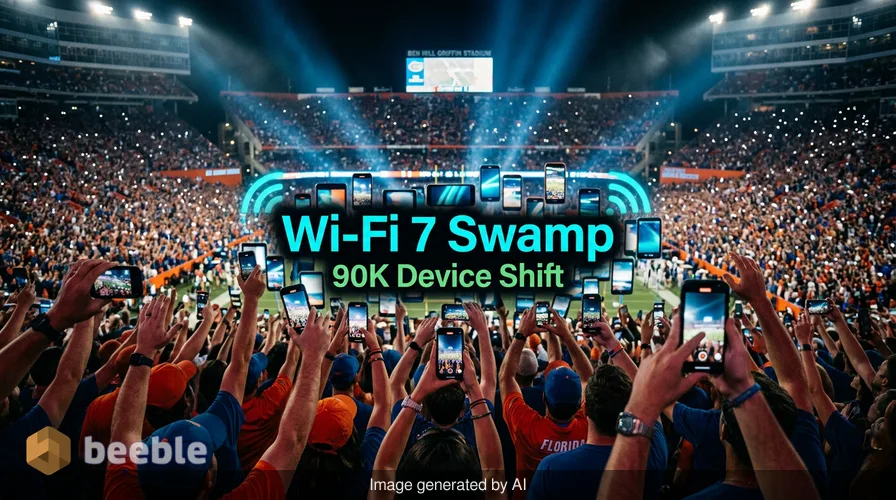
Have you ever found yourself in a crowded stadium, phone held high, trying to send a ten-second video of a touchdown to a friend, only to watch the progress bar stall indefinitely? It is a common frustration that highlights a fundamental law of digital physics: when too many people try to talk to the same antenna at once, the conversation falls apart. In a venue like Ben Hill Griffin Stadium—affectionately known as "The Swamp" at the University of Florida—this isn't just a minor annoyance for fans; it is a massive logistical hurdle for the university and a technical nightmare for engineers.
Recently, Extreme Networks stepped into this high-pressure environment to deploy Wi-Fi 7, making it the largest stadium in Florida to adopt the latest wireless standard. While this might sound like a niche technical upgrade, it represents a massive shift in how we think about connectivity in public spaces. To understand why this matters, we have to look past the marketing brochures and see how these invisible signals are actually managed in a concrete bowl packed with nearly 90,000 human bodies, each carrying at least one—and often two—connected devices.
The Density Problem and the Solution Under the Hood
To understand the magnitude of this upgrade, it helps to view a stadium’s wireless network as a complex traffic management system. Historically, Wi-Fi has struggled in high-density environments because it was designed for the home or office, where only a few dozen devices compete for attention. In a stadium, the air is thick with competing signals. For the average user, this manifests as "ghost bars"—your phone says you have full signal, but nothing loads.
Wi-Fi 7, also known by the technical label 802.11be, acts like a massive expansion of a city's highway system. If Wi-Fi 6 was a well-paved four-lane road, Wi-Fi 7 is a twelve-lane super-expressway with dedicated flyovers for emergency vehicles. Under the hood, the most disruptive feature is something called Multi-Link Operation (MLO). Previously, your phone would connect to one frequency at a time—either 2.4GHz, 5GHz, or 6GHz. With Wi-Fi 7, a device can transmit and receive data across multiple frequencies simultaneously. This essentially eliminates the "stop-and-go" traffic that happens when one frequency gets congested.
Looking at the big picture, the deployment at The Swamp isn’t just about faster Instagram uploads. It’s about creating a robust, systemic foundation for everything from mobile ticketing and digital concessions to real-time security analytics. When the network is resilient, the entire stadium operates more efficiently.
Why The Swamp is the Ultimate Stress Test
There is a reason why networking companies use stadiums as their proving grounds. Technically speaking, a stadium is a hostile environment for radio waves. Human bodies are mostly water, and water is exceptionally good at absorbing the signals your phone needs to function. When you pack 90,000 people into tight rows of concrete, you are creating a massive, shifting barrier for Wi-Fi.
Furthermore, the physical architecture of Ben Hill Griffin Stadium presents a unique challenge. Outdoor environments require hardware that can withstand the volatile Florida weather—the heat, the humidity, and the occasional torrential downpour. Extreme Networks had to install access points that are not only powerful but also tough enough to live under seats or high up in the rafters without failing.
Curiously, the goal of this technology is to become invisible. From a consumer standpoint, the mark of a successful network is that you never have to think about it. You tap your phone to enter the gate, you order a hot dog from your seat, and you check the scores of other games without a second thought. For the University of Florida, this seamlessness translates into tangible revenue and better safety protocols. If the network goes down, the digital ticket scanners stop working, the credit card machines at the kiosks freeze, and the entire flow of the event grinds to a halt.
Breaking Down the Specs: Wi-Fi 6 vs. Wi-Fi 7
For those curious about the actual leap in performance, the following table simplifies the technical shift occurring in large-scale deployments like this one.
| Feature | Wi-Fi 6 / 6E | Wi-Fi 7 | Practical Benefit |
|---|---|---|---|
| Max Channel Width | 160 MHz | 320 MHz | Like doubling the width of a pipe; more data can flow at once. |
| Data Encoding (QAM) | 1024-QAM | 4096-QAM | Packs 20% more data into the same signal. |
| Multi-Link (MLO) | Not Available | Simultaneous Multi-Band | Reduces lag and prevents dropped connections in crowds. |
| Theoretical Top Speed | ~9.6 Gbps | ~46 Gbps | Provides a massive buffer for high-definition video streaming. |
Essentially, these upgrades ensure that the network doesn’t just work today, but remains scalable for the next decade of mobile technology. As fans start bringing augmented reality (AR) glasses or 8K-capable smartphones to games, the stadium's backbone will already be prepared to handle the load.
The "So What?" Filter: Why This Matters Beyond the Game
It is easy to dismiss a stadium Wi-Fi upgrade as a luxury for sports fans, but looking at the big picture, this is a bellwether for the future of our digital lives. Stadiums are the extreme edge cases of connectivity. If a networking solution can handle the chaotic, high-interference environment of a Saturday night in Gainesville, it can handle almost anything.
For the average user, the technology being refined here will eventually trickle down to your local library, your office, and your home. We are moving toward an interconnected world where "dead zones" are considered a systemic failure rather than a common nuisance. The deployment of Wi-Fi 7 at such a massive scale suggests that the hardware is now mature enough for the mainstream.
On the market side, this move solidifies Extreme Networks' position in the competitive landscape of industrial networking. By successfully managing a foundational piece of infrastructure for a major university, they demonstrate that their cloud-managed systems can handle the most decentralized and unpredictable traffic patterns imaginable.
Moving Toward a More Transparent Connection
Practically speaking, we are witnessing the end of the era where we had to "choose" between being connected and being in a crowd. Historically, large events meant going off the grid by necessity. Now, the digital and physical worlds are becoming indistinguishable.
Ultimately, the arrival of Wi-Fi 7 at The Swamp is a reminder that while the devices in our pockets get most of the glory, the invisible backbone of modern life—the routers, the cables, and the cloud controllers—is what actually does the heavy lifting. The next time you are at a massive event and your phone works perfectly, take a moment to look up at the rafters. You’ll likely see a small, unassuming gray box that is working tirelessly to make sure your digital life doesn't skip a beat.
As we look toward the future, the takeaway is clear: our expectations for connectivity are shifting. We no longer just want a signal; we expect a resilient, transparent, and foundational connection regardless of how many people are standing next to us. Whether you're a student at Florida or a remote worker in a busy coffee shop, the engineering lessons learned in the heat of a football stadium are paving the way for a more reliable internet for everyone. Instead of worrying about the technical jargon of bits and bands, we can simply focus on the experience, trusting that the digital plumbing is finally wide enough to handle the flow.



See you on the other side.
Our end-to-end encrypted email and cloud storage solution provides the most powerful means of secure data exchange, ensuring the safety and privacy of your data.
/ Create a free account
