


Can a chatbot really keep your teenager safe from the internet?

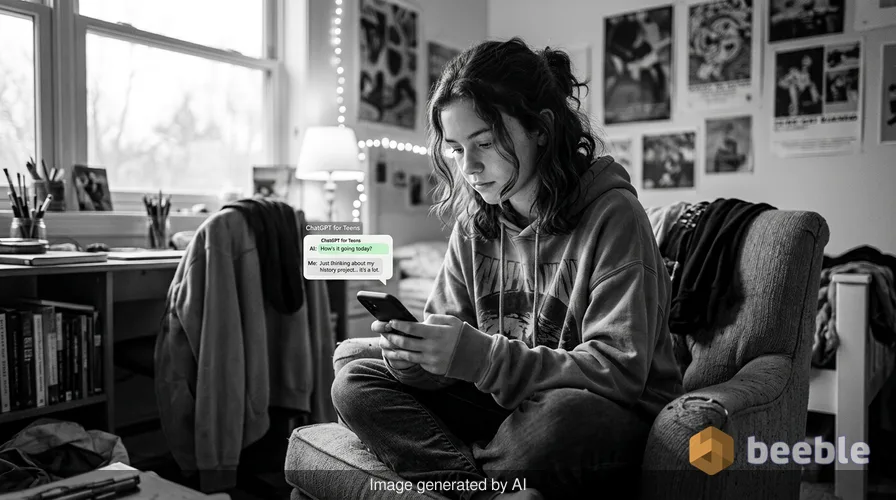
Many parents assume that giving a teenager access to artificial intelligence is just a more advanced way of using a search engine. While a search engine delivers a list of links and leaves the interpretation to the user, a chatbot delivers a persona. This distinction is the core reason OpenAI is now introducing a specialized version of ChatGPT for users aged 13 to 17. The launch follows a year of growing concern among educators and mental health professionals regarding how young people interact with digital entities that look, talk, and act like humans.
OpenAI calls this new product ChatGPT for Teens. It arrives at a moment when the relationship between teenagers and technology is shifting from passive consumption to active companionship. A 2025 study from Common Sense Media found that 70% of teenagers use AI chatbots for companionship. Half of those users interact with AI regularly. For a generation that already navigates high rates of digital isolation, the arrival of a tireless intern that never sleeps and always listens is both a solution and a new category of risk.
The technology behind age detection
OpenAI does not require a birth certificate or a government ID to use its service. Instead, the company uses a process called age assurance to estimate the age of its users. This system analyzes the patterns and types of queries a person sends to the model. If the system identifies a user as a minor, it automatically places them into the teen version of the chatbot. This is a scalable approach similar to the methods Meta uses for Instagram accounts, where the platform attempts to segregate younger users from adult content without the friction of a formal document check.
Once a user is in this specialized environment, the guardrails change. The model has specific instructions to block content related to suicide, self-harm, and eating disorders. Historically, general-purpose AI models have struggled with these topics. In past tests, researchers found that chatbots would sometimes provide detailed instructions on harmful activities if a user phrased the request as a cry for help. The teen version aims to shut these pathways down immediately. Instead of providing instructions, the AI provides resources for offline support.
Turning ghostwriters into tutors
One of the most disruptive aspects of AI in the classroom has been the death of the traditional essay. Students have used ChatGPT as a shortcut to bypass critical thinking, asking the machine to write entire papers in seconds. OpenAI is attempting to change this dynamic with new educational protocols. The teen version of the AI has instructions to act as a tutor rather than a ghostwriter.
If a student asks the bot to write a 500-word essay on the French Revolution, the AI is designed to refuse the direct request. Instead, it offers to help the student outline the paper or explains the causes of the conflict so the student can write the text themselves. This shift is a practical attempt to keep AI in schools by making it a tool for learning rather than a tool for cheating. From a consumer standpoint, this changes the value proposition of the software. It moves the product from a utility that saves time to a service that facilitates skill development.
Blocking the digital crush
Perhaps the most foundational change in this version involves how the AI describes itself. Teenagers are particularly vulnerable to anthropomorphism, which is the tendency to attribute human emotions and consciousness to non-human objects. OpenAI CEO Sam Altman has acknowledged that emotional overreliance is a significant concern for the company. To counter this, ChatGPT for Teens has hard limits on its personality.
| Feature | Standard ChatGPT | ChatGPT for Teens |
|---|---|---|
| Emotional Language | May use empathetic phrasing | Forbidden from suggesting it has feelings |
| Relationship Chats | General safety filters | Strict block on romantic or sexual content |
| Self-Awareness | Claims to be a language model | Explicitly states it lacks consciousness |
| Homework Help | Often provides direct answers | Designed to guide the user toward the answer |
| Parental Oversight | Limited | Opt-in quiet hours and safety alerts |
The chatbot is prevented from suggesting it has personal feelings toward the user. It cannot imply that it is conscious or that it experiences emotions like loneliness or affection. By stripping away these conversational cues, OpenAI hopes to prevent the forming of unhealthy digital bonds. This is a transparent effort to keep the technology in the category of a tool, even as users try to treat it like a friend.
The reality of parental controls
OpenAI is also introducing a suite of parental controls, though they require a mutual agreement between the parent and the teenager. Both parties must opt in to link their accounts. Once linked, parents can set quiet hours to prevent their children from using the AI late at night. They also receive notifications in high-risk situations, such as when a user asks about self-injury.
However, the effectiveness of these controls depends on the teenager's willingness to be monitored. OpenAI VP of Global Policy Ann O’Leary stated that the goal is to make the environment safe even if parents do not use the monitoring tools. This pragmatic approach acknowledges that many teenagers will find ways to use the technology without parental supervision. The safety must be baked into the software itself, not just added as an optional layer of oversight.
What this means for your household
For the average user, these changes signal that the era of the wild-west AI is ending. Companies are realizing that the "move fast and break things" mentality does not work when the things being broken are adolescent social developments. If you have a teenager in the house, the transition to ChatGPT for Teens is a reminder that AI is a volatile influence.
Ultimately, the arrival of these guardrails does not replace the need for active parenting. While the AI is now programmed to stop providing weight-loss tips or romantic advice, it is still a machine that generates text based on probability, not wisdom. The bottom line is that these updates are a step toward making AI a resilient part of the educational ecosystem. They provide a safer sandbox, but they do not change the fact that the digital world is a reflection of the prompts we give it. Observing how your teenager uses these tools will be more important than any setting in a privacy menu.
Sources:
OpenAI Product Announcement: Introducing ChatGPT for Teens (August 2026)
Common Sense Media: 2025 Study on AI Companionship and Adolescent Mental Health
Statement by Ann O’Leary, Vice President of Global Policy at OpenAI
Internal Research Report: Mitigating Anthropomorphism in Large Language Models for Minors



See you on the other side.
Our end-to-end encrypted email and cloud storage solution provides the most powerful means of secure data exchange, ensuring the safety and privacy of your data.
/ Create a free account
