


Can a Free Chinese AI Model Actually Outperform OpenAI?

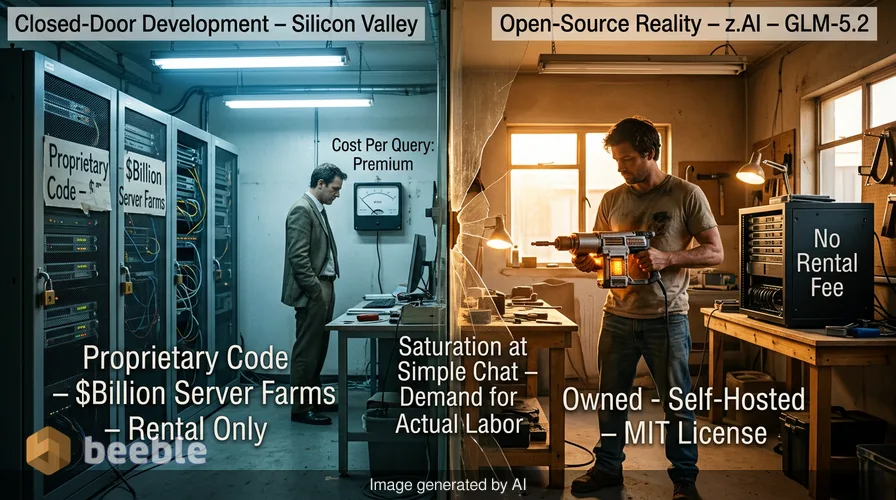
While the prevailing narrative in Silicon Valley suggests that massive capital and closed-door development are the only paths to artificial intelligence, the reality on the ground is shifting. For years, companies like OpenAI and Anthropic held a comfortable lead, protected by billion-dollar server farms and proprietary code. That lead is no longer a certainty. The release of GLM-5.2 from the Chinese firm z.AI has triggered a wave of concern among American tech leaders. This model is a direct challenge to the idea that the best technology must be expensive, restricted, and American.
GLM-5.2 arrives at a time when the AI industry is reaching a saturation point with simple chat interfaces. Users are moving past the novelty of asking a bot to write a poem and are now demanding models that can handle actual labor. This is where z.AI has positioned its latest release. It is an open-source model, meaning the underlying code is available for anyone to download, inspect, and run on their own hardware. In a world where most frontier models are rented out like expensive utility services, GLM-5.2 is like a set of high-end power tools that you actually own.
The massive digital filing cabinet inside GLM-5.2
To understand why this model has captured the attention of CEOs and engineers, look at its context window. In simple terms, a context window is the amount of information an AI can keep in its active memory at one time. If you think of an AI as a tireless intern, the context window is the size of the desk they work at. If the desk is small, the intern has to keep swapping papers in and out of a filing cabinet, which leads to mistakes and lost information.
GLM-5.2 has a 1 million token context window. Practically speaking, this means the model can read, analyze, and remember approximately 750,000 words in a single session. This puts it on a level playing field with GPT-5.5 and Claude 4.8. For a developer, this is a game changer. They can feed the AI an entire software project consisting of thousands of files and ask it to find a specific bug. The AI does not forget the beginning of the code by the time it reaches the end. This capacity for long-form reasoning is what allows for agentic workflows, where the AI performs a sequence of complex tasks without human hand-holding.
Why coding is the ultimate test of AI logic
Coding is the hardest task for a large language model because there is no room for creative interpretation. If a comma is in the wrong place, the program fails. Guillermo Rauch, the CEO of Vercel, noted that he was shocked by the coding proficiency of GLM-5.2. This sentiment is common among early adopters who are finding that the model handles logic better than many of its closed-source competitors.
When an AI writes code, it is essentially solving a massive logic puzzle. High-quality coding performance suggests that the model has a deep understanding of structure and cause-and-effect. This makes it useful for more than just software engineering. A model that is good at coding is typically excellent at legal analysis, financial modeling, and any other task that requires strict adherence to rules. For the average user, this means the tools they use for daily productivity—like spreadsheets that fill themselves or apps that automate their emails—will become significantly more reliable.
How open source models break the rental cycle
Historically, the tech industry has oscillated between open and closed systems. Currently, the most powerful AI models are closed. You pay a monthly subscription to OpenAI or Anthropic to use their intelligence. You never see how the model works, and you cannot run it on your own servers. This is a highly profitable model for the providers, as it creates a recurring revenue stream and keeps the consumer dependent on their infrastructure.
Open-source models like GLM-5.2 disrupt this cycle. When a model is open-source, a company can download it and run it on their own internal hardware. This is essential for industries like healthcare or finance where data privacy is paramount. They do not have to send sensitive patient records or trade secrets to a third-party server in the cloud. Furthermore, they do not have to pay a fee every time they ask the AI a question. Once they have the hardware, the intelligence is essentially free. This democratization of high-end AI lowers the barrier to entry for startups and small businesses that cannot afford massive subscription costs.
The distillation strategy and the closing gap
There is a lingering question about how Chinese firms are keeping pace despite US restrictions on high-end microchips. The answer lies in a technique called distillation. Think of it as a student taking meticulous notes from a world-class professor. A company can take a massive, expensive model and use it to train a smaller, more efficient student model. This student model learns the patterns and logic of the larger one but requires far less computing power to run.
Anthropic has expressed concern that this process is allowing China to close the gap in frontier capabilities. By using distillation and other efficiency-focused techniques, Chinese companies are doing more with less. They are building models that are lean and fast, which makes them easier to deploy on standard consumer hardware. This shift suggests that the sheer number of chips a country possesses is no longer the only metric for AI supremacy. Intellectual efficiency is becoming just as important as raw computing power.
What this means for your digital budget
For the average consumer, the arrival of GLM-5.2 is good news for the wallet. When a high-quality free alternative enters a market, the paid providers are forced to respond. We saw this in the early days of the internet with browsers and email services. As open-source models become as capable as their paid counterparts, the cost of AI across the board will likely drop.
Looking at the big picture, this also means that AI is becoming a decentralized commodity rather than a centralized luxury. You will soon have the option to run a world-class AI directly on your laptop or phone without an internet connection. This provides a level of resilience and privacy that was previously impossible. You are no longer at the mercy of a single company's terms of service or pricing tiers.
The bottom line on the global AI race
Ultimately, the rise of GLM-5.2 shows that the AI race is a marathon, not a sprint. While the US currently leads in the total number of frontier models, the gap is narrowing through sheer engineering ingenuity and a commitment to the open-source philosophy. The question of whether Silicon Valley's lead is safe is no longer a theoretical debate among investors. It is being answered in real-time by developers who are switching their daily workflows to models built thousands of miles away.
Practically speaking, you should begin to look for AI tools that offer local execution or open-source foundations. The era of the all-powerful, centralized AI provider is not ending, but it is certainly facing its first real challenge. As a consumer, your power lies in your choice of platforms. If a free, open model can do the work of a paid, closed one, the market will inevitably follow the value. You may find that your most helpful digital assistant in the coming years is one that lives on your own device, answers to no one but you, and costs nothing to operate.
Sources:
- z.AI (Zhipu AI) Technical Report for GLM-5 Series
- Vercel CEO public statements on X (formerly Twitter)
- Anthropic Policy Report on Frontier AI Development
- DeepSeek R1 Performance Benchmarks and Market Impact Analysis



See you on the other side.
Our end-to-end encrypted email and cloud storage solution provides the most powerful means of secure data exchange, ensuring the safety and privacy of your data.
/ Create a free account
