


Can an AI really teach you to play piano by moving your fingers for you?

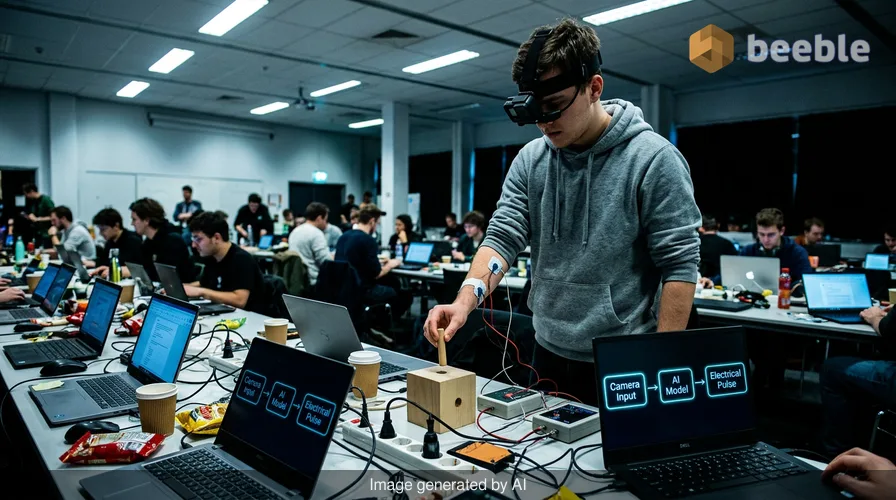
Have you ever wished you could download a new skill directly into your brain? For decades, science fiction has promised us a world where learning to fly a helicopter or play the violin is as simple as plugging a cable into a port. While we are nowhere near a total brain-computer interface, a group of students at the Massachusetts Institute of Technology recently demonstrated a way to skip the years of practice and go straight to the movement. They built a wearable device that allows an artificial intelligence to take the wheel of your own body.
Developed in just 48 hours during the MIT Hard Mode 2026 hackathon, the project is called Human Operator. It is a system that combines a head-mounted camera, a powerful AI model, and a set of electrodes that stick to your skin. The goal is simple. If you do not know how to perform a specific physical task, the AI does it for you by sending electrical pulses to your muscles. Essentially, the software acts as a digital apprentice that has studied every manual and video on the internet and is now ready to guide your hands.
Giving software a physical grip
To understand how Human Operator works, we have to look under the hood at two very different technologies. The first is a Vision-Language Model, or VLM. For the average user, a VLM is an AI that can see and talk. Most of the AI tools we use today are limited to text or still images. A VLM is more robust. It processes a live video feed from a camera mounted on the user's head and understands what it sees in the context of human language. If you tell the device to play a specific note on a piano, the VLM identifies the piano, locates the correct key, and determines the exact hand movement required to reach it.
The second piece of the puzzle is Electrical Muscle Stimulation, known as EMS. This is not a new invention. Physical therapists have used EMS for years to help patients recover from injuries or to prevent muscle loss. It works by sending small electrical signals to the motor nerves. These signals cause the muscle to contract without any effort from the brain. In the Human Operator system, the AI is the one sending those signals. When the VLM decides that your index finger needs to move, it triggers a pulse in the corresponding electrode on your forearm. Your finger moves, even if you did not consciously decide to twitch it.
Moving from screens to skin
The team at MIT describes this as giving AI a body. Historically, AI has lived inside boxes. It writes emails, generates images, or analyzes spreadsheets. When we want AI to interact with the physical world, we usually build a robot. However, robots are expensive, heavy, and often clumsy. By using the human body as the hardware, the Human Operator team has bypassed the need for motors and gears. They are using the most advanced machine on the planet—the human musculoskeletal system—and simply swapping out the control unit.
In demonstrations, the prototype helped users perform basic tasks like waving or making an "OK" gesture. More impressively, it guided a user to play specific notes on a piano. For a beginner, the hardest part of learning an instrument is the disconnect between the brain and the fingers. You know which note you want to hit, but your hand does not have the muscle memory to find it. Human Operator bridges that gap. It provides a tangible experience of the correct movement. Instead of looking at a diagram of where your fingers should go, you feel your fingers move to the right spot.
Why this matters for home healthcare
Looking at the big picture, the implications for this technology are significant in the field of rehabilitation. Every year, millions of people survive strokes or traumatic brain injuries that leave them with limited mobility. Physical therapy is the foundational path to recovery, but it is often slow, expensive, and requires constant supervision from a specialist. A device like Human Operator could change that dynamic.
Imagine a patient who needs to relearn how to use a fork or a pen. Instead of waiting for a weekly appointment with a therapist, they could wear a streamlined version of this device at home. The AI would watch their environment and help them complete daily tasks. It is a decentralized approach to medicine. It moves the expertise of the clinic into the living room. Because EMS hardware is relatively cheap and VLMs are becoming more efficient, this could eventually become a standard tool for home-based recovery. It turns a passive exercise into an active, guided experience.
The practical limits of a 48-hour invention
From a consumer standpoint, it is important to remain grounded. Human Operator is a prototype born in a hackathon. While the team won the Learn Track at MIT, the device is not ready for the mass market. There are several systemic hurdles to clear before you see these at a local electronics store. First, there is the issue of precision. Human muscles are complex. Moving a single finger is easy, but performing a complex task like typing or surgery requires a level of electrical control that we have not yet mastered through skin-based electrodes.
Second, there is the question of comfort and safety. EMS pulses feel like a sharp tingle or a small thud against the skin. While they are safe when used correctly, long-term use can lead to muscle fatigue. If the AI is not perfectly calibrated, it could cause a muscle cramp or an unintended movement. Furthermore, the privacy aspect is transparent. To work, the device needs a camera that sees everything the user sees. This creates a massive stream of personal data that must be secured. We have already seen how volatile data privacy can be with smart home devices. Adding a camera that can literally move your body adds a new layer of risk.
Beyond the jargon of human augmentation
In everyday life, we are already augmented. We use GPS to navigate, smartphones to remember facts, and glasses to see. This MIT project is just the next logical step in that progression. It is a shift from cognitive augmentation to physical augmentation. Instead of the AI telling you where to turn, it moves your hand to turn the wheel. This creates a resilient link between software and biology.
This technology is disruptive because it changes the value of specialized physical skills. If a wearable can guide a technician through the repair of a jet engine or a plumber through a complex pipe installation, the barrier to entry for many trades drops. It does not replace the human worker. Instead, it acts as a tireless intern that provides real-time, physical coaching. This could lead to a more flexible workforce where people can switch between different types of manual labor with minimal training.
What this means for your future habits
Ultimately, the Human Operator project shows us that the line between human and machine is blurring in ways that are practical rather than just theoretical. We are moving away from a world where we command machines and toward a world where we collaborate with them. For the average person, this might eventually mean a pair of gloves that teaches you how to knit or a sleeve that helps you perfect your golf swing. It is a shift in how we think about our own bodies.
As we move forward, pay attention to how often you rely on digital guidance. We already trust our phones to tell us what to say and where to go. The jump to letting a device move our muscles is smaller than it seems. The bottom line is that the physical world is no longer off-limits for software. When AI can reach out and touch the world through us, our definition of learning will change forever. You may not be downloading a skill into your brain tomorrow, but you might be strapping it to your arm sooner than you think.
Sources:
MIT Hard Mode 2026 Project Archives
Human Operator Project Website
Vision-Language Model Technical Specifications (OpenAI/Google Research)
Clinical Guidelines for Electrical Muscle Stimulation in Physical Therapy



See you on the other side.
Our end-to-end encrypted email and cloud storage solution provides the most powerful means of secure data exchange, ensuring the safety and privacy of your data.
/ Create a free account
