


Can an AI with 'Real Eyes' Finally Handle Your Daily Digital Chores?

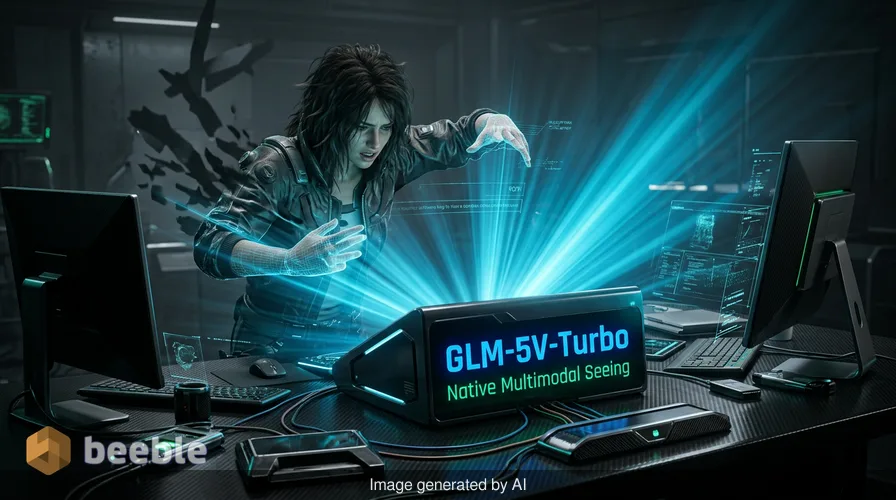
Have you ever tried to describe a complex software glitch or a physical object to an AI assistant, only to feel like you were playing a frustrating game of charades? For years, our digital helpers have been functionally blind, relying on us to translate the visual world into text before they could even begin to process it. But as we move further into 2026, that barrier is dissolving. The recent unveiling of GLM-5V-Turbo represents a significant pivot in how machines perceive our world, moving us away from clunky, pieced-together systems toward a native foundation for multimodal agents.
In simple terms, we are moving past the era where an AI "reads" a picture and toward an era where the AI actually "sees" it in real-time, just as we do. This shift isn't just a technical curiosity for researchers in lab coats; it is a disruptive development that changes the fundamental relationship between the average user and their devices.
The Vision Gap: Why Your Current AI is Squinting
Historically, AI models that could handle both text and images were built like a digital Frankenstein’s monster. Engineers would take a powerful language model—the "brain"—and stitch it to a separate vision encoder—the "eyes." While this worked for basic tasks like identifying a dog in a photo, it created a massive communication lag. The eyes would see something, translate it into a language the brain understood, and then the brain would react.
Looking at the big picture, this two-step process is too slow and imprecise for anything more complex than a static image. If you wanted an AI agent to help you navigate a website, find a specific setting in a video editing suite, or guide you through a physical repair via your smartphone camera, these "stitched-together" models often stumbled. They lacked the intuitive grasp of spatial relationships and temporal flow.
GLM-5V-Turbo changes the game by being a native multimodal model. This means that from the very first day of its training, it was taught to process visual and textual information simultaneously in a single, unified architecture. Think of it as the difference between a person who has to use a translation app to understand a conversation and a native speaker who feels the rhythm and nuance of the language instinctively.
Under the Hood: The Power of Native Multimodality
Behind the jargon of "native foundation models," there is a core philosophy of efficiency. By using a single backbone for both sight and thought, GLM-5V-Turbo achieves a level of robust performance that previous iterations couldn't touch. In my time analyzing tech architectures, I’ve seen many "Turbo" labels that were more marketing than substance. However, in this case, the name refers to a systemic optimization of how data flows through the model.
To put it another way, the model doesn't just see pixels; it understands the interconnected nature of what those pixels represent. When it looks at a spreadsheet on your screen, it doesn't just see a grid of numbers. It understands that clicking the "Sum" button will trigger a specific logical action. This makes the model an ideal candidate for a "digital agent"—an AI that doesn't just talk to you, but actually does things on your behalf.
From a consumer standpoint, the "Turbo" aspect is crucial because it lowers the latency of these interactions. If an AI agent takes five seconds to recognize that you’ve opened a new window, the experience feels broken. GLM-5V-Turbo aims for near-instantaneous visual processing, which is the foundational requirement for an AI that can work alongside you in real-time.
Beyond the Screen: AI as a Tireless Intern
Imagine you are a small business owner trying to manage your inventory. Instead of manually typing data into a system, you could simply point your tablet at a delivery of goods. A native multimodal agent powered by GLM-5V-Turbo could recognize the items, count them, compare them against your digital purchase order, and flag any discrepancies immediately.
Essentially, the AI becomes a tireless intern with perfect eyesight. It doesn't get bored scanning thousands of lines of code for a visual bug, and it doesn't get distracted when helpfully identifying which wire you need to unplug in a crowded server rack. This is where the scalable nature of this tech becomes apparent; it can be applied to everything from high-end industrial maintenance to helping a student solve a geometry problem by "looking" at their notebook.
Curiously, this also opens the door for more accessible technology. For users with visual impairments, a native multimodal agent that can describe a complex, changing environment in real-time—rather than just reading out static text—is a profound leap forward. It moves AI from being a conversational novelty to a practical tool for navigating the physical and digital worlds.
The Market Side: Why the 'Turbo' Matters for Your Wallet
On the market side, the release of models like GLM-5V-Turbo signals a shifting landscape in the AI arms race. For a long time, the industry was obsessed with making models bigger—more parameters, more data, more power. But we’ve hit a point of diminishing returns where the cost of running those massive models is becoming unsustainable for most companies.
What this means is that the focus has shifted toward efficiency and "agentic" capabilities. Developers are now prioritizing models that are streamlined enough to run quickly and cheaply while remaining smart enough to handle complex tasks. This is good news for the everyday user. As these models become more efficient, the cost of the services that use them should, in theory, become more transparent and affordable.
We are also seeing a decentralization of AI power. While the initial versions of these models require massive server farms, the "Turbo" optimizations are a step toward bringing native vision capabilities directly to our smartphones and laptops. We are not quite there yet, but the trajectory suggests that within a year or two, your phone won't need to send your screen data to a remote cloud server to understand what you're doing; it will happen right in your pocket.
The Privacy Question: Can We Trust an AI That Sees?
As an analytical translator of tech trends, I would be remiss if I didn't address the elephant in the room: privacy. A native multimodal agent that can "see" your screen or look through your camera is a powerful tool, but it is also a potential privacy nightmare. If an AI is constantly monitoring your visual input to be helpful, that data is incredibly sensitive.
Historically, we have traded privacy for convenience, but the stakes are higher here. For these agents to become truly mainstream, the companies behind them—like the Zhipu AI team behind the GLM series—must be resilient in their commitment to security. We need to see more local processing and clear, opt-in boundaries for visual data.
Zooming out, the success of GLM-5V-Turbo won't just be measured by its benchmarks or its speed, but by how well it respects the user's digital borders. If the tech feels opaque or invasive, users will reject it, no matter how disruptive the features are.
What This Means for You: Practically Speaking
Ultimately, the arrival of GLM-5V-Turbo suggests that our interaction with computers is about to become much more intuitive. We are moving away from a world of clicking, typing, and searching, and toward a world of showing and doing.
For the average user, the takeaway is simple: start looking at your digital tasks through the lens of a "visual agent." The next time you find yourself performing a repetitive visual task—like cropping dozens of photos, extracting data from scanned receipts, or navigating a complex government website—know that the tools to automate those tasks are finally becoming "native."
Looking ahead, you should expect your favorite apps to start asking for "vision" permissions more frequently. Instead of being wary of every request, look for those that utilize native models like GLM-5V-Turbo to provide actual utility. The era of the blind AI is over. As we integrate these observant assistants into our lives, the focus will shift from how we talk to machines to how we work alongside them.
Rather than viewing this as just another tech update, observe your own digital habits this week. Identify the moments where you wish you could just point at something and say, "Fix this" or "Explain that." Those are the exact gaps that GLM-5V-Turbo and its successors are preparing to fill. The future of AI isn't just about what it can say; it's about what it can see and do for you.
Sources
- Zhipu AI Technical Report: GLM-5V-Turbo Native Foundation Model Development
- arXiv:2604.26752v2 - Toward a Native Foundation Model for Multimodal Agents
- Global AI Market Analysis: The Shift Toward Agentic Workflows (Q2 2026)
- Industry Standards for On-Device Multimodal Processing



See you on the other side.
Our end-to-end encrypted email and cloud storage solution provides the most powerful means of secure data exchange, ensuring the safety and privacy of your data.
/ Create a free account
