


Can an Underdog from Hangzhou Really Outsmart Silicon Valley’s Biggest AI Labs?

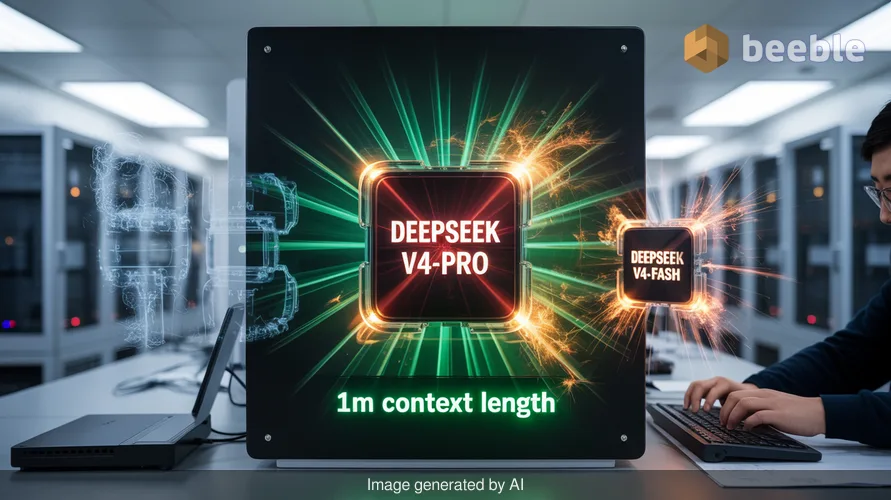
While the prevailing narrative suggests that the future of artificial intelligence is a billionaire’s game played exclusively in San Francisco and Seattle, a quiet startup from Hangzhou is systematically dismantling that assumption. For the better part of two years, the global tech community has watched with a mix of awe and suspicion as DeepSeek—a company that seemingly came from nowhere—has managed to match the performance of industry titans like OpenAI and Google.
With the release of DeepSeek V4, the company isn't just asking for a seat at the table; it is effectively trying to flip the table over. In an industry where progress is often measured by how many billions of dollars a company can burn on electricity and hardware, DeepSeek is pitching a different reality: one where efficiency, open-source accessibility, and clever engineering matter more than raw spending. To put it another way, if GPT-5.5 is a high-maintenance supercar, DeepSeek V4 is trying to be the high-performance electric vehicle that anyone can fix in their garage.
The Memory Revolution: Why One Million Tokens Matter
To understand why the V4 release is causing a stir, we have to look at what the company calls its "one-million token context length." For the average user, technical terms like "tokens" and "context windows" usually serve as a signal to stop reading, but the concept is actually quite tangible.
Think of an AI model like a tireless intern sitting at a desk. The context window is the size of that desk. If the desk is small, the intern can only look at a few pages of a document at a time. To answer a question about page 50, they have to put away page 1, potentially losing the overarching theme of the project. A one-million token context window is the digital equivalent of giving that intern a desk the size of a football field. They can lay out hundreds of documents, thousands of lines of code, or a dozen full-length novels and "see" all of them simultaneously.
Essentially, this means you can upload a massive legal contract, a 500-page technical manual, or an entire software codebase and ask the AI specific questions without it "forgetting" the beginning of the file. While other models have attempted this, DeepSeek claims V4 does it with significantly reduced compute and memory costs. For a small business owner or a solo developer, this isn't just a technical spec; it is a scalable tool that allows them to do the work of a much larger team for a fraction of the price.
Pro vs. Flash: The Two Sides of the V4 Coin
DeepSeek has split its release into two distinct tiers: V4-Pro and V4-Flash. This is a pragmatic move that reflects how we actually use technology in everyday life.
DeepSeek V4-Pro is the "heavy lifter." It is a robust, larger model designed for complex reasoning, high-level coding, and nuanced creative tasks. According to internal benchmarks, it is nipping at the heels of Gemini-3.1-Pro, falling only slightly behind in world knowledge tests. It is the model you use when you need the AI to think deeply about a systemic problem.
Conversely, V4-Flash is the "sprint runner." It is smaller, leaner, and built for speed. If you are a developer building a customer service bot or a real-time translation app, you don't need the AI to ponder the mysteries of the universe; you need it to be streamlined and responsive. By offering a "Flash" version, DeepSeek is targeting the cost-sensitive part of the market where every millisecond and every penny counts. Historically, the AI race has been about being the "smartest," but DeepSeek is betting that being the "most practical" is a better winning strategy.
The Shadow of "Distillation" and Geopolitical Friction
Under the hood, however, the story is not purely about engineering triumphs. The release of V4 comes at a volatile time for international tech relations. Only days ago, the White House and major US labs accused Chinese firms of "distillation"—a process also known as a model extraction attack.
In simple terms, distillation is like a student who doesn’t want to read the textbook themselves, so they ask a straight-A student thousands of questions and write down the answers. By studying the patterns in the top student's responses, the second student can learn to mimic their logic without ever having to do the foundational work. OpenAI and Anthropic have hinted that DeepSeek’s rapid rise might be fueled by this method, using the outputs of American models to train their own more efficiently.
DeepSeek denies these claims, emphasizing their original research, but the tension is tangible. This friction has already led to systemic roadblocks. In 2025, we saw countries like the US, South Korea, and Italy ban government use of DeepSeek. Germany even went as far as pulling the app from major stores, citing concerns that user data could be illegally transferred to servers in China. For the consumer, this creates a bizarre paradox: you have access to some of the most powerful, cost-effective AI on the planet, but using it might mean navigating a minefield of privacy concerns and national security legislation.
What This Means for Your Daily Workflow
Zooming out, how does a model from Hangzhou affect your life? The impact is most visible in the "democratization" of high-end tools. Because DeepSeek V4 is open-source (meaning its code is available for others to inspect and build upon), it can be integrated into a wide variety of third-party apps like Claude Code or OpenClaw.
You don't have to use DeepSeek’s specific website to benefit from its tech. You might find that your favorite coding editor or document analysis tool suddenly gets a lot cheaper or faster because the developers switched to DeepSeek’s V4-Flash backend.
| Feature | DeepSeek V4-Pro | DeepSeek V4-Flash |
|---|---|---|
| Primary Use Case | Complex reasoning & deep coding | Rapid response & low-cost tasks |
| Context Window | 1 Million Tokens | 1 Million Tokens |
| Accessibility | High (Open Source) | High (Open Source) |
| Cost to Run | Moderate | Extremely Low |
| Performance | Rivals top-tier closed models | Optimized for efficiency |
From a consumer standpoint, the competition is a win. When DeepSeek lowers its prices, OpenAI and Google are forced to respond. We are seeing a cyclical pattern where the "cost of intelligence" is plummeting. What was a luxury service costing hundreds of dollars a month just two years ago is now becoming a digital utility, as ubiquitous and cheap as electricity.
Looking at the Big Picture
Ultimately, the release of DeepSeek V4 is a reminder that the AI revolution is not a monolithic event controlled by a single ZIP code. It is an interconnected, global race where the rules are being written in real-time. DeepSeek’s ability to produce high-performing models on less powerful chips is a resilient response to export bans and hardware shortages. It proves that when you can’t throw more hardware at a problem, you have to throw more ingenuity at it.
However, the "So What?" filter for the average user remains one of caution. While the tech is impressive and the cost is disruptive, the opaque nature of data handling and the ongoing allegations of intellectual property theft shouldn't be ignored. We are moving toward a world where the most powerful tools in our pocket might also be the most controversial.
As we move deeper into 2026, the best approach for any tech-savvy consumer is one of balanced experimentation. Use these tools for their unprecedented power to summarize, code, and create, but remain mindful of where your data is going. The AI race is speeding up, and while the winners aren't yet clear, the real beneficiary is the user who can leverage these tools without becoming a casualty of the privacy wars. Observe your digital habits: are you choosing a tool because it's the best, or simply because it's the most convenient? In the era of V4, you might finally be able to have both, provided you’re willing to accept the baggage that comes with it.
Sources:
- DeepSeek Official V4 Release Notes via Hugging Face
- IBM Research Report on Context Length and Tokenization
- OpenAI GPT-5.5 Launch Statement
- U.S. Department of Commerce Special Report on Model Extraction Attacks (2025)
- European Data Protection Board (EDPB) ruling on DeepSeek App Store availability



See you on the other side.
Our end-to-end encrypted email and cloud storage solution provides the most powerful means of secure data exchange, ensuring the safety and privacy of your data.
/ Create a free account
