


Can Apple solve the privacy problem that turned smart glasses into social pariahs?

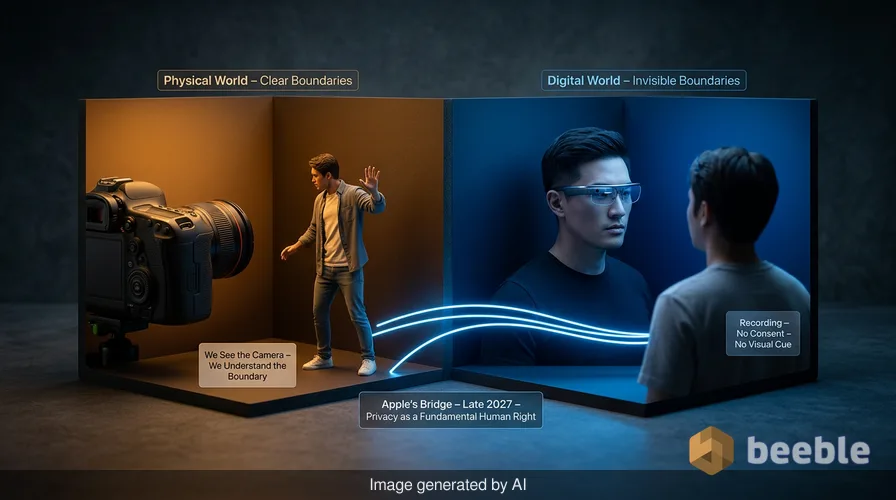
In the physical world, we have a clear sense of when someone watches us. We see a camera lens pointed our way or notice a stranger staring. We understand the boundaries of a private conversation in a quiet room. In the digital world, these boundaries are often invisible. Wearable technology, like smart glasses, removes the visual cues we rely on to protect our personal space. Apple is now attempting to bridge this gap with a product that promises to be different from the competitors that came before it.
Mark Gurman reports that Apple pushed its smart glasses launch to late 2027. This delay is a strategic move to refine the hardware and the privacy narrative. The company is aware of the backlash Meta faced with its Ray-Ban smart glasses. Critics often call those devices "pervert glasses" because users can record others without clear consent. For a company that markets privacy as a fundamental human right, avoiding this label is a matter of brand survival.
The architectural difference of on-device processing
Apple plans to build its glasses on a foundation of on-device processing. This means the device handles data locally rather than sending it to a remote server. In a regulatory context, this approach aligns with the principle of data minimization. This principle, found in Article 5 of the General Data Protection Regulation (GDPR), requires companies to collect only the data necessary for a specific purpose. By keeping video and audio data on the hardware, Apple reduces the risk of a massive data breach.
Most current smart glasses function as a gateway to the cloud. When a user records a video or asks an AI assistant a question, that information often travels to the manufacturer's servers. Apple intends to use its custom silicon to ensure that what the glasses see stays within the user's personal ecosystem. This technical choice is like a sealed envelope. Even if the envelope travels through the mail, the contents remain hidden from the carrier. In this case, Apple is the carrier that refuses to peek inside.
Why the absence of facial recognition matters
Facial recognition is a lightning rod for privacy regulators. The European Union AI Act classifies certain uses of remote biometric identification as high-risk or prohibited. Apple reportedly decided to omit facial recognition from its first generation of glasses. This decision removes a significant legal and ethical hurdle. Without the ability to identify strangers in real time, the glasses are less of a surveillance tool and more of a personal utility.
In practice, facial recognition in smart glasses would create a permanent digital trail of every person a user passes on the street. This would turn a walk in the park into a data collection event for everyone in the vicinity. By stripping this feature, Apple acknowledges that the right to anonymity in public spaces is under threat. The company is choosing to limit the device's capabilities to protect the privacy of non-users. This is a rare instance where a tech giant prioritizes the rights of the person not holding the product over the features offered to the customer.
The bystander privacy paradox
Even without facial recognition, the presence of a camera on a person's face creates tension. Meta tried to solve this with a small LED light that shines when the camera is active. However, users found ways to cover the light with tape or ink. This bypass makes the safety feature useless. Apple must find a more robust way to signal to the public that recording is in progress. A tamper-proof indicator is necessary to build social trust.
Privacy is not a one-time transaction between a person and a company. It is a continuous negotiation between a user and the people around them. If Apple cannot convince the public that its glasses are not a hidden surveillance tool, the product will fail in social settings. The company has a history of using hardware-level indicators that are difficult to disable. For example, the green light on a Mac camera is wired to the sensor. If the light is off, the sensor has no power. Applying this level of hardware integrity to smart glasses is a requirement for public acceptance.
AI training and the contractor problem
Meta recently faced criticism for reports that it used customer recordings to train AI models. The company also reportedly used human contractors to review footage to improve its algorithms. This practice turns private moments into raw material for corporate development. Apple plans to steer clear of these methods. The company is expected to process AI tasks locally or through Private Cloud Compute, which uses end-to-end encryption for server-side tasks.
Using contractors to listen to or watch user data is a systemic privacy failure. It violates the expectation of confidentiality that users have when they interact with personal technology. Apple’s commitment to avoiding this practice is a significant differentiator. By refusing to use customer data for model training, the company treats data as a toxic asset rather than a resource to be mined. This approach protects the user and limits Apple’s legal liability under emerging AI safety laws.
Navigating the regulatory patchwork quilt
The legal landscape for smart glasses is a patchwork quilt of local and international laws. In the United States, wiretapping laws vary by state. Some states require all parties to consent to a recording, while others only require one. In a two-party consent state like California or Florida, wearing smart glasses that record audio could lead to legal trouble for the user. Apple must design its software to respect these geographical boundaries.
In the European Union, the GDPR provides a stringent framework for the processing of personal data. If smart glasses capture the image of a passerby, that image is personal data. While there is a "household exemption" for personal use, the line blurs when users upload that footage to social media. Apple’s role as a data controller or data processor is a nuanced legal question. The company will likely argue that it is merely a hardware provider, but its tight control over the software ecosystem makes that claim precarious.
Practical steps for the privacy-conscious consumer
As 2027 approaches, consumers must look beyond the marketing slogans. Privacy by design is a foundation, but the user is the one who lives in the house. When Apple eventually releases its glasses, prospective buyers should perform a personal privacy audit. This involves more than just checking a box during setup.
First, review the permissions for on-device AI. Even if processing is local, the device is still creating a detailed log of your life. Second, look for physical hardware switches or indisputable indicators of recording. If a piece of tape can hide the recording light, the privacy protection is a failure. Third, examine the terms of service for any mention of "system improvement" or "data sharing with partners." These phrases are often emergency exits for companies to bypass their own privacy promises.
Apple has the technical ability to make smart glasses that are not a constant threat. The company has the Secure Enclave for biometric data and a history of hardware-software integration that prioritizes user security. However, the true test will be how the device treats the people who did not buy it. A privacy-preserving product must protect the bystander just as much as the wearer. If Apple succeeds, it will set a new standard for wearable technology. If it fails, smart glasses will remain a niche product for those who do not care about the social cost of surveillance.
Sources
- General Data Protection Regulation (GDPR) Article 5 and Article 17.
- European Union AI Act (Regulation on Artificial Intelligence).
- California Consumer Privacy Act (CCPA) as amended by the CPRA.
- Principles of Data Minimization and Privacy by Design as defined by the International Association of Privacy Professionals (IAPP).
Disclaimer: This article is for informational and journalistic purposes only and does not constitute formal legal advice. Privacy laws vary significantly by jurisdiction and individual circumstances.



See you on the other side.
Our end-to-end encrypted email and cloud storage solution provides the most powerful means of secure data exchange, ensuring the safety and privacy of your data.
/ Create a free account
