


Can India actually ban usernames on encrypted messaging apps?

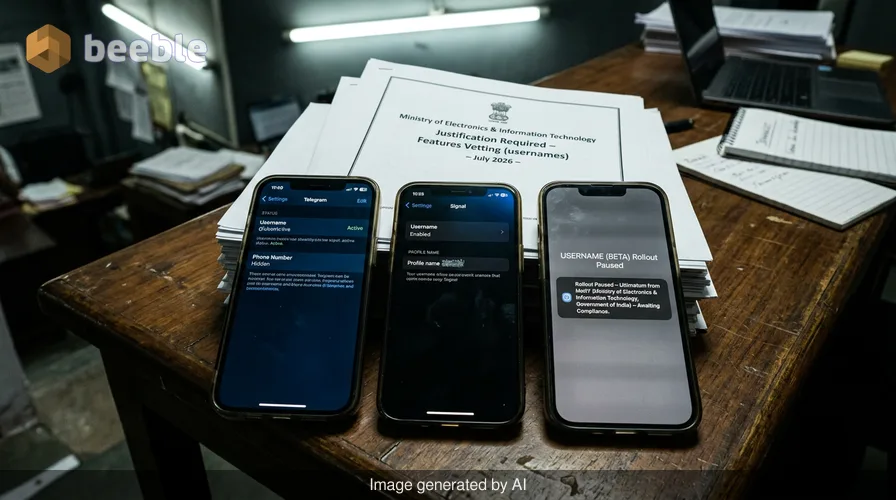
Long before a user sends a private message, the software architect at a desk thousands of miles away decides whether that message requires a phone number to exist. This technical choice is now a legal battleground in India. The Ministry of Electronics and Information Technology recently issued formal notices to Telegram and Signal. The government wants these platforms to justify features that allow people to communicate using usernames instead of revealing their phone numbers. This move follows a three-day ultimatum delivered to WhatsApp, forcing the company to pause its own username rollout.
India is changing its strategy for digital policing. In the past, the government blocked entire applications or ordered the removal of specific accounts. Now, the state is vetting individual product features across multiple services. The focus is on anonymity. The government views the ability to hide a phone number as a gateway to fraud. Privacy advocates view it as the last line of defense for journalists and dissidents.
The shift from app bans to feature vetting
For years, the relationship between the Indian government and global tech firms followed a predictable pattern. A platform would host content the government found objectionable, and the Ministry would order a takedown. If the platform refused, a legal standoff occurred. We saw this when the government clashed with X over content related to farmer protests. The recent notices to Telegram and Signal represent a more granular approach to regulation.
The government is no longer just looking at what people say. It is looking at how the software is built. By targeting the username feature, the IT Ministry is challenging the concept of pseudonymity. Telegram has allowed usernames for a long time, enabling users to join large public groups without exposing their contact details to strangers. Signal introduced a similar feature to enhance user safety, allowing people to share a handle while keeping their primary identifier—the phone number—hidden from the public eye.
The Ministry’s inquiry asks these companies to detail their safeguards against impersonation. This is a technical interrogation of privacy by design. If a platform is built to minimize the data it collects, it has less information to provide when the state demands identity verification. The government source cited digital arrest scams and phishing as the primary reasons for this crackdown. In these scams, criminals use the perceived anonymity of messaging apps to pose as law enforcement or tax officials.
Why usernames matter for digital hygiene
In my work as a journalist, digital hygiene is a daily requirement rather than a choice. I teach sources to use Signal because it minimizes the trail of breadcrumbs left behind. When a source contacts a reporter, they often do so at great personal risk. Sharing a phone number is like handing over a key to one's physical location and identity. A username acts as a buffer. It is a pseudonymous layer that protects the person behind the screen.
End-to-end encryption is a sealed envelope. It ensures that only the sender and the receiver can read the contents. However, the government is not just interested in the letter inside the envelope. They want the return address to be a verified, government-linked phone number. By masking that number with a username, the platform makes the return address much harder to trace.
For Signal, the username feature is a privacy-preserving mechanism. It does not store the username in a way that links it to a user's phone number on their servers in plain text. For the IT Ministry, this is an opaque system that prevents the identification of the "first originator" of a message, a requirement under the Information Technology (Intermediary Guidelines and Digital Media Ethics Code) Rules, 2021.
The three-day ultimatum for WhatsApp
WhatsApp finds itself in a precarious position. Unlike Signal or Telegram, WhatsApp is a significant social media intermediary with hundreds of millions of users in India. When WhatsApp announced it would allow users to pick usernames, the Ministry reacted with an immediate directive. The company had three days to justify the feature or face regulatory action.
The government's logic is based on the rise of digital arrest scams. These are sophisticated attacks where victims are told they are under investigation for money laundering or drug trafficking. The attackers use messaging apps to maintain a continuous video call, effectively placing the victim under a "digital arrest" until they transfer money. The Ministry argues that usernames make it easier for these attackers to operate without being traced.
This creates a conflict between safety and privacy. If a platform requires every user to be identifiable by a phone number, it helps law enforcement track criminals. However, it also creates a systemic vulnerability for everyone else. Data breaches at telecom companies or malicious actors with access to phone number databases can use that information to harass individuals. In this regulatory context, the government is prioritizing the state’s ability to police over the individual's ability to remain private.
The legal basis for the dragnet
The Internet Freedom Foundation (IFF) has called for the withdrawal of these notices. The group argues that the government has no clear basis in law to vet individual software features in this manner. The IT Rules of 2021 already require platforms to identify the originators of messages when ordered by a court or competent authority. However, those rules are currently under legal challenge in various Indian courts.
The IFF states that the notice to Signal strikes directly at protected speech. Journalists, activists, and whistleblowers rely on the ability to communicate without being identified by the state. If the government forces these platforms to remove username features, it effectively mandates that every digital conversation must be linked to a physical ID through a SIM card. In India, SIM cards are linked to Aadhaar, the national biometric ID system.
This creates a chain of identity that is difficult to break. If you remove pseudonymity, you remove the ability for a vulnerable person to speak out without immediate fear of reprisal. The regulatory landscape is becoming a patchwork quilt of requirements that make it increasingly difficult for privacy-focused apps to operate.
How users can protect their identity
While the legal battle continues, users must take steps to manage their digital footprints. The tension between the government and these platforms means that features you rely on today might change or disappear tomorrow.
| Feature | Telegram | Signal | |
|---|---|---|---|
| Username Status | Active and established | Active (Phone number privacy) | Rollout paused by government |
| Data Collection | Collects metadata and contacts | Minimal (Only registration date) | Significant metadata collection |
| Encryption | Optional for secret chats | Default for all messages | Default for all messages |
| Government Notice | Issued notice on safeguards | Issued notice on safeguards | Directed to freeze rollout |
If you use these apps for sensitive communications, audit your settings now. In Signal, you can go to Settings > Privacy > Phone Number and set "Who can see my number" to "Nobody." You can also set "Who can find me by number" to "Nobody." This forces people to use your username to find you.
In Telegram, the username is public by default if you set one. You should review your privacy settings to ensure your phone number is not visible to everyone. However, be aware that Telegram’s architecture is different from Signal’s. Telegram stores more metadata on its servers, which makes it more vulnerable to legal demands for data.
The road ahead for privacy in India
The IT Ministry's focus on usernames is not an isolated event. It is part of a broader trend toward total traceability. The government wants to eliminate the dark corners of the internet where they cannot see who is talking to whom. While the stated goal is to prevent fraud, the method involves dismantling privacy protections for all citizens.
The Digital Personal Data Protection (DPDP) Act of 2023 is also beginning to take effect. While the Act focuses on how companies handle data, it includes provisions that allow the government to exempt its own agencies from many privacy requirements. This creates a one-way mirror where the state can see the citizen, but the citizen cannot see the state.
Ultimately, the fight over usernames is a fight over the right to be pseudonymous. If the government succeeds in forcing Telegram, Signal, and WhatsApp to link every interaction to a phone number, the sealed envelope of encryption remains, but the privacy of the sender is gone. The envelope is still closed, but the names of the sender and receiver are written in permanent ink on the outside.
Take the time to review your app permissions and privacy settings. If a feature that protects your identity is available, use it. If a platform is forced to remove that feature, evaluate whether that platform still meets your security needs. Personal reputation and safety depend on these small technical choices. The Ministry of Electronics and Information Technology issued the notices on Thursday. The platforms have yet to provide a public response.
Sources
- Information Technology (Intermediary Guidelines and Digital Media Ethics Code) Rules, 2021.
- Digital Personal Data Protection Act, 2023 (India).
- Supreme Court of India: Justice K.S. Puttaswamy (Retd.) vs Union Of India (Right to Privacy judgment).
- Official statements from the Internet Freedom Foundation (IFF) regarding messaging app notices.
Disclaimer: This article is for informational and journalistic purposes only. It does not constitute formal legal advice. Privacy laws and regulations are subject to change and vary by jurisdiction.



See you on the other side.
Our end-to-end encrypted email and cloud storage solution provides the most powerful means of secure data exchange, ensuring the safety and privacy of your data.
/ Create a free account
