


Can Mark Zuckerberg turn your daily news feed into a global scoreboard?

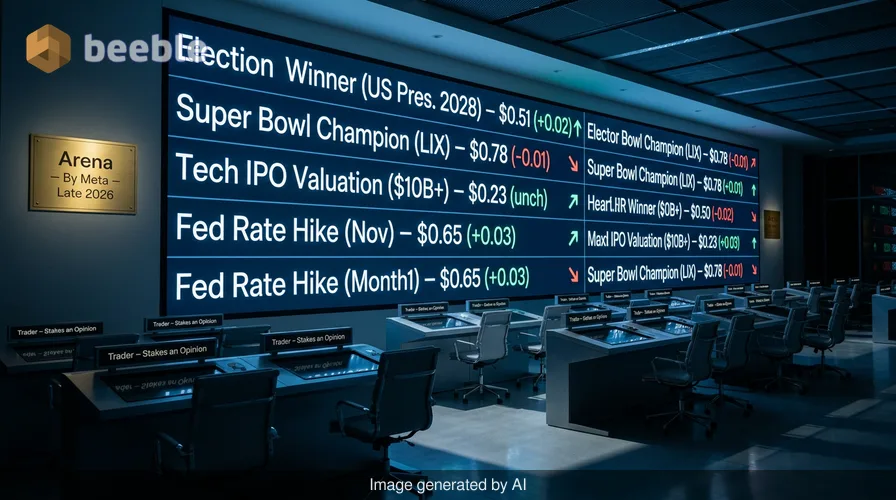
Have you ever found yourself certain that a specific team would win a game or a particular candidate would carry an election? Most people express these convictions through social media posts or casual bets with friends, but Mark Zuckerberg wants to turn those hunches into a platform that functions like a global mood ring for human intuition. Meta is reportedly developing its own version of a prediction market. This internal project is currently known as Arena.
Prediction markets are a specific type of financial exchange where people trade on the outcome of real-world events. On the surface, they look like gambling. Under the hood, they function more like a specialized stock market where the commodity is information. If a prediction market is healthy, the price of a bet tells you exactly how likely an event is to happen. Zuckerberg is the latest tech leader to chase this trend. He joins a list of figures who believe that putting a price tag on an opinion makes that opinion more accurate.
How prediction markets work in plain English
A prediction market is a system that turns a yes-or-no question into a tradable asset. Imagine a contract that asks if a specific movie will win an award. If you are right, that contract is worth exactly $1. If you are wrong, it is worth $0.
Before the award ceremony, people buy and sell these contracts based on what they think will happen. If a contract trades for 60 cents, it means the market collectively believes there is a 60% chance the movie will win. If new information emerges, such as a positive review or a shift in critic sentiment, the price moves. This creates a real-time probability map. In simple terms, these platforms use the wisdom of the crowd to forecast the future.
Two companies currently dominate this space. Polymarket operates on the blockchain and has a global user base. Kalshi is the first platform sanctioned by the US Commodity Futures Trading Commission. Together, they handled roughly $44 billion in trading volume by 2025. This massive scale caught the attention of Wall Street and tech giants alike. The parent company of the New York Stock Exchange even invested $2 billion into Polymarket recently. This is no longer a niche hobby for data nerds. It is a massive financial sector that influences how the world views the probability of major events.
Why Meta wants to build Arena
Meta already has billions of users who discuss news, politics, and sports every second of the day. For the average user, Arena would likely feel like an extension of those conversations. The reporting suggests that Arena will start as a cashless system. Instead of wagering dollars, you would earn points for being right. This approach is a common tactic for tech companies to test the waters of a controversial product without triggering immediate legal scrutiny from gambling regulators.
Meta has a clear incentive to build this tool. Prediction markets generate incredible engagement. Users check the app constantly to see how prices fluctuate. Furthermore, the data from these markets is valuable for Meta’s AI ambitions. High-quality data is the digital crude oil that fuels large language models. By seeing how millions of people bet on specific outcomes, Meta can gather a dataset on human reasoning and sentiment that is much more precise than simple likes or comments.
Ultimately, this is about competition for influence. Platforms like X have become hubs for real-time news and speculation. If Zuckerberg can successfully integrate a prediction market into the Meta ecosystem, he creates a reason for people to stay on his apps for news consumption. He is essentially trying to turn the act of reading the news into a game where you can prove your intelligence by being right more often than your neighbors.
The legal battle over betting on reality
The rise of prediction markets has caused a major rift between different levels of government. Historically, the US Commodity Futures Trading Commission tried to block these platforms. They argued that betting on elections or political events was against the public interest. However, the legal tide shifted in late 2024 when a US court ruled that Kalshi could offer election contracts. This opened the floodgates for billions of dollars in volume.
Currently, the situation is messy. Several US states are suing these platforms. They claim that prediction markets are simply unlicensed gambling operations. Conversely, the federal government under the Trump administration has taken a more permissive stance. They have even gone as far as suing states that try to ban these markets. This creates a confusing environment where a platform might be legal at the federal level but illegal in your specific zip code.
There are also serious concerns about integrity. In 2025, a former special forces soldier was arrested after allegedly using insider knowledge of a military operation in Venezuela to place a winning trade on Polymarket. This trade was worth around $400,000. This highlights a foundational risk. If someone has secret information about a government action or a corporate merger, they can use prediction markets to profit at the expense of regular users. This is essentially insider trading for the real world.
What this means for your digital habits
For most people, the arrival of Arena won't mean they suddenly become day traders. However, it will change how information appears in your feed. We are moving toward a reality where every news headline has a percentage attached to it. When you read about a potential law or a sports trade, you will see a market-based probability alongside the text.
From a consumer standpoint, this has both benefits and drawbacks. On the positive side, these markets are often more accurate than traditional polls. Because participants have something to lose, they tend to be more objective than a random person answering a phone survey. On the negative side, it creates a constant pressure to gamify your life. Every event becomes a win or a loss.
Meta’s cashless version might feel safer than Polymarket, but it is a gateway. It trains users to view reality as a series of bets. If the points eventually turn into real money, or if Meta integrates with a third-party exchange, the line between social media and a casino will disappear. You should observe your own habits as these tools become more common. Are you reading the news to stay informed, or are you reading it to find an edge in a game?
Practical takeaways for the average user
If you decide to interact with these platforms, keep a few things in mind. First, remember that prices reflect what people believe, not necessarily what is true. A market can be wrong if it is influenced by a local bias or a coordinated group of traders. Second, look for transparency. Regulated platforms like Kalshi have more oversight than decentralized platforms.
| Platform | Regulatory Status | Primary Asset | Typical User |
|---|---|---|---|
| Polymarket | Global / Blockchain | Crypto (USDC) | Crypto enthusiasts, global speculators |
| Kalshi | US Regulated (CFTC) | US Dollars | Professional traders, US-based hedgers |
| Meta Arena | Internal / Unregulated | Points (Cashless) | Social media users, casual fans |
Zooming out, the arrival of Meta in this space is a signal that prediction markets are here to stay. They are no longer a fringe experiment. They are becoming the primary way that modern society measures the probability of the future. Whether you participate or not, these markets will likely influence the decisions made by politicians, CEOs, and the algorithms that control your phone.
Sources:
- New York Times reporting on Project Arena and Meta internal development
- US Commodity Futures Trading Commission (CFTC) public rulings on Kalshi
- Polymarket historical trading volume and investment data via Dune Analytics
- Politico investigation into prediction market influencer campaigns



See you on the other side.
Our end-to-end encrypted email and cloud storage solution provides the most powerful means of secure data exchange, ensuring the safety and privacy of your data.
/ Create a free account
