


Can your AI assistant finally get the details right in your photos?
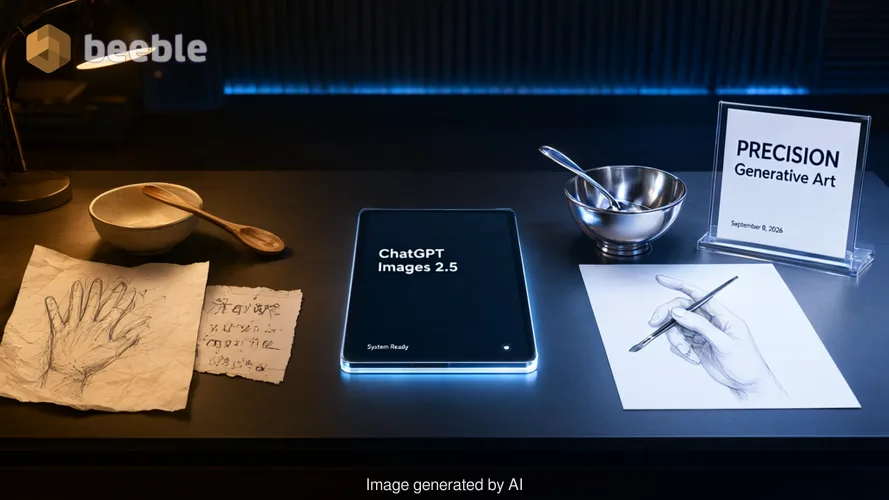
How many times have you asked an AI to generate a simple poster, only to find the words look like an alien language? For years, the promise of generative art has been haunted by six-fingered hands, garbled text, and a strange inability to place a spoon correctly inside a bowl. We have reached a point where the novelty of AI art has worn thin, leaving users frustrated by the gap between a creative vision and the pixelated reality. OpenAI released ChatGPT Images 2.5 on September 8, 2026, to address these specific points of friction. This update is a direct response to the growing demand for tools that act less like a random slot machine and more like a precise digital instrument.
The mechanical shift in ChatGPT Images 2.5
Under the hood, this update changes how the model processes spatial relationships. In older versions, the AI viewed an image as a collection of pixels that happen to be next to each other. If you asked for a cat sitting on a fence, the model calculated the probability of cat-shaped pixels appearing near fence-shaped pixels. ChatGPT Images 2.5 uses a new architectural layer that treats objects as distinct three-dimensional entities within a virtual space. Practically speaking, this means the AI understands that a coffee cup has a bottom that must rest on a surface, rather than just floating in the general vicinity of a table.
This shift in logic reduces the number of structural errors that previously made AI images easy to spot. The model now employs a high-fidelity text-rendering engine that treats letters as vectors rather than textures. Historically, AI models struggled with text because they viewed characters as patterns of light and shadow. By treating text as a specific data type, Images 2.5 is capable of producing clear, legible signage, labels, and documents. For the average user, this means that creating a menu for a local cafe or a flyer for a neighborhood event no longer requires a secondary trip to a photo editing suite to fix spelling mistakes.
Editing your vision with a tireless intern
The most significant change for the daily workflow is the introduction of native, real-time editing. Previously, if you liked a generated image but hated the color of a character's shirt, you had to start the entire process from scratch. You would cross your fingers and hope the next generation kept the face you liked while changing only the clothing. That approach was inefficient and volatile.
Images 2.5 introduces a layer-based selection tool. Think of the AI as a tireless intern sitting at a desk next to you. You can point to a specific section of the image and give a verbal command to change just that part. You can say, "Make the sky darker" or "Move the dog to the left side of the frame," and the AI adjusts the existing image without altering the other elements. This level of control shifts the user from being a passive observer to being an active director. It is a pragmatic solution for small business owners who need consistent brand visuals without hiring a full-time design agency.
Why the move to vector output matters
For professional designers and industrial users, the addition of scalable vector exports is a foundational change. Most AI tools generate raster images, which are made of a fixed grid of pixels. If you try to blow up a small raster image to fit a billboard, it becomes a blurry mess. To put it another way, raster images are like paintings, while vector images are like blueprints.
| Feature | ChatGPT Images 2.0 | ChatGPT Images 2.5 |
|---|---|---|
| Text Legibility | Low (Garbled) | High (Clear Type) |
| Editing Style | Prompt-based (New Image) | Selective (In-painting) |
| File Format | PNG / JPG | PNG / JPG / SVG (Vector) |
| Spatial Reasoning | 2D Pattern Matching | 3D Object Awareness |
| Consistency | Low (Randomized) | High (Style Transfer) |
By allowing users to export graphics in SVG format, OpenAI is targeting the heavy industry of marketing and manufacturing. A vector file can be scaled to the size of a skyscraper or shrunk to the size of a postage stamp without losing a single line of detail. This makes the tool useful for creating logos that need to go on both a website and a physical storefront sign. It removes the technical barrier that previously kept AI art confined to social media posts and digital screens.
The cost of high fidelity creation
Looking at the big picture, these improvements come with a cost that is not always visible on a subscription receipt. Generating images that understand 3D space and precise text requires significantly more computing power. This update relies on the latest generation of specialized chips from Nvidia and other hardware providers. As AI models become more complex, the energy required to run them increases, which creates a cyclical pressure on the global power grid.
From a consumer standpoint, this might lead to changes in how we pay for these services. We are moving away from the era of "unlimited" generations. OpenAI has introduced a credit-based system for the most advanced features of Images 2.5, such as the vector exports and the high-resolution refinement. For the casual user, the free tier remains functional for basic tasks, but the high-end industrial tools are becoming a premium commodity. This reflects a broader trend in the tech market where the basic service is a loss leader and the professional utility is the profit engine.
Privacy and the digital paper trail
Every image generated by the 2.5 model now includes an invisible digital watermark following the C2PA standard. This is not a visible logo in the corner of the picture. Instead, it is a piece of metadata embedded in the file that proves the image was created by an AI. In an era where misinformation is a systemic risk, this transparent approach is necessary for maintaining trust in digital media.
Curiously, this feature also protects the creator. If you use ChatGPT to design a unique product mockup, the digital trail can help verify that you are the original user who prompted the design. While the legal system is still catching up to the concept of AI copyright, having a verifiable record of creation is a practical step toward protecting intellectual property. The model also has stricter filters to prevent the generation of deepfakes or images that infringe on existing trademarks, which reduces the liability for businesses using these tools for public-facing content.
Navigating the new creative economy
The bottom line is that AI is no longer just a toy for generating weird landscapes or surreal portraits. With the 2.5 update, it has become a streamlined piece of office equipment. For a freelancer, this means you can spend less time fighting with a brush tool and more time refining the concepts that actually sell. For the everyday user, it means the frustration of "AI hands" is slowly becoming a thing of the past.
Ultimately, you should view these tools as a way to augment your existing skills rather than a total replacement for human judgment. The AI provides the speed, but you still provide the direction. Observe how often you reach for a specialized design tool over the next month. You might find that the ability to simply ask for a change is more valuable than the ability to draw it yourself. Shift your perspective from seeing AI as a generator to seeing it as a collaborator that finally understands the difference between a table and the floor.
Sources:
OpenAI Product Release Notes (September 2026)
Reuters Technology Market Analysis
International Bureau of Web Standards - C2PA Update
Computing Power Consumption Report 2026



See you on the other side.
Our end-to-end encrypted email and cloud storage solution provides the most powerful means of secure data exchange, ensuring the safety and privacy of your data.
/ Create a free account
