


China’s Gamble on AI Token Trading Could Change What You Pay for Every Digital Search

While the world remains fixated on which tech giant can build the smartest chatbot, a far more disruptive battle is brewing in the unglamorous halls of global financial exchanges. Most people assume the winner of the AI race will be the company with the best algorithms. In reality, the crown may go to whoever figures out how to make those algorithms affordable and predictable for the rest of us.
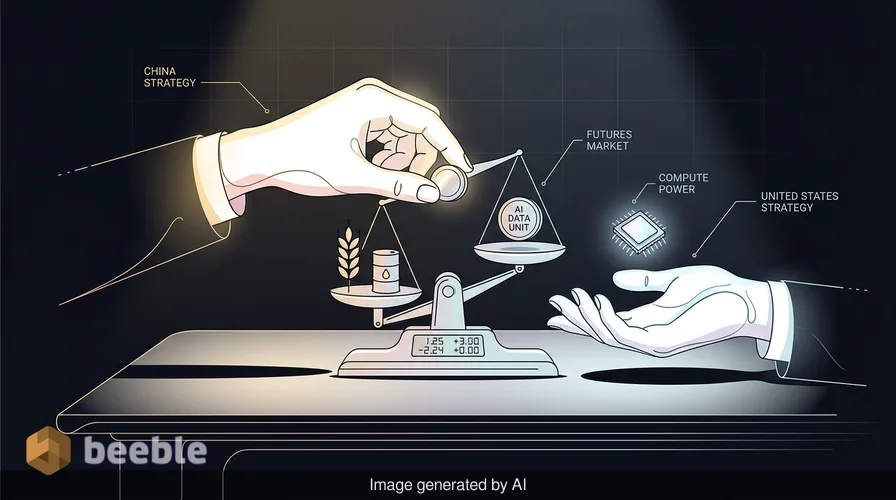
Looking at the big picture, we are witnessing the birth of a new commodity. China is currently designing a futures market specifically for AI tokens—the fundamental units of data that power Large Language Models (LLMs). This move by the Shanghai Futures Exchange marks a sharp departure from the strategy seen in the United States, where the focus has largely remained on trading "compute power" or the raw processing speed of chips.
What this means is that "intelligence" is being treated less like a mysterious magic trick and more like a barrel of oil or a bushel of wheat. For the average user, this shift under the hood could be the difference between a stable $20-a-month subscription and a volatile, unpredictable cost for digital services.
The Digital Crude Oil: What is an AI Token?
To understand why a futures market matters, we first have to strip away the marketing gloss. Behind the jargon, an AI model doesn’t see words or images; it sees tokens. Think of a token as the digital crude oil of the 21st century. It is the refined fuel that allows an AI to process your request and spit out an answer.
In simple terms, a token is roughly equivalent to 0.75 of a word. When you ask an AI to write a recipe for sourdough bread, you are consuming tokens. When a bank uses AI to scan thousands of legal documents, it is burning millions of tokens. Right now, the price of these tokens is set by the providers—OpenAI, Google, or Alibaba—and can fluctuate based on demand, server availability, or corporate whim.
For a small business owner using AI to automate customer emails, these costs are currently a line item they can’t fully control. If token prices spike because of a sudden global surge in demand, that business owner’s margins shrink instantly. This is where the Shanghai Futures Exchange steps in. By creating a market where people can buy and sell tokens at a set price months in advance, China is attempting to turn a volatile tech expense into a resilient, manageable utility.
The Great Divide: Tokens vs. Compute
Curiously, the U.S. and China are taking two very different paths to solve the same problem. To put it another way, if AI were a car, the U.S. is trying to trade the horsepower of the engine, while China is trying to trade the gallons of gasoline.
U.S. exchanges have largely focused on "compute futures." This involves trading the time spent on a GPU (graphics processing unit). It’s a logical approach for a country that dominates the hardware side of the equation through companies like Nvidia. If you own the engine, you want to trade engine time.
Conversely, China’s focus on tokens looks at the output. From a consumer standpoint, this is often more intuitive. Most businesses don’t care how many flops of compute power it took to generate a report; they care how many tokens the report cost.
| Feature | US Approach (Compute Futures) | China Approach (AI Token Futures) |
|---|---|---|
| Focus | Hardware capacity (GPU time) | Data output (Tokens) |
| Analogy | Renting the factory floor | Buying the finished goods |
| Primary Risk | Chip shortages / Electricity costs | Model efficiency / Data demand |
| Best For | Model developers & Cloud providers | End-user businesses & App developers |
| Current State | Emerging in private/specialized OTC markets | Designing for public exchange (SHFE) |
Why the Everyday User Should Care
At this point, you might be thinking this sounds like a problem for Wall Street or Silicon Valley, not for someone just trying to use a translation app. However, these systemic changes have a way of trickling down to the kitchen table.
Practically speaking, we are moving away from the "wild west" era of AI pricing. In the early days of any disruptive tech, companies often give services away for free or at a loss to gain users. But as the industry matures, the "So What?" filter kicks in: How do we make this sustainable?
If token prices are traded on an exchange, it brings transparency to an otherwise opaque market. When prices are transparent, competition usually increases. This could lead to:
- Predictable Subscriptions: Instead of "usage limits" that reset every month, companies could offer more flexible plans because they’ve already locked in their costs on the futures market.
- AI "Nutrition Labels": Just as we look at the price of gas before a road trip, we might soon see apps that tell us exactly how many tokens a task will cost before we hit "enter."
- The End of the Infinite Free Tier: As tokens become a tangible commodity with a clear market price, tech companies will find it harder to hide the true cost of "free" services, likely leading to more ad-supported or micro-payment models.
Skepticism and the Shifting Landscape
While the concept of token futures is foundational to a mature AI economy, we should maintain a healthy dose of skepticism. Financializing a new technology often invites speculation. Historically, whenever we turn a utility into a tradable asset, we risk creating bubbles.
If speculators drive up the price of token futures in Shanghai, it could ironically make AI more expensive for a developer in Beijing or even a researcher in London. There is also the technical challenge: not all tokens are created equal. A token from a high-end GPT-5 model is vastly more valuable than a token from a lightweight, open-source model. The Shanghai Futures Exchange faces a daunting task in standardizing these contracts so that they are actually useful for the industry rather than just a playground for day traders.
Furthermore, the "race" aspect cannot be ignored. By establishing a token futures market first, China is attempting to set the global benchmark for how AI is valued. If the world starts pricing AI services based on the Shanghai token index, it gives China significant systemic influence over the global tech supply chain, much like how Brent Crude influences global gas prices.
Practical Foresight: Navigating the Tokenized Future
Ultimately, the move toward an AI token futures market tells us one thing: the era of AI as a novel toy is over. It is now being integrated into the foundational plumbing of the global economy.
As a consumer, it is time to shift your perspective. Start observing your digital habits not just as "using an app," but as consuming a resource. Just as you might be mindful of your electricity usage during a heatwave or your data roaming while abroad, you will soon need to understand the unit economics of your digital life.
Keep an eye on the service agreements of the tools you use daily. If you see a shift toward "credit-based" systems or "token-weighted" billing, you’re seeing this futures market in action. The invisible backbone of the modern world is being rebuilt, and while it might seem like just another financial headline, it is actually the first step toward making the "tireless intern" of AI a permanent, predictable part of our working lives.
In the coming years, don't be surprised if the evening news reports on the "closing price of AI tokens" right alongside the S&P 500 and the price of gold. It's not just tech news; it's the new cost of thinking.
Sources:
- Shanghai Futures Exchange (SHFE) Internal Design Reports (Drafting Phase 2026)
- International Federation of Robotics - Industrial AI Integration Study
- Ministry of Industry and Information Technology (MIIT) Tech Commodity Briefing
- Global Market Data - AI Compute and Token Volatility Index
- Analysis of U.S. Commodity Futures Trading Commission (CFTC) proposed guidelines on digital assets



See you on the other side.
Our end-to-end encrypted email and cloud storage solution provides the most powerful means of secure data exchange, ensuring the safety and privacy of your data.
/ Create a free account
