


China's open-source AI plan is a direct challenge to the Silicon Valley monopoly

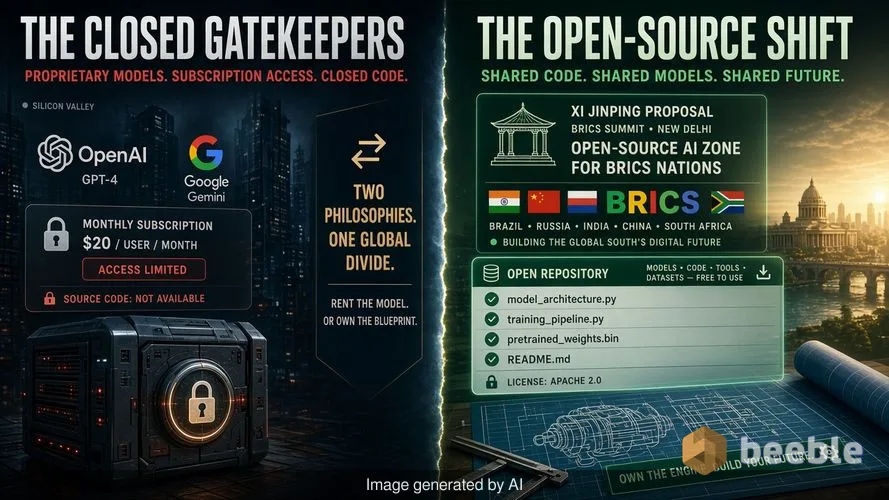
Most people assume the future of artificial intelligence is a two-way street between a handful of California companies and their subscription-paying users. While the dominance of closed-door models like GPT-4 feels inevitable, a massive shift in how the world shares code is currently underway. President Xi Jinping recently proposed an open-source AI zone for the BRICS nations at a summit in New Delhi. This move signals a departure from the proprietary walls built by the West. By offering the blueprints to advanced systems, China is attempting to make Beijing the primary architect of the Global South's digital future.
This proposal arrives at a moment when the artificial intelligence market is splitting into two distinct philosophies. On one side are the gatekeepers like OpenAI and Google, who treat their underlying code as a trade secret. On the other side is an emerging movement toward open-source models, where the base code is free for anyone to download, tweak, and run on their own hardware. For the average user, this looks like the difference between renting a car and owning the engine designs. China has realized that the easiest way to win over the developing world is not to sell them a finished product, but to give them the tools to build their own.
A shift toward collective computing
The proposed open-source AI zone is a strategic play for influence across the 11-nation BRICS bloc, which now includes heavyweights like India, Brazil, and Saudi Arabia. Xi Jinping is framing this as an initiative for inclusive growth. The goal is to establish specialized research centers and training programs that allow these nations to develop their own large language models. Historically, technology transfers from the West have come with strict licensing agreements and heavy costs. This new zone offers a decentralized alternative.
Chinese companies like Alibaba and DeepSeek already produce some of the most capable open-weights models in the world. By sharing this technology, China provides a foundation for other countries to build apps that speak their local languages and respect their cultural norms. For a developer in Mumbai or a startup in Cairo, this is a tangible benefit. They can take a high-performing Chinese model and train it on their own data without sending that information to a server in Oregon or Dublin. This setup allows for greater digital sovereignty for nations that are wary of Western data dominance.
Open source as a diplomatic tool
Artificial intelligence is the digital crude oil of the 21st century. It is the raw resource that will power everything from crop yields in Brazil to traffic management in Johannesburg. By controlling the distribution of this resource, China gains a seat at the head of the table for international standards. The initiative includes a promise to support cooperation in the development and application of large language models. This is not just about code. It is about creating a global AI governance framework that rivals the rules currently being drafted in Washington and Brussels.
From a market side, this strategy addresses the volatile nature of tech exports. US export controls have made it difficult for Chinese firms to acquire the highest-end chips. Conversely, these same controls make it harder for the West to maintain a monopoly on software. If China can convince the rest of the world to use its open-source foundations, the hardware becomes less of a barrier. The software ecosystem becomes the new frontier of influence. This is a pragmatic response to a world where trade barriers are rising.
The code behind the great wall
Under the hood, Chinese open-source models have become surprisingly resilient. Models like Alibaba’s Qwen series frequently top the charts for coding and mathematical reasoning. These are not second-tier products. They are robust tools that compete directly with the best the West has to offer. The difference is the delivery method. When a model is open-source, any company can integrate it into their internal systems without fear that a foreign government will suddenly cut off their API access.
Looking at the big picture, this creates a streamlined path for industrial development. Heavy industry is the invisible backbone of modern life, and it is increasingly managed by AI. A steel mill in Russia or a mining operation in Ethiopia can use these open models to optimize their logistics. They do not need to wait for a Silicon Valley sales rep to call them back. They can download the code and start working today. This accessibility is the core of Xi’s pitch to the BRICS members.
What this means for your data and devices
For the average consumer, this geopolitical chess match will change how your daily technology works. As more countries adopt Chinese-led open-source standards, we will see a fragmentation of the internet. You might find that your favorite productivity apps in one region use an entirely different logic than those in another. The decentralized nature of these models means that privacy could improve for some, as data stays on local devices. However, it also means that global transparency is harder to maintain.
Practically speaking, this competition will likely drive down the price of AI services. When there is a free, high-quality alternative available through a BRICS-sponsored zone, Western companies cannot keep their subscription prices high forever. We are entering a cyclical phase of the tech market where software becomes a commodity. The real value will move away from the code itself and toward the specific data used to train it. Your personal preferences and habits will be the new currency that these systems compete to understand.
The battle for global standards
Xi Jinping’s upcoming visit to the United States for talks with President Donald Trump adds another layer of complexity. AI governance is expected to be a primary topic of discussion. While the US focuses on safety through centralized control, China is pushing for a consensus-based framework that includes emerging economies. This creates a systemic tension between two different views of global security. The US views open access as a risk that could allow bad actors to weaponize AI. China views closed doors as a form of digital colonialism.
Behind the jargon, the bottom line is power. The country that sets the standards for how AI is trained, tested, and deployed will control the economic landscape for decades. Xi’s proposal is a clear attempt to ensure that China is not left out of these conversations. By building an open ecosystem for AI, China is creating a coalition of nations that are incentivized to support its vision for the future. This is a foundational shift in how international tech policy operates.
Bridging the gap between two worlds
Zooming out, the creation of an open-source AI zone is a reminder that the digital world is no longer a single, unified space. We are seeing the rise of a multipolar tech environment. In everyday life, this means you will have more choices, but those choices will come with new risks. A decentralized AI world is harder to regulate and more prone to regional biases. Yet, it also offers the promise of an intuitive tech experience that is tailored to specific cultures and needs rather than a one-size-fits-all approach from California.
Ultimately, you should observe how the apps on your phone begin to change. Watch for the rise of local AI assistants that do not require a constant cloud connection. Pay attention to how your government handles data agreements with foreign tech zones. The shift toward open-source models is not just a win for developers. It is a fundamental change in who owns the intelligence that will soon guide every aspect of our lives. You are no longer just a user of technology. You are a participant in a global experiment to decide who gets to hold the keys to the future. Shift your perspective to look past the brand names and focus on the architecture of the tools you use every day.
Sources:
- CCTV State Broadcaster Official Readout
- BRICS Secretariat Summit Summary New Delhi
- Ministry of Industry and Information Technology of the People's Republic of China
- International Energy Agency Report on Industrial AI Applications
- Stanford Institute for Human-Centered AI Index 2026



See you on the other side.
Our end-to-end encrypted email and cloud storage solution provides the most powerful means of secure data exchange, ensuring the safety and privacy of your data.
/ Create a free account
