


Could an AI Actually Move Your Muscles Better Than You Can?

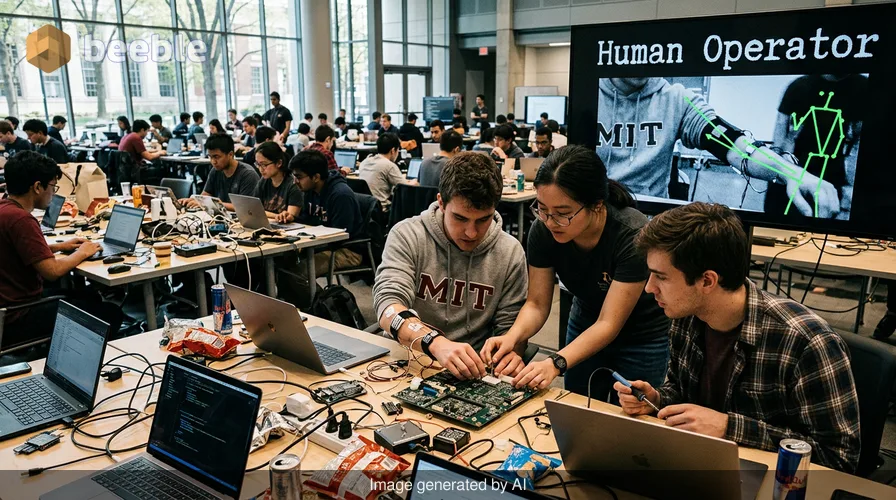
Have you ever tried to learn a new skill—like playing a complex piano melody or mastering the perfect soldering technique—only to find that your hands simply won’t cooperate with your brain? We often think of our movements as a closed loop between our intentions and our motor cortex. But what if we could invite a third party into that loop? Specifically, what if an artificial intelligence could look at the world, understand what you are trying to do, and literally pull the strings of your muscles to make it happen?
This isn't a scene from a cyberpunk thriller; it’s the result of a 48-hour sprint at the Massachusetts Institute of Technology (MIT). During the recent "Hard Mode 2026" hackathon, a team of software engineering students debuted a project called Human Operator. By combining high-end vision models with hardware that sends electrical pulses directly into the wearer’s arm, they have effectively given AI a way to "pilot" a human body.
Giving the Digital Brain a Physical Body
To understand the significance of this, we first have to look at the current state of AI. For the last few years, AI has been a brain without a body—a tireless intern capable of writing emails, generating images, or analyzing vast spreadsheets, but trapped behind a glass screen. While robotics companies are working hard to build metal bodies for these brains, the Human Operator team took a different route: they decided to use the bodies we already have.
At the core of this system is a Vision-Language Model (VLM). If a standard AI is like a text-based search engine, a VLM is more like a digital observer that can see an object—say, a piano keyboard—and understand both what it is and how a human should interact with it. The user wears a head-mounted camera that acts as the AI’s eyes. When you give a verbal command like "play a C-major chord," the AI doesn't just tell you how to do it; it calculates the exact muscle movements required.
Behind the jargon, the hardware side relies on Electrical Muscle Stimulation (EMS). This technology isn't new; it has been the foundational backbone of physical therapy for decades, used to prevent muscle atrophy or assist in rehabilitation. However, by connecting EMS to a VLM, the students have created a bridge between digital intent and physical action. The system sends small, precise electrical pulses to pads on the user's forearm, triggering specific muscles to contract and move the fingers without the user consciously deciding to do so.
From Waving to Writing: How it Works in Practice
In demonstrations that feel both impressive and slightly eerie, the Human Operator device was shown guiding a user’s hand to perform an "OK" gesture, wave at a passerby, and even press specific notes on a piano. For the average user, the sensation is often described as a strange "tug" or an external urge moving the limb.
Essentially, the AI is bypassing the traditional neural pathways. Usually, your brain sends an electrical signal down your spine to your arm. Here, the AI is "side-loading" that signal directly into the muscle. Looking at the big picture, this prototype proves that the barrier between software and biology is becoming increasingly transparent.
| Component | Role in the Human Operator System |
|---|---|
| Head-Mounted Camera | The "Eyes": Captures real-time video of the environment and objects. |
| Vision-Language Model (VLM) | The "Brain": Processes visual data and converts spoken instructions into action plans. |
| EMS Controller | The "Nervous System": Translates the AI's plan into specific electrical voltages. |
| Electrode Pads | The "Actuators": Delivers pulses to the skin to contract forearm and wrist muscles. |
Why This Matters for the Everyday Consumer
While a 48-hour hackathon project is rarely ready for the local electronics store, the implications for consumer tech are disruptive and scalable. Historically, we have learned physical tasks through observation and repetition—a process that is often slow and prone to error.
Imagine a world where "muscle memory" can be downloaded. A DIY enthusiast could wear a version of this device to learn how to use a delicate wood-carving tool safely. A medical student could feel the exact pressure required for a surgical incision by having an AI-guided hand lead the way. To put it another way, we are moving from "watching a tutorial" to "feeling the tutorial."
From a market side, this also opens a massive door for the assistive technology industry. For individuals recovering from strokes or nerve damage, the primary challenge is often the disconnect between the brain’s desire to move and the muscle's ability to respond. A streamlined, AI-driven EMS system could act as a digital bridge, helping patients regain mobility through a more intuitive, automated form of physical therapy.
The "So What?" Filter: Practical Hurdles and Skepticism
As impressive as it is to see a student-built rig move a hand in two days, we should maintain a healthy dose of pragmatic skepticism. The human body is incredibly complex, and our muscular system is not a simple set of binary switches. Every person has a different physiological makeup; what triggers a finger flick in one person might do nothing for another or cause discomfort for a third.
Moreover, the logic behind these AI models can sometimes be opaque. If an AI misinterprets its surroundings—mistaking a sharp knife for a harmless pen—the consequences of it "taking control" of your hand are suddenly much higher. There is a foundational question of consent and safety that hasn't been fully addressed: how do we ensure the user can override the AI instantly if something goes wrong?
Currently, these systems are resilient enough for a controlled lab or a stage demo, but the real world is messy and volatile. The "digital crude oil" of data that fuels these models needs to be incredibly precise to handle the nuances of human movement without causing strain or injury.
Looking Ahead: The Evolution of Human Augmentation
Ultimately, the Human Operator project isn't just about making a hand move; it’s about a shifting paradigm in how we view our relationship with machines. We are used to tools that we operate (like a car or a mouse), but we are entering an era of tools that operate us.
Practically speaking, this tech will likely show up first in heavy industry or high-stakes training environments before it reaches the living room. It is much easier to justify a complex AI-muscle interface for training a technician to handle hazardous materials than it is for teaching a hobbyist the ukulele. However, as the hardware becomes more decentralized and the software more robust, the line will continue to blur.
For the average person, the takeaway is simple: pay attention to the "wearable" space. We have spent the last decade tracking our steps and our heart rates. The next decade will likely be about using those same devices to actively influence how we move and learn. Whether you’re ready to let an AI "take the wheel" of your arm or not, the technology to make it happen is already being built in dorm rooms and labs across the globe.
Sources:
- MIT Hard Mode 2026 Project Archives: Human Operator Documentation.
- Association for Computing Machinery (ACM): Research on Vision-Language Models in Robotics.
- International Journal of Physical Medicine & Rehabilitation: Historical Use of EMS in Clinical Settings.
- Project Website: Human Operator Team Technical Specifications.



See you on the other side.
Our end-to-end encrypted email and cloud storage solution provides the most powerful means of secure data exchange, ensuring the safety and privacy of your data.
/ Create a free account
