


EU Parliament Signals New Era for AI Copyright: Protecting Creators in the Age of Generative Models

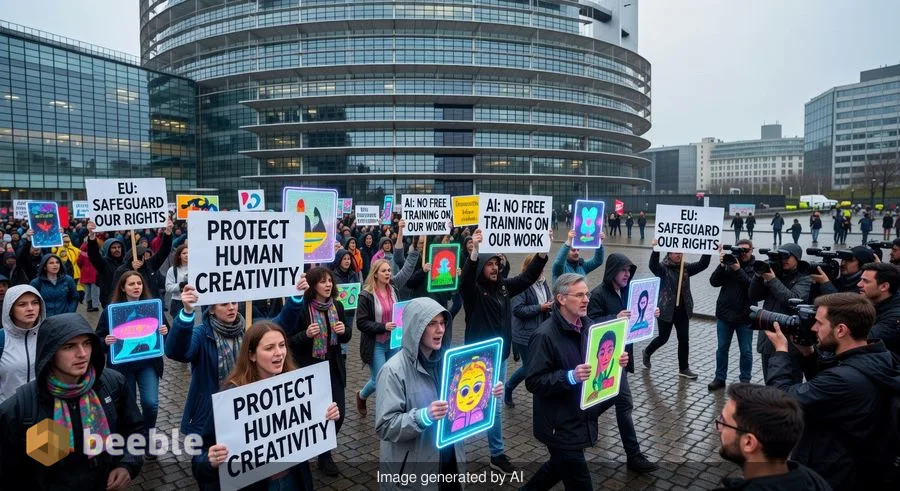
The intersection of artificial intelligence and intellectual property has long been a legal gray area, but the European Parliament is now moving to turn that fog into a firm boundary. On Tuesday, March 10, 2026, lawmakers in Strasbourg adopted a comprehensive set of recommendations aimed at establishing a permanent, robust framework to protect creative works from being used as AI training data without explicit consent or compensation.
This move represents a significant escalation in the ongoing dialogue between the technology sector and the creative industries. While the original EU AI Act laid the groundwork for transparency, these new recommendations signal that European legislators believe the initial measures did not go far enough to safeguard the livelihoods of artists, writers, and musicians.
Moving Beyond the Opt-Out Model
For the past several years, the standard practice for many AI developers has been a "scrape first, answer questions later" approach. Under existing frameworks, many creators were forced to manually "opt-out" of training datasets—a process often described as a digital game of whack-a-mole. If an artist didn't specifically tag their work with machine-readable code to forbid scraping, it was considered fair game for large language models (LLMs) and image generators.
The Parliament’s new stance suggests a fundamental shift toward an "opt-in" philosophy. By urging a permanent solution, lawmakers are exploring the possibility of making explicit licensing the default requirement for any copyrighted material used in AI training. This would effectively place the burden of proof and the responsibility of negotiation on the AI companies rather than the individual creators.
The Transparency Crisis in AI Training
A primary hurdle in the fight for copyright protection is the "black box" nature of many AI models. It is often impossible for a photographer or novelist to prove their work was used to train a specific model because the training sets are proprietary and opaque.
The recommendations adopted this week call for a more granular level of transparency. This includes the creation of a centralized, searchable database where AI developers must disclose the specific datasets used to train their models. Think of it as a nutritional label for software; instead of calories and fats, it lists the intellectual property consumed to build the model's intelligence.
Economic Implications for the Creative Industry
Creative industry groups have hailed the vote as a landmark victory. For years, organizations representing authors and visual artists have argued that AI companies are engaging in a form of "data colonialism"—extracting value from human creativity to build products that may eventually compete with those very same creators.
"This isn't just about stopping progress; it's about ensuring that progress is built on a foundation of fairness," says one industry advocate. "If a machine can generate a symphony in seconds because it studied a million human-composed scores, the humans who provided that 'education' deserve a seat at the table."
The proposed rules could lead to the establishment of collective licensing bodies, similar to those that manage music royalties for radio and streaming. Under such a system, AI companies would pay into a fund that distributes royalties to creators whose works are part of the training ecosystem.
The Technical Challenge of Enforcement
While the political will is strengthening, the technical execution remains a daunting task. How do you verify that a model hasn't "memorized" a specific copyrighted image? How do you handle "derivative" works where the AI has learned a style rather than a specific piece of content?
Lawmakers are looking toward emerging technologies like digital watermarking and blockchain-based attribution to solve these issues. However, critics argue that these technologies are not yet foolproof. There is also the concern of "regulatory divergence," where AI companies might simply move their training operations to jurisdictions with more lax copyright laws, potentially putting European tech firms at a competitive disadvantage.
Practical Takeaways for Stakeholders
As the EU moves toward drafting formal legislation based on these recommendations, different sectors should begin preparing for a more regulated environment.
For Creators and Rights Holders:
- Audit Your Digital Presence: Ensure your work is tagged with "no-ai" metadata where possible, even if the law is still catching up.
- Join Collective Organizations: Membership in guilds or copyright collectives will likely be the most effective way to negotiate for royalties in the future.
- Document Your Work: Keep clear records of original creations to simplify potential future claims.
For AI Developers and Tech Firms:
- Prioritize Data Provenance: Shift focus toward datasets with clear lineage and permission structures.
- Invest in Transparency Tools: Develop internal systems to track and disclose training data to avoid future compliance shocks.
- Explore Ethical Licensing: Proactively seek partnerships with content repositories rather than relying on web scraping.
What Happens Next?
The adoption of these recommendations is not yet law, but it serves as a powerful mandate for the European Commission to draft specific legislative proposals. We can expect a period of intense lobbying and public consultation throughout the remainder of 2026.
The goal is to create a "permanent" solution that balances the undeniable potential of AI with the fundamental rights of human creators. As the digital landscape continues to evolve, the EU is clearly signaling that it intends to remain the world’s most aggressive regulator of the algorithmic frontier.
Sources
- European Parliament Press Room: Official releases on AI and Intellectual Property.
- EU AI Act (Regulation 2024/1689): Implementation timeline and Article 53 requirements.
- International Federation of the Phonographic Industry (IFPI): Reports on AI and creative rights.
- World Intellectual Property Organization (WIPO): Studies on generative AI and copyright law.



See you on the other side.
Our end-to-end encrypted email and cloud storage solution provides the most powerful means of secure data exchange, ensuring the safety and privacy of your data.
/ Create a free account
