


Europe is preparing to evict American tech giants from its most sensitive data centers

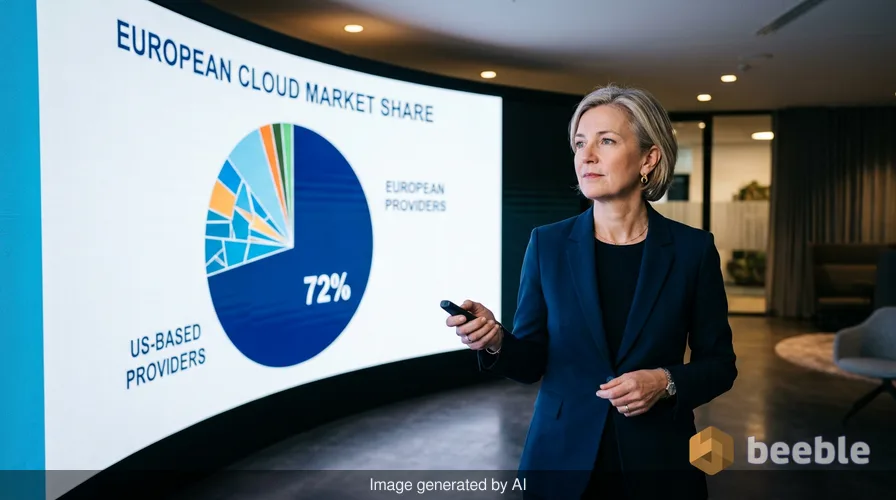
American companies currently manage 72% of the cloud infrastructure market in Europe. Amazon Web Services, Microsoft Azure, and Google Cloud are the three dominant players. This concentration of power has prompted the European Commission to draft new rules that could exclude these giants from sensitive government projects. The proposed Cloud and AI Development Act aims to reduce the continent's reliance on foreign technology. EU tech chief Henna Virkkunen plans to announce the package this Wednesday. The document suggests that Europe is ready to sacrifice some efficiency for the sake of digital sovereignty.
Looking at the big picture, the cloud is the invisible backbone of modern life. It is the digital space where banks process transactions, hospitals store patient records, and power grids balance electricity loads. For years, European organizations have outsourced this work to US companies because their tools are scalable and affordable. However, the legal environment has changed. The draft proposal indicates that price is no longer the most important factor for the EU. Instead, the commission wants to ensure that the hardware and software used in strategic sectors are born and raised in Europe.
The legal paradox of the cloud act
The central conflict stems from a piece of American legislation called the Cloud Act. This law gives US authorities the power to demand data from American companies regardless of where that data is physically stored. If a French hospital uses a server managed by Microsoft, US law enforcement could technically request access to those French records. This contradicts European privacy laws like the GDPR. Essentially, a cloud provider cannot follow both sets of rules at the same time without creating a legal conflict.
Europe views this as a systemic risk. If a foreign government has a backdoor into the energy grid or the banking system, that constitutes a national security threat. To put it another way, Europe does not want to keep the keys to its house in a drawer that someone in Washington can open. The new draft rules are a direct response to this fear. They introduce strict requirements for cloud providers to prove they are immune to foreign laws. For the big three US providers, meeting these rules is nearly impossible because they are headquartered in Seattle or Mountain View.
A shift from price to origin
In a standard government tender, the contract usually goes to the company that offers the best service for the lowest price. The US giants almost always win these competitions because they have massive global operations that allow them to keep costs low. The new EU proposal changes the scoreboard. It introduces mandatory non-price award criteria. Under these rules, a government agency must prioritize software and hardware developed within the EU.
This is a major win for local companies like OVHcloud, T-Systems, and Orange. These firms have struggled to compete with the sheer processing power and feature sets of Amazon or Google. Now, they are being given a protected space in the market. While their services may be less advanced or more expensive, they offer something the US firms cannot: a guarantee that they only answer to European judges. This protectionist shift is intended to help European tech firms grow into more robust competitors.
What this means for sensitive sectors
The draft document identifies specific areas where these rules apply. These include banking, energy, healthcare, and water management. For the average user, this means the digital plumbing behind your essential services is about to change. Your local energy provider might move its data from a US-owned server to a European one. This process is not as simple as moving files from one USB drive to another. It involves migrating vast amounts of code and reconfiguring complex digital architectures.
In everyday life, you might notice that some digital government services become slower or less intuitive during this transition. American providers spend billions of dollars every year to make their interfaces user-friendly and their systems resilient. European competitors often operate with smaller budgets. As a result, the user experience might take a step backward in the short term. The following table illustrates how the requirements for these strategic tenders are expected to change.
| Feature | Current tender standards | Proposed EU strategic standards |
|---|---|---|
| Data location | Can be global with safeguards | Must be strictly within the EU |
| Company ownership | Any (US, Asian, European) | Preference for EU-headquartered firms |
| Hardware origin | Global supply chain | EU-developed hardware preferred |
| Law enforcement access | Subject to US Cloud Act | Immunity from foreign data requests |
| Pricing weight | Primary factor in selection | Secondary to sovereignty criteria |
The cost of digital independence
Building a local tech ecosystem is a transparently expensive goal. American cloud providers are like a massive digital power grid that can supply electricity to everyone at a low cost. Trying to build a separate, European-only grid is a massive undertaking. It requires new data centers, new chips, and thousands of specialized engineers. Critics of the plan argue that excluding the world's most innovative companies will hinder Europe's progress in artificial intelligence and data science.
Conversely, supporters believe that the price of dependence is too high. If the relationship between the US and the EU sours, or if a future US administration decides to use data access as a political tool, Europe would be defenseless. By forcing government agencies to buy local, the EU is effectively subsidizing its own tech industry. This is a long-term play. The goal is to create a self-sustaining cycle where local profits lead to local research and development, eventually closing the gap with Silicon Valley.
How this affects the global tech market
The reaction from the United States is expected to be frosty. Washington has already expressed frustration with European laws like the Digital Markets Act, which it views as an attack on American success. This new proposal takes the fight from the consumer market into the government market. Public tenders are a huge source of revenue. If Microsoft and Amazon are locked out of European government contracts, it represents a significant loss of potential income.
This move also sets a precedent for other regions. If Europe successfully builds a digital wall around its strategic data, countries like India or Brazil might follow suit. We are seeing a shift from a decentralized, global internet toward a series of regional digital blocks. This fragmentation makes it harder for companies to operate globally but gives individual nations more control over their own digital destinies.
What this means for you
From a consumer standpoint, the immediate impact is minimal. You will still be able to use your favorite American apps for your personal life. However, your relationship with the state is changing. The bottom line is that your most sensitive data—your health records, your tax filings, and your energy usage—is becoming part of a geopolitical tug-of-war.
Practically speaking, you should expect the digital services provided by your government or bank to change. They may introduce new security protocols or move to new apps. You might also see slight increases in fees or taxes to cover the cost of this more expensive, local infrastructure. Sovereignty is a premium product, and the bill eventually reaches the taxpayer.
Ultimately, this draft document is a sign that the era of the borderless internet is ending. Europe is choosing to prioritize the safety of its data over the speed of its innovation. This is a pragmatic decision based on the reality of global politics in 2026. As these rules become law, the digital maps of the world will look much more like physical maps, with clear borders and local rules governing every byte of information.
Sources
- Reuters: EU draft proposal on cloud security and state tenders.
- European Commission: Cloud and AI Development Act preliminary briefing.
- US Department of Justice: Clarifying Lawful Overseas Use of Data (CLOUD) Act summary.
- Eurostat: Cloud computing adoption statistics in European enterprises.
- Market analysis: Synergy Research Group cloud market share reports.



See you on the other side.
Our end-to-end encrypted email and cloud storage solution provides the most powerful means of secure data exchange, ensuring the safety and privacy of your data.
/ Create a free account
