


Europe’s AI Dream is Currently Stuck in a Decade-Long Waiting List

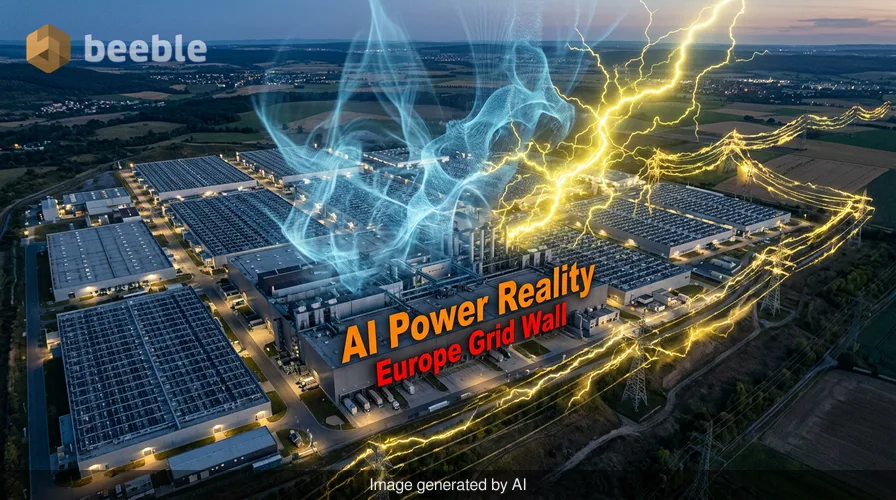
We often talk about artificial intelligence as if it were a ghost in the machine—an ethereal, weightless presence that lives in the 'cloud' and solves our problems with a bit of clever code. From a consumer standpoint, it feels like magic. You type a prompt into a chatbot on your phone, and a few seconds later, you have a travel itinerary or a corrected line of code. But behind the jargon of 'neural networks' and 'large language models' lies a gritty, industrial reality. AI isn't just software; it is a massive heavy industry project that requires more electricity than almost anything else we’ve ever plugged into a wall.
While the popular narrative suggests that Europe is on the verge of an AI-powered economic renaissance, the reality on the ground is far more volatile. A new study by the energy think tank Interface suggests that Europe’s digital ambitions are running head-first into a physical wall: the electricity grid. The continent wants to build the brains of the future, but it hasn't figured out how to keep the lights on in the factory.
The Industrial Backbone of Your Chatbot
To understand why this is a crisis, we have to look under the hood at how data centres have changed. Historically, a data centre was like a very large library—a quiet place that stored information and sent it out when someone requested it. These facilities were energy-intensive, sure, but their power needs were relatively predictable and flexible.
AI has changed the math entirely. An AI data centre is less like a library and more like a heavy-duty smelting plant. Training a model like GPT-4 reportedly consumed roughly 46 gigawatt-hours of energy. To put that into perspective for the average user, that is enough electricity to power the entire city of Brussels for nearly five days.
In simple terms, the chips required for AI (like those made by Nvidia) run at maximum intensity for weeks or months at a time. They don’t 'idle.' This creates a massive, sustained draw on the power grid that most European cities simply weren't designed to handle. We are essentially trying to run a fleet of industrial steel mills on a grid built for toaster ovens and streetlights.
The 13-Year Waiting Room
Looking at the big picture, the most tangible evidence of this friction is found in what the industry calls the FLAP-D cities: Frankfurt, London, Amsterdam, Paris, and Dublin. These are the traditional hubs of European data traffic. If you live in Europe, your digital life likely flows through one of these five cities.
Today, these hubs are essentially closed for business. In Dublin, there is a de facto ban on new data centres until at least 2028. In Frankfurt and Amsterdam, the situation is even more opaque and restrictive. The study reveals that if you want to build a new high-end AI facility in these primary markets today, you might be waiting between 7 to 13 years just to get a connection to the power grid.
Practically speaking, a 13-year wait in the tech world is an eternity. By the time a facility planned today actually comes online in 2039, the AI models it was designed to house will be museum pieces. This creates a systemic risk where Europe’s AI ambitions become 'stranded assets'—expensive buildings that sit empty because they lack the lifeblood of electricity.
Why the Grid is Gasping for Air
Behind the scenes, the problem is that Europe’s electricity grid is already exhausted. It is currently being asked to do three massive, interconnected jobs at once:
- Electrifying Transport: Moving millions of drivers from petrol to electric vehicles.
- Heating Homes: Transitioning from gas boilers to electric heat pumps.
- Green Energy Shift: Integrating volatile renewable sources like wind and solar, which don't always produce power when the sun isn't shining or the wind isn't blowing.
Adding massive AI clusters to this mix is like trying to merge a freight train onto a crowded suburban cul-de-sac. The grid—the network of wires, substations, and transformers—is the invisible backbone of modern life, and it is currently at its breaking point. When a single AI cluster demands 300 megawatts (the equivalent of 250,000 European homes), the local utility can't just 'plug it in.' They often have to rebuild the entire local transmission network, a process that is bogged down by red tape, local protests, and sheer engineering complexity.
The Consumer Impact: What This Means for You
It is easy to view this as a 'big business' problem, but the consequences trickle down to the everyday user in several disruptive ways.
| Feature | Current Reality | The Potential "Grid Gap" Impact |
|---|---|---|
| AI Feature Access | Near-instant updates to global tools. | Delayed rollouts in Europe as companies prioritize regions with cheaper, ready power. |
| Subscription Costs | Competitive pricing for Pro AI tools. | Likely price hikes as companies pass on the cost of high European energy and long delays. |
| Service Speed | Low latency (quick replies). | Potential 'lag' if your data has to travel to a different continent for processing. |
| Energy Bills | Driven by heating and home appliances. | Possible upward pressure on local utility rates to fund massive grid upgrades. |
On the market side, we are already seeing the first signs of a retreat. High-profile companies like OpenAI have reportedly put some of their UK and Norway expansion plans on ice. The reason? The electricity is too expensive, and the wait times are too long. For the average user in Europe, this could eventually mean that the most advanced AI features—the ones that require the most 'juice'—simply won't be available locally. Your digital assistant might become a bit slower or a bit less 'smart' than its American counterpart because the infrastructure to support it is stuck in a permit queue.
Zooming Out: A Shifting Landscape
Ultimately, the issue isn't that Europe lacks the talent or the will to lead in AI; it’s that it lacks the plumbing. Historically, we’ve treated digital infrastructure as something separate from the physical world. We are now learning, quite painfully, that they are one and the same.
To fix this, the report suggests a more robust and streamlined approach. Instead of building data centres wherever it’s convenient for business, they need to be built where the energy actually is—often far away from major cities, near massive wind farms or nuclear plants. This decentralized approach would take the pressure off local grids and make the whole system more resilient.
Curiously, this might lead to a new industrial geography. We might see tech hubs sprout up in northern Scandinavia or rural regions of Spain and France—places with plenty of land and surplus green energy—rather than the crowded outskirts of London or Paris.
Key Takeaways for the Reader
- AI is an Energy Hog: Every AI query has a tangible physical cost in electricity. As models get smarter, their 'appetite' grows exponentially.
- Infrastructure is the Bottleneck: The primary reason Europe might fall behind in AI isn't a lack of coders; it's a lack of power grid capacity.
- Expect a 'Two-Speed' Digital World: If grid constraints continue, European users might see slower rollouts of power-hungry AI features compared to the US or Asia.
- The Geography of Tech is Changing: The next decade will likely see data centres move away from big cities toward regions with the most stable and affordable green energy.
As we move forward, it’s worth shifting your perspective. The next time you use an AI tool, remember that it isn't just 'math in the cloud.' It is the result of thousands of spinning turbines and a massive, straining web of copper wires stretching across the continent. Appreciating the invisible industrial mechanics that power our digital lives is the first step toward understanding why our tech future might be a lot more expensive—and a lot more complicated—than we were led to believe.
Sources:
- Interface Think Tank: "Energy and Digital Policy: The Data Centre Challenge"
- International Energy Agency (IEA): Electricity 2024 Report
- Cloudscene: Global Data Centre Market Statistics 2025-2026
- EirGrid & TenneT: Grid Connection Capacity Reports for Ireland and the Netherlands



See you on the other side.
Our end-to-end encrypted email and cloud storage solution provides the most powerful means of secure data exchange, ensuring the safety and privacy of your data.
/ Create a free account
