


Europe’s Digital Independence: Inside the EURO-3C Sovereign Cloud and AI Initiative

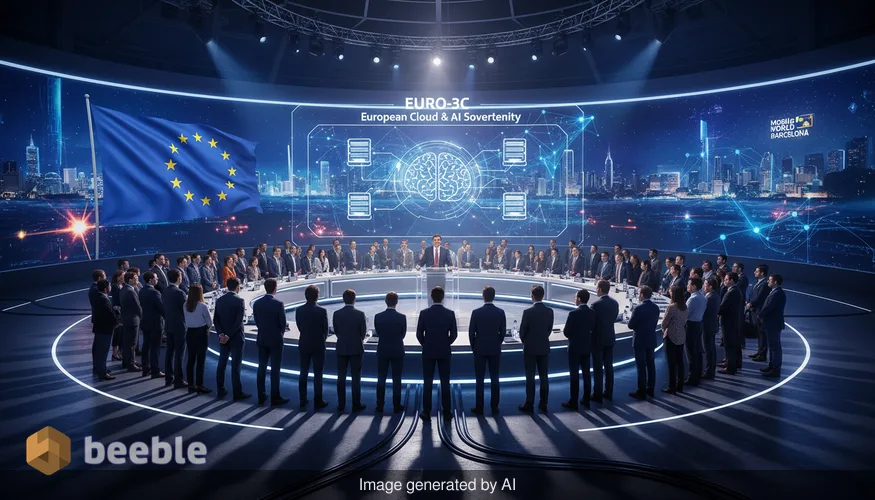
For years, the European digital landscape has been a patchwork of local innovation built on top of foreign foundations. While European companies excel in specialized sectors, the underlying infrastructure—the servers, the AI models, and the data processing pipelines—has largely remained the domain of a few massive providers from the United States and China.
At the 2026 Mobile World Congress (MWC) in Barcelona, that narrative shifted. Led by Spanish telecom giant Telefónica and backed by the European Commission, a consortium of over 70 organizations announced the launch of EURO-3C. This ambitious project aims to build a federated, sovereign cloud and AI infrastructure designed to give the continent control over its own digital destiny.
The Architecture of Sovereignty
At its core, EURO-3C (European Cloud, Computing, and Communication) is not a single data center or a lone software platform. Instead, it is a federated model. To understand this, imagine the difference between a single massive supermarket chain and a network of local farmers' markets that all use the same payment system, quality standards, and delivery trucks.
By federating resources, EURO-3C allows telecommunications operators, startups, and small-to-medium enterprises (SMEs) to pool their computing power. This creates a distributed network where data doesn't have to travel to a centralized hub in Virginia or Shanghai. Instead, it can be processed at the "edge"—physically closer to where the data is generated, whether that is a factory floor in Germany or a smart city grid in Spain.
Why Europe is Moving Away from the Hyperscalers
The reliance on "hyperscalers" (the industry term for giant providers like AWS, Microsoft Azure, and Google Cloud) has long been a point of friction for European regulators. The primary concern is not just economic, but legal and ethical.
Under the U.S. CLOUD Act, for instance, American authorities can theoretically request data stored by U.S. companies even if that data resides on servers in Europe. For European industries dealing with sensitive health, financial, or governmental data, this creates a perpetual state of legal uncertainty. EURO-3C aims to solve this by ensuring that the infrastructure is governed entirely by European law, providing a "safe harbor" for sensitive AI training and data storage.
The Integration of Cloud, AI, and Edge
What sets EURO-3C apart from previous attempts at European cloud independence is its holistic approach. It isn't just about storage; it is about the entire stack of modern computing. Sebas Muriel Herrero, Chief Digital Officer at Telefónica, noted that the project is designed to make cloud, AI, and edge computing work together seamlessly.
By integrating AI directly into the sovereign cloud, European startups can train large language models (LLMs) or computer vision systems without exporting their proprietary data to external platforms. This "local-first" AI approach is critical for the next generation of digital services, such as autonomous driving and real-time industrial automation, where even a millisecond of latency caused by long-distance data travel can be a deal-breaker.
Comparing the Models: Hyperscalers vs. EURO-3C
| Feature | Global Hyperscalers (US/China) | EURO-3C Federated Model |
|---|---|---|
| Governance | Subject to foreign jurisdiction (e.g., CLOUD Act) | Strictly under EU law and GDPR |
| Data Location | Centralized in massive regional hubs | Distributed across local edge nodes |
| Infrastructure | Proprietary, closed-loop ecosystems | Open, federated, and interoperable |
| Primary Goal | Global scale and market dominance | Digital sovereignty and local economic growth |
| AI Training | Data often used to improve provider models | Data remains under the owner's control |
The Power of 70: A Collaborative Ecosystem
The strength of EURO-3C lies in its diversity. The consortium includes not just the "big telcos" like Telefónica, but also specialized technology companies and agile startups. This ecosystem approach is intended to prevent the project from becoming a bureaucratic monolith.
By involving SMEs, the European Commission is ensuring that the benefits of high-performance computing are accessible to smaller players who might otherwise be priced out of the AI race. It creates a marketplace where a small AI firm in Estonia can easily deploy its software on infrastructure provided by a telco in Italy, all within a unified, secure framework.
Practical Takeaways for European Businesses
As EURO-3C moves from announcement to implementation, businesses operating within the EU should begin preparing for this shift in the digital landscape. Here is how to approach the transition:
- Audit Your Data Sensitivity: Identify which parts of your data stack are subject to strict residency requirements. These are the primary candidates for a sovereign cloud migration.
- Evaluate Edge Use Cases: If your business relies on real-time data (IoT, manufacturing, retail analytics), look into how federated edge computing can reduce your latency costs.
- Monitor Interoperability Standards: One of the goals of EURO-3C is to prevent "vendor lock-in." Ensure your current cloud architecture is containerized (using tools like Kubernetes) to make moving workloads easier.
- Engage with Local Providers: Reach out to the telcos and tech providers involved in the EURO-3C consortium to understand their specific roadmaps for 2026 and beyond.
The Road Ahead
Building a "cloud empire" to rival the established giants is a monumental task. Critics often point to past European projects that struggled to gain commercial traction due to complexity or lack of scale. However, the inclusion of AI and edge computing as foundational pillars suggests that EURO-3C is looking toward the future of the internet, rather than trying to replicate the cloud of the past decade.
If successful, EURO-3C won't just be a technical achievement; it will be a declaration of independence for the European digital economy.
Sources
- Telefónica Official Newsroom: EURO-3C Project Announcement
- European Commission: Digital Sovereignty and the Data Act
- Euronews Next: Interviews from MWC Barcelona 2026
- Gaia-X Association: Federated Services Specifications



See you on the other side.
Our end-to-end encrypted email and cloud storage solution provides the most powerful means of secure data exchange, ensuring the safety and privacy of your data.
/ Create a free account
