


Forget the Chatbots—The Real AI Fortune Is in Renting Out the Hardware

When a software engineer opens their laptop today and begins typing a command into Cursor, an AI-powered code editor, the software almost magically finishes their thought. A few keystrokes become an entire functional block of code, saving hours of tedious manual typing. But if you follow that seamless, instantaneous prediction backward from the screen, you leave the realm of software and enter a deeply physical world.
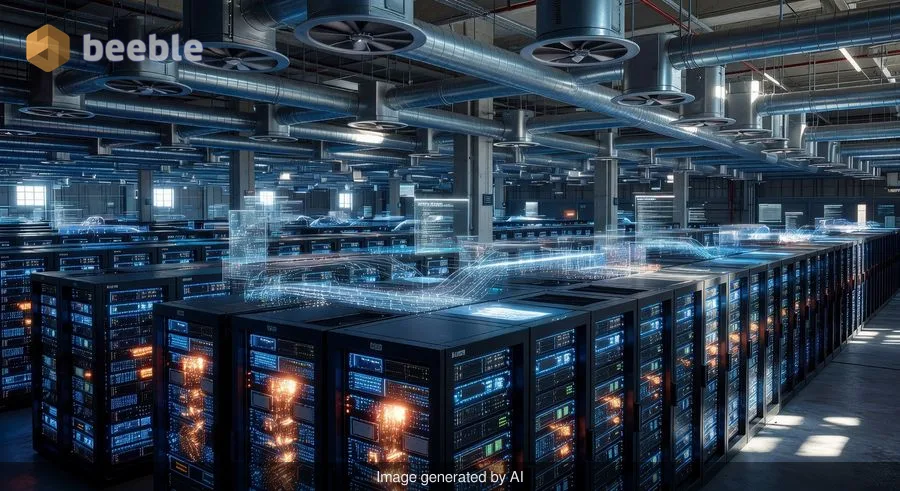
Trace the code autocomplete back to the foundational AI model that powers it. Trace that model back to its training grounds, and you will find tens of thousands of humming, power-hungry computer chips stacked in a cavernous, hyper-cooled data center. Soon, for Cursor's next generation of AI, those data centers will belong to Elon Musk's xAI.
In a move that signals a shifting reality in the tech industry, xAI is reportedly finalizing an arrangement to supply its stockpile of computing power to Cursor, a coding startup recently valued at a staggering $29 billion. Cursor plans to train its upcoming model, Composer 2.5, using tens of thousands of xAI's graphics processing units (GPUs).
Looking at the big picture, this arrangement marks a systemic evolution. xAI is no longer just a laboratory trying to build a clever chatbot to rival OpenAI's ChatGPT. By leasing out its physical hardware, xAI is quietly transforming into a cloud infrastructure provider—competing directly with the silent, trillion-dollar backbone of the modern internet.
The Digital Crude Oil Economy
To understand why this partnership matters, we have to talk about microchips—specifically, GPUs. In the current technological era, GPUs are the digital crude oil. They are the raw, unrefined resource required to produce the fuel that powers artificial intelligence. Just as a nation's geopolitical influence was once dictated by its access to petroleum reserves, a modern tech company's ceiling is strictly defined by its access to computing power.
Historically, the companies that control the servers control the tech economy. Amazon, Microsoft, and Google—the undisputed titans of the cloud—own millions of these chips. They rent this computing power out to developers globally, generating unprecedented profits that dwarf the revenue of their consumer-facing products.
In recent years, specialized players like CoreWeave and Lambda have emerged, building highly lucrative businesses exclusively around supplying GPUs to AI model developers. Access to compute is the ultimate bottleneck. It doesn't matter how brilliant your software engineers are; if you do not have the physical chips to train your AI model, your product cannot exist.
Why Cursor Needs a Supercomputer
Cursor's objective is to build Composer 2.5, an AI model that deeply understands the logic, syntax, and architecture of programming languages. Training a model of this magnitude requires ingesting and analyzing billions of lines of code, identifying patterns, and learning how different software frameworks interact.
To put it another way, training an advanced AI is like asking a human to read every book in a massive metropolitan library a thousand times over to master the English language. One person reading sequentially would take lifetimes. But if you hire 50,000 people to read different sections simultaneously and share their notes, the job gets done in months.
Under the hood, that is exactly what tens of thousands of interconnected GPUs do. They process mathematical equations in parallel, breaking down an opaque ocean of coding data into tangible, scalable intelligence. But housing, powering, and cooling 50,000 top-tier GPUs requires a facility roughly the size of several football fields, consuming enough electricity to power a small city.
Cursor, as a software-focused startup, has no desire to pour billions of dollars into pouring concrete and managing industrial cooling systems. They just need the compute time.
From Building Brains to Renting Out the Garage
xAI's pivot to renting out its hardware is born out of pragmatic economic reality. Over the past few years, Musk's company has aggressively acquired some of the largest GPU clusters in the world to train its proprietary Grok models.
But running data centers is a volatile, capital-intensive business. The infrastructure costs are astronomical. Once a company finishes training a specific version of its own model, there are inevitably periods where parts of its massive supercomputer sit idle. In the world of high-performance computing, idle silicon is a severe financial liability.
By renting some of its GPUs to Cursor, xAI achieves two overarching goals. First, it offsets the blistering costs of building and maintaining its data centers. Second, it establishes a robust financial pipeline that generates immediate, transparent revenue while the company continues to develop its own software in parallel.
Curiously, this deeply echoes the origin story of Amazon Web Services (AWS). Over two decades ago, Amazon built massive internal server infrastructure to handle its e-commerce spikes, eventually realizing it could monetize the downtime by renting the excess capacity to other businesses. That "side hustle" is now the primary profit engine of the entire Amazon empire.
The Shifting Cloud Hierarchy
The current landscape of AI compute can be broken down into a few distinct tiers, and xAI's new move places it directly in the middle of a heated market.
| Provider Type | Key Players | Core Business Model | Primary Advantage for AI Startups |
|---|---|---|---|
| The Cloud Titans | Amazon (AWS), Microsoft Azure, Google Cloud | General-purpose cloud hosting and enterprise IT solutions. | Unmatched global scale and integration with existing corporate databases. |
| Specialty GPU Clouds | CoreWeave, Lambda | Renting bare-metal access to high-end Nvidia chips specifically for AI. | Highly optimized networking for AI tasks; often cheaper and faster to spin up than Titans. |
| The AI Lab Moonlighters | xAI (via the Cursor deal) | Training proprietary AI models, but renting out excess hardware capacity. | Potential for deeply negotiated partnerships, data-sharing, and leveraging bleeding-edge cluster setups. |
What This Means for the Everyday Consumer
For the average user, the corporate machinations of cloud computing and GPU allocations can feel incredibly distant. You aren't buying server racks; you're just downloading apps on your phone or using software at work.
Practically speaking, however, this infrastructure shift directly impacts the digital tools you interact with daily. Because startups like Cursor can lease immense computing power from entities like xAI without building their own data centers, the barrier to entry for creating disruptive software remains low.
When a developer uses a hyper-intelligent coding assistant to write an app, that app gets to market faster, with fewer bugs, and often at a lower cost. This translates to more robust, user-friendly software in your hands—whether that is a financial planning app, a mobile game, or a productivity tool at your office.
Conversely, as these AI models become more foundational to everyday life, the reliance on a handful of massive data centers grows. The companies that own the digital crude oil—the physical chips—will ultimately hold the most leverage over software prices. If the cost of renting GPUs rises, the subscription fees for your favorite digital services will inevitably follow.
The Invisible Mechanics of Tomorrow's Tech
The bottom line is that the "cloud" is not a weightless, abstract entity; it is a heavy, industrial machine made of silicon, copper, and cooling fans. xAI's arrangement with Cursor highlights a critical truth about the modern technology boom: the companies writing the smartest code are completely beholden to the companies pouring the concrete for the data centers.
As you navigate your digital life—tapping screens, asking chatbots questions, or relying on software to do your job—take a moment to recognize the physical reality behind the convenience. The speed at which humanity's digital tools evolve in the coming years will not just depend on the brilliance of software engineers, but on the industrial logistics of how efficiently we can deploy, power, and rent out millions of microchips.
Sources:
- Industry reports on xAI computing infrastructure and Memphis data center expansions.
- Market data regarding Cursor's 2026 valuation and Composer 2.5 development cycles.
- Financial analyses of the AI cloud computing sector, including AWS, Azure, Google Cloud, and CoreWeave operations.
- Background context on global GPU supply chains and high-performance computing metrics.



See you on the other side.
Our end-to-end encrypted email and cloud storage solution provides the most powerful means of secure data exchange, ensuring the safety and privacy of your data.
/ Create a free account
