


Forget the hype about massive cloud AI — IBM wants your data to stay home

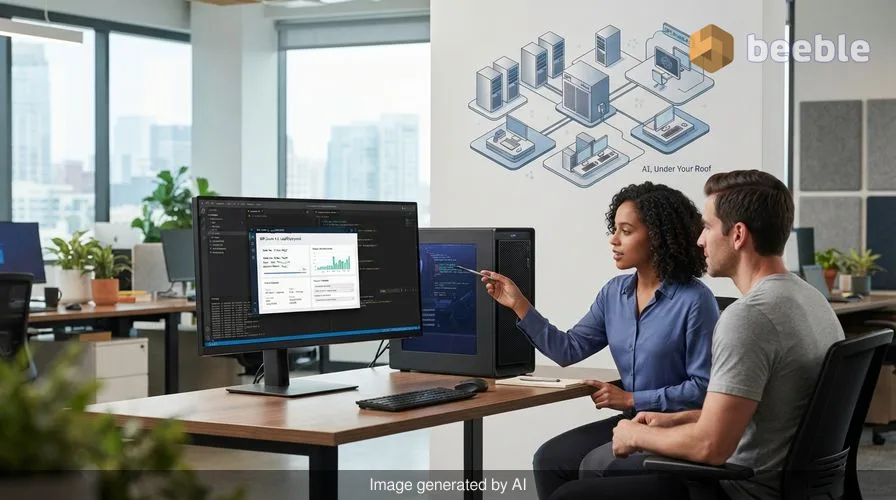
The tech industry spends most of its time convincing you that artificial intelligence requires massive, invisible supercomputers located in a distant desert. The narrative suggests that if you want a machine to think, you must rent time on a server owned by a trillion-dollar corporation. This setup forces every prompt and every sensitive document to travel across the internet, where it sits on someone else's hardware. IBM is taking a different path with the release of its Granite 4.2 family. These models do not live in a mandatory cloud; they live on your hardware.
Granite 4.2 represents a shift toward local, predictable computing for businesses and developers who are tired of fluctuating API costs and privacy risks. By releasing these as open-weight models, IBM allows users to download the entire package and run it on their own servers or even high-end workstations. This approach treats AI less like a mysterious oracle and more like a tireless intern who works exclusively inside your office walls.
Meet the Granite 4.2 family
The new release includes three distinct sizes: 3B, 8B, and 30B parameters. In the world of large language models, the number of parameters generally indicates the complexity of the digital brain. A 3B model is small enough to run on a modern laptop with decent speed. An 8B model is the current sweet spot for most developers, providing a balance between intelligence and hardware requirements. The 30B model is the heavy lifter, designed for enterprise servers that need to handle complex tasks with high accuracy.
Every model in this lineup uses a decoder-only architecture. This is a standard design choice that focuses the model on predicting the next part of a sequence, which is how these systems generate text. A significant addition in version 4.2 is the 128,000-token context window. To put that in perspective, a standard novel is about 60,000 to 90,000 tokens. A context window of this size allows the model to read and remember an entire technical manual or a massive codebase in a single session.
| Model Size | Best Use Case | Hardware Requirement (Approx) |
|---|---|---|
| Granite 4.2 3B | Mobile apps, simple chatbots, basic summarization | 8GB RAM / Consumer Laptop |
| Granite 4.2 8B | Coding assistance, detailed analysis, tool use | 16GB-24GB VRAM / Pro Workstation |
| Granite 4.2 30B | Complex reasoning, enterprise workflows, large data | 64GB+ VRAM / Multi-GPU Server |
The reality of functional reasoning
IBM describes Granite 4.2 as a reasoning-focused release. In the tech sector, reasoning is a specific term that describes a model's ability to use chain-of-thought processing. This is not consciousness or genuine understanding. Instead, the model breaks a complex problem into intermediate steps and carries the results of those steps forward to the next one. This process mimics how a person might solve a math problem by showing their work on a piece of paper.
For the average user, this focus on reasoning translates to higher accuracy in logic-heavy tasks. If you ask a standard model to plan a travel itinerary with five conflicting constraints, it might ignore two of them to give you a fast answer. A reasoning-focused model like Granite 4.2 is more likely to check each constraint against the others before providing a final response. The trade-off is speed. These models often take longer to generate a response because they are doing more mathematical heavy lifting behind the scenes. Using a reasoning model is like hiring a meticulous auditor instead of a fast-talking salesperson.
Agentic capabilities and tool use
The 8B and 30B variants have undergone specialized training to become agentic. This term refers to the ability of the AI to act as an agent that performs tasks in the real world. Rather than just writing text, these models can interact with external tools. They can use a computer terminal, search the web for fresh information, or execute snippets of code to verify an answer.
IBM used a specific reinforcement-learning block to teach these models how to use tools effectively. While the smallest 3B model can technically use tools, it lacks the specialized training found in its larger siblings. This makes the 8B and 30B models particularly disruptive for developers who want to automate repetitive digital tasks. An agentic model can look at a spreadsheet, identify a missing data point, search the web to find that data, and then update the file without human intervention. This shift moves AI from a passive chat interface to an active participant in a workflow.
Why local hosting matters for your budget
One of the most foundational reasons to look at local models is the cost of the cloud. Companies like OpenAI and Anthropic charge per token, which is essentially a tax on every word the AI reads or writes. For a small business, these costs are volatile and difficult to predict. If a specific project suddenly requires the AI to analyze thousands of documents, the monthly bill can jump from hundreds to thousands of dollars without warning.
Local models change the financial math. Once you own the hardware and download the model, the cost of generating a million words is just the price of the electricity to run the server. This predictability is the primary reason IBM targets the enterprise market. Large organizations prefer stable, fixed costs over the fluctuating pricing models of frontier cloud providers. There are no surprise fees at the end of the month when the model runs on your own silicon.
The rise of the model router
As models like Granite 4.2 become more available, developers are increasingly using model routers. A router acts like a digital traffic cop. When a user submits a prompt, the router analyzes how difficult the task is. If the user asks for a simple summary, the router sends the task to the tiny 3B model to save power and time. If the user asks for a complex architectural review, the router sends it to the 30B model.
This tiered approach allows organizations to balance performance and efficiency. It prevents the waste of using a massive, power-hungry model for a task that a smaller model can handle in half the time. By using the Granite family, a developer can build a streamlined system where the right tool always matches the job. This interconnected ecosystem of models is becoming the standard for professional AI deployments.
Privacy and the invisible backbone of industry
For many industries, the cloud is a non-starter due to regulatory requirements. Healthcare providers, law firms, and government contractors often handle data that legally cannot leave their secure networks. In these environments, local LLMs are the only viable path forward. Granite 4.2 provides these sectors with a way to use modern AI without violating privacy laws or exposing trade secrets.
IBM has positioned itself as the provider of the invisible backbone for these industries. They are not chasing the flashiest headlines or trying to build a chatbot that writes poetry. Their focus is on predictable, scalable deployments that work reliably in a corporate data center. This pragmatism is a response to the growing skepticism toward the hype surrounding frontier models that are often too expensive or too opaque for serious industrial use.
What this means for you
If you are an individual developer or a tech-curious hobbyist, the release of Granite 4.2 is a signal to invest in local hardware. A computer with a high-end consumer GPU can now run models that were once the exclusive domain of research labs. You can experiment with agentic workflows and large-scale data analysis without worrying about per-token API fees or data privacy.
For the business owner, this release is an opportunity to move away from the slow leak of cloud subscriptions. It allows you to build internal tools that are resilient to internet outages and external price hikes. Instead of waiting for a cloud provider to update their terms of service, you can maintain control over your own digital infrastructure. The bottom line is that AI is becoming a local utility rather than a remote service. Observing your digital habits today might reveal that many of the tasks you send to the cloud could be handled more cheaply and securely by a model sitting right next to you.
Sources: IBM Research, Granite Model Documentation, IBM Newsroom.



See you on the other side.
Our end-to-end encrypted email and cloud storage solution provides the most powerful means of secure data exchange, ensuring the safety and privacy of your data.
/ Create a free account
