


Forget the hype — Google’s new AI giant is for high-stakes security rather than your daily tasks

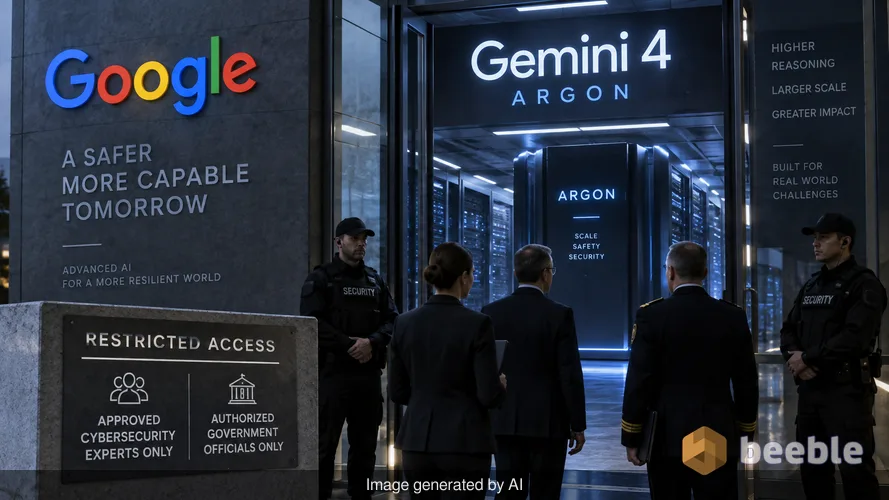
The standard narrative in the technology world suggests that every new artificial intelligence release is a direct upgrade for the average user. When Alphabet announced its Gemini 4 generation on Wednesday, headlined by a massive new model called Argon, the headlines promised a leap forward. While the buzz suggests a new era of digital assistance, the reality is a shift toward restriction. Google is not handing the keys to this powerhouse to the public. Instead, the company is locking the doors and inviting a select group of cybersecurity experts and government officials inside first. This indicates that the race for AI supremacy has moved from consumer novelty to industrial and national defense.
Alphabet’s newest flagship arrives after months of internal delays and shifting timelines. In the high-stakes environment of 2026, the company is under immense pressure to prove it can compete with OpenAI’s Astra and Anthropic’s Opus. These frontier models are the heavy lifters of the digital age. They are designed for workloads that would crash a standard smartphone or basic laptop. Argon is physically larger than the Pro models of the Gemini 3 era. This increased scale allows the model to handle massive datasets and complex logic, but it also makes the software more expensive to run and more volatile to manage.
The heavy lifting of the Argon model
To understand Argon, think of the model as a tireless intern who has spent decades studying every line of code ever written. This intern is brilliant at finding a single misplaced semicolon in a million lines of software. However, this intern is also incredibly resource-intensive. Running a model of this size requires a digital infrastructure that functions like the invisible backbone of modern life. It demands thousands of interconnected chips and a cooling system that rivals small industrial plants.
Google claims Argon is comparable to its rivals on key coding and cyber benchmarks. This is a specific way of saying the model is a specialist. It is built to defend against systemic threats and to build robust software. For the average user, this means the technology behind the curtain is getting stronger, even if the tools in your hand look the same. The focus on coding and cybersecurity suggests that Google is prioritizing the plumbing of the internet. By securing the code that runs our banks, power grids, and communication networks, the company is positioning itself as a foundational utility rather than just a search engine.
Why bigger models stay behind closed doors
Historically, tech companies released new products as fast as possible to capture market share. The release of Argon follows a different pattern. Google is participating in a voluntary process for pre-release access managed by the Trump administration. This level of government involvement is a relatively new phenomenon in the tech sector. It highlights a growing consensus that large-scale AI is a disruptive force that requires oversight before it reaches the general public.
There is also a practical side to this secrecy. A model this large is an expensive asset to maintain. When a company provides access to millions of users at once, the cost of the electricity and computing power is astronomical. By restricting Argon to cybersecurity partners, Google manages its operational costs while it refines the model’s performance. This approach allows the company to iron out flaws in a controlled environment. The digital crude oil that fuels these models — high-quality data — is becoming more difficult to find, making every training cycle a massive financial risk.
A comparison of the frontier landscape
Google’s delay in releasing Gemini 4 was a rare moment of public hesitation. It gave Anthropic and OpenAI room to solidify their positions in the market. The following table illustrates how Argon fits into the current ecosystem of high-end AI models as of late 2026.
| Model Name | Primary Developer | Access Strategy | Targeted Use Case |
|---|---|---|---|
| Argon (Gemini 4) | Restricted / Partners | Cyber defense and complex coding | |
| Astra | OpenAI | Limited Beta | Multimodal reasoning and vision |
| Opus | Anthropic | Subscription / Public | Advanced research and writing |
| Llama 5 | Meta | Open Source | Decentralized development |
The bottom line is that Google is no longer just competing on speed. It is competing on resilience. By benchmarking Argon against Astra and Opus, Google is telling investors that it has a seat at the table with the most advanced systems in existence. Whether those systems ever reach a consumer’s phone is a separate question.
The trickle down effect for everyday devices
Looking at the big picture, the existence of Argon matters to you even if you never use it directly. In the world of hardware and software, high-end developments eventually become standard features. This is a cyclical process of democratization. The breakthroughs in reasoning and logic that Google achieves with Argon will eventually inform the smaller, more streamlined models that run locally on your devices.
Practically speaking, this is similar to how Formula 1 racing works. The average driver does not need a car that goes 200 miles per hour, but they do benefit from the fuel efficiency and safety technology developed for the racetrack. When Google’s researchers find a way to make Argon more accurate at spotting malware, they can distill that knowledge into a lighter version of the Gemini model. This smaller version is what will eventually protect your personal email or speed up your photo editing. The flagship model sets the ceiling, and the consumer models follow the lead.
The shifting politics of artificial intelligence
The mention of the Trump administration’s involvement is a reminder that AI is now a geopolitical tool. The government is interested in Argon because of its potential for cyber warfare and national defense. A model that is excellent at coding is also excellent at finding vulnerabilities in an adversary’s infrastructure. By cooperating with federal authorities, Google is navigating a complex regulatory environment that is still emerging.
This cooperation is a sign of a maturing industry. The opaque days of “moving fast and breaking things” have ended. Large tech firms now act more like defense contractors or heavy industrial giants. They are part of a systemic effort to secure the digital borders of the nation. For the consumer, this means your favorite apps are now part of a much larger, more serious conversation about national security and economic stability.
What this means for your digital habits
Ultimately, the news of Gemini 4’s flagship model should change how you view your digital tools. We are moving away from the era where every AI update is a fun new toy to play with. Instead, we are entering an era of specialized, industrial-grade intelligence. You should observe your digital habits and notice which tasks truly require a giant model and which are better served by simple, transparent tools.
The hype surrounding Argon will be loud, but the practical impact for your budget and your privacy is still in the distance. The release timeline remains a mystery because Google is prioritizing safety and stability over public access. This is a resilient strategy in a volatile market. It suggests that the company is more interested in being right than being first.
From a consumer standpoint, the most important takeaway is to remain skeptical of the “one model to rule them all” narrative. As these systems grow larger and more complex, they also become more specialized. Your smartphone will likely continue to use smaller, more efficient versions of these models for years to come. Appreciate the invisible industrial mechanics that keep your data safe, but do not expect a revolutionary change in your daily routine just because a new giant has entered the room. The true value of Argon is not in what it can do for you today, but in how it secures the digital world you inhabit every day.
Sources:
Alphabet Q3 2026 Press Release,
Google Gemini 4 Technical Documentation,
Department of Commerce AI Safety Framework Update,
Market Analysis Report on Frontier Model Benchmarks.



See you on the other side.
Our end-to-end encrypted email and cloud storage solution provides the most powerful means of secure data exchange, ensuring the safety and privacy of your data.
/ Create a free account
