


Forget the Hype -- Real Robots Still Struggle to Open a Door, but NVIDIA Cosmos 3 Wants to Change That

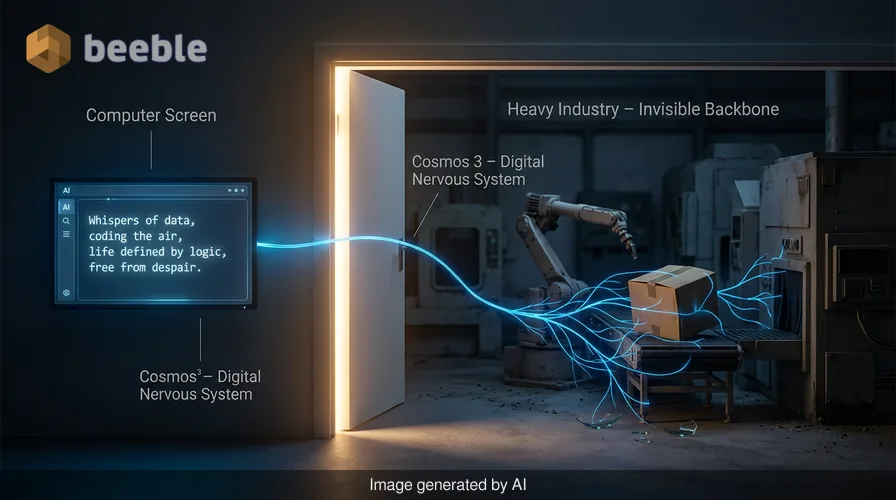
Most tech headlines suggest that robots are moments away from folding your laundry and walking your dog. In reality, a robot in a modern factory often requires a team of engineers to program every single centimeter of its movement. If a box sits slightly crooked on a conveyor belt, the entire system might stop. The physical world is messy, unpredictable, and difficult for software to navigate. While digital AI can write a poem in seconds, physical AI has struggled to understand how a ball bounces or how a glass breaks.
NVIDIA has released Cosmos 3 to address this specific gap. The company calls it an open world foundation model for physical AI. This system is a departure from the chatbots many people use today. It is a digital nervous system designed to help machines perceive the physical world and predict what happens next. Looking at the big picture, this release is a move to move AI from our computer screens into the heavy industry that forms the invisible backbone of modern life.
The two brains inside the machine
Under the hood, Cosmos 3 uses a mixture-of-transformers architecture. This sounds complex, but it essentially gives the AI two different types of thinking power. The first part is a reasoning transformer. Think of this as the navigator in a car who looks at the map and decides the best route. It processes visual information and spatial relationships to understand the environment. The second part is an expert generation transformer. This is the driver who knows exactly how much to turn the wheel and when to press the brakes.
By pairing these two structures, the model understands object interactions and motion before it tries to act. In the past, robots often relied on fixed scripts. They did not understand why they were moving a certain way. Cosmos 3 uses what NVIDIA calls leading physics accuracy to predict trajectories. If a robot needs to pick up a slippery object, the model helps it understand how friction and gravity will affect the task.
Why an omnimodel is different from a chatbot
Most people are familiar with language models that process text. Cosmos 3 is an omnimodel, which means it handles a wide variety of data types simultaneously. It understands text, images, video, and ambient sound. This is a streamlined way to build a machine that can actually survive in a human environment. A robot in a warehouse needs to see a forklift coming, hear its warning beep, and understand a text-based instruction on a screen all at the same time.
This model also generates its own data. This is a practical solution to a major problem in robotics. It is very expensive and slow to film thousands of hours of robots failing in the real world to teach them what not to do. Cosmos 3 creates synthetic data, or digital practice sessions, where robots can fail millions of times in a simulation before they ever touch a piece of hardware. This reduces the need for massive real-world training sets and allows for faster development.
Moving from simulation to reality
Industry researchers at McKinsey suggest that robotics will soon cross the gap from simulation to reality. Historically, robots worked in cages on assembly lines to keep humans safe. Today, they operate in dynamic settings where they must adapt to moving people and shifting objects. This requires autonomy that older software could not provide.
| Feature | Traditional Robotics Software | NVIDIA Cosmos 3 Physical AI |
|---|---|---|
| Environment | Controlled, static cages | Dynamic, unpredictable spaces |
| Training Data | Hand-coded scripts | Synthetic data and vision models |
| Response to Change | Often fails if a part is moved | Predicts physics to adapt on the fly |
| Input Types | Limited sensor data | Video, sound, text, and spatial data |
| Hardware | Single-purpose machines | Universal physical AI agents |
Deloitte predicts that the global installed capacity of industrial robots will reach 5.5 million by 2026. This growth depends on machines becoming more intuitive. When a robot has a foundational model like Cosmos 3, it does not need to be reprogrammed for every new task. It has a general understanding of how the world works.
The power of an open coalition
NVIDIA is not keeping this technology behind a closed door. The company launched the Cosmos Coalition, which includes developers and world model builders like Black Forest Labs and Runway. This is a decentralized approach to development. By making the model open, NVIDIA allows other companies to contribute their own research and data.
For the average user, this means that different brands of robots or autonomous cars can share a common language for understanding physics. Major electronics companies like Samsung and LG are already using the platform. In the automotive sector, Li Auto uses it to develop autonomous vehicles. When these companies work on the same foundational model, the technology improves faster for everyone.
Behind the jargon of synthetic data
One of the most disruptive parts of this announcement is the focus on neural scene reconstruction and video augmentation. Essentially, these tools allow a developer to take a single video of a warehouse and turn it into thousands of different scenarios. They can change the lighting, add obstacles, or simulate a equipment failure.
This is tangible progress because it solves the data bottleneck. It is much easier to train a self-driving car to handle a rare blizzard if you can generate a high-quality, physics-accurate simulation of that blizzard. For the consumer, this leads to products that are more resilient and safer. A delivery robot using these skills is less likely to get confused by a sidewalk puddle or a stray dog because it has already seen thousands of variations of those obstacles in its digital training.
What this means for your everyday life
Ultimately, you might never see the Cosmos 3 software directly, but you will experience its effects. This technology is a foundational layer for the next generation of consumer goods and services. On the market side, this shift could lead to more affordable products as smart factories become more efficient.
What this means for you:
- Safer autonomous systems: Cars and delivery drones will have a better grasp of physical laws, making them more predictable in bad weather or crowded streets.
- Smarter appliances: The next generation of home robots will likely move away from simple vacuuming and toward complex tasks like clearing a table without breaking a glass.
- Faster manufacturing: Companies like Samsung can retool their factories for new products in days instead of months because their robots are easier to train.
- Improved workplace safety: AI agents in warehouses can detect defects or safety hazards that human eyes might miss during a long shift.
Looking at the big picture
Jensen Huang, the founder of NVIDIA, describes this as the big bang of physical AI. While that is corporate language, the underlying shift is real. We are moving away from AI that just talks and toward AI that does. The release of Cosmos 3 Super provides the highest level of physics accuracy for applications that cannot afford errors, such as heavy machinery or autonomous transit.
From a consumer standpoint, we are entering a period where the machines around us will start to seem less like programmed tools and more like aware assistants. They will perceive, reason, and act with a level of fluidity that was once restricted to science fiction. As these models become more common, the barrier between the digital world and the physical world will continue to thin.
Instead of waiting for a single breakthrough robot to change the world, we are seeing the arrival of a universal brain that can be installed in many different types of machines. This systemic change will likely redefine how we interact with technology in our homes, our offices, and our cities. Observe the next time you see a self-checkout machine or an automated delivery cart. These devices are transitioning from simple computers into physical AI agents that truly understand the world they inhabit.
Sources: NVIDIA Corporate Newsroom, McKinsey Global Institute, Deloitte Industrial Outlook 2026.



See you on the other side.
Our end-to-end encrypted email and cloud storage solution provides the most powerful means of secure data exchange, ensuring the safety and privacy of your data.
/ Create a free account
