


Forget the Hype—Robotaxis Aren't Taking Over Your City Anytime Soon

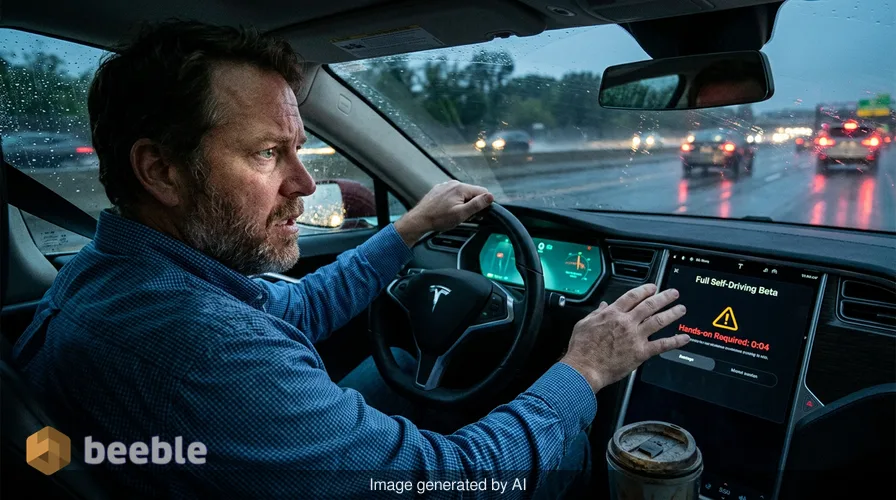
While the vision of a steering-wheel-free world feels like a destiny written in silicon, the reality of the road is far more stubborn than the lines of code meant to conquer it. For years, the narrative from Silicon Valley has been one of imminent disruption. We have been told that by the mid-2030s, the act of driving your own vehicle will be as quaint and niche as farrier work or manual typesetting. Yet, as we sit here in May 2026, looking at the progress made over the last two years, it is becoming increasingly clear that Elon Musk’s timeline for a driverless future is less of a roadmap and more of an aspirational sketch.
Looking at the big picture, the claim that 90% of all miles driven will be autonomous within a decade assumes a level of technological and social frictionlessness that simply does not exist. Musk’s prediction, shared at various summits and during earnings calls, suggests a world where AI handles the drudgery of the commute while humans lounge in mobile living rooms. But for the average user, the transition is proving to be a slow, systemic shift rather than a sudden revolution. To understand why, we have to look under the hood at the mechanical and digital hurdles still standing in the way.
Why the "Long Tail" is Wagging the Dog
In the world of artificial intelligence, there is a concept known as the long tail. Practically speaking, this refers to the infinite number of rare, unpredictable scenarios that occur on real-world roads. While an AI can be trained to recognize a stop sign or a pedestrian in a crosswalk with high precision, it struggles with the chaotic "what-ifs." Think of AI as a tireless intern: it is incredibly diligent and never sleeps, but it lacks the foundational common sense to handle a situation it hasn't seen in a training manual.
Consider the incident where robotaxis in San Francisco became paralyzed during a power outage because they couldn't interpret a darkened traffic light. Or the instances where autonomous systems struggled with flooded roads or complex hand signals from a construction worker. To a human, these are intuitive puzzles solved in a split second. To a machine, they are opaque logic errors. These long-tail scenarios are not just minor glitches; they are the primary reason why Level 5 autonomy—the ability to drive anywhere, in any weather, without human intervention—remains out of reach for the foreseeable future.
The Regulatory and Industrial Anchor
Beyond the code, we must contend with the invisible backbone of modern life: regulation and infrastructure. Historically, the automotive industry moves at a glacial pace compared to software development. This is because the stakes of a software bug in a photo-sharing app are low, while a bug in a two-ton vehicle is a matter of life and death.
Europe, for instance, has taken a robust and cautious approach. While Level 2 systems (where the car helps with steering and braking but the human is still the boss) are now widespread, Level 3 and Level 4 approvals are granted only under highly controlled conditions. The legal labyrinth of liability is another systemic barrier. If a driverless car crashes, who is at fault? The owner? The software developer? The sensor manufacturer? Until these questions are settled with transparent, international standards, manufacturers will remain hesitant to release fully autonomous fleets to the general public.
Conversely, countries like China are racing ahead, driven by a different regulatory appetite and a centralized push for industrial dominance. However, even there, the rollout is concentrated in specific urban "sandboxes." For the average user living in a rural area or a city with aging infrastructure, the driverless dream remains a distant prospect.
The Economic Barrier: Why Your Next Car Still Needs You
From a consumer standpoint, the most significant hurdle might be the price tag. The hardware required for true autonomy—including high-resolution LiDAR, redundant sensor suites, and massive onboard computing power—remains expensive. While these costs are disruptive and will eventually scale down, they currently make full autonomy a luxury feature rather than a mainstream standard.
According to recent industry reports, even by 2035, full autonomy in personal vehicles is projected to be a niche feature, appearing in only a small fraction of new cars. The more likely scenario is that autonomy will be decentralized into specific use cases, such as long-haul trucking or urban robotaxi fleets, where the high equipment costs can be amortized over thousands of commercial miles.
Decoding the Levels of Autonomy
To cut through the jargon, it is helpful to see exactly where we stand today versus where the hype says we should be. The following table breaks down the levels of automation as defined by global standards.
| Level | Name | What it Means for You | Current Status (2026) |
|---|---|---|---|
| Level 2 | Partial Automation | The car steers and brakes, but you must keep your eyes on the road. | Standard in most new mid-range cars. |
| Level 3 | Conditional Automation | The car drives itself in traffic jams or on highways, but you must be ready to take over. | Available in select luxury models in specific regions. |
| Level 4 | High Automation | The car can drive itself in a geofenced area (like a downtown core) without human help. | Operational in limited robotaxi fleets (Waymo, etc.). |
| Level 5 | Full Automation | The car can drive anywhere, anytime, in any weather. No steering wheel required. | Theoretically possible, but not currently in sight. |
What This Means for Your Future Commute
So, what is the bottom line for the everyday driver? In simple terms, you should expect a gradual evolution rather than a total replacement of your driving habits. In the coming years, you will likely see your car take over more of the boring parts of driving—sitting in stop-and-go traffic or staying centered on a long highway stretch. This is the emerging reality of Level 2+ and Level 3 systems.
However, the idea that 90% of your driving will be done by an AI within a decade feels like a volatile overestimation. We are moving toward a hybrid world where human intuition and machine precision must coexist. For the average user, this means that while your next car will certainly be smarter and safer, you aren't going to be taking a nap in the backseat on your way to work anytime soon.
Ultimately, we should view Musk’s timeline as a catalyst for innovation rather than a literal deadline. It forces the industry to solve hard problems and pushes regulators to modernize. But as a consumer, the best approach is one of resilient pragmatism. Appreciate the safety features as they arrive, but keep your hands on the wheel and your eyes on the road. The digital crude oil of the 21st century—data—is still being refined, and until the AI can handle a snowy night in a construction zone with a malfunctioning traffic light, the human driver remains the most sophisticated computer on the road.
Sources:
- World Economic Forum 2025 Autonomous Vehicle Report
- National Highway Traffic Safety Administration (NHTSA) Safety Records
- International Energy Agency (IEA) 2025 Global EV Outlook
- Waymo and Tesla Corporate Transparency Reports
- SAE International J3016 Standards Documentation



See you on the other side.
Our end-to-end encrypted email and cloud storage solution provides the most powerful means of secure data exchange, ensuring the safety and privacy of your data.
/ Create a free account
