


Forget the hype — the real AI revolution is happening in a lab full of yeast

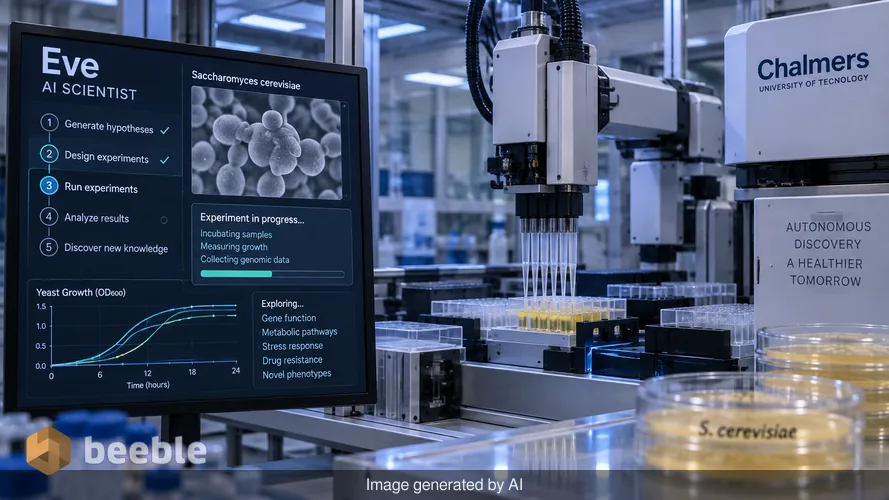
While the public fixates on AI chatbots that can write poems or generate fake videos, a far more disruptive shift is occurring in a laboratory at Chalmers University of Technology in Sweden. For decades, the image of scientific discovery involved a human researcher hunched over a microscope, waiting for a lightbulb moment. That image is now outdated. Researchers have developed an AI scientist named Eve that does not just help humans with their work. Eve generates its own hypotheses, designs its own experiments, and interprets the results without needing a coffee break.
This is not a simulation. It is a closed-loop laboratory where software and hardware work together to probe the mysteries of biology. Specifically, the system is studying Saccharomyces cerevisiae, better known as brewer's yeast. While yeast might seem like a simple subject for such advanced technology, it is a foundational organism in biological research. The ability for a machine to autonomously navigate the complexities of a living genome marks a systemic change in how we develop new medicines and understand life itself.
The tireless intern that never sleeps
To understand why this matters, look at the typical workflow of a human scientist. A researcher reads hundreds of papers, forms a theory, manually sets up a petri dish, waits for a reaction, and then spends days analyzing the data. It is a slow, cyclical process prone to human error and fatigue. Eve functions like a tireless intern with a perfect memory. The researchers updated this robot scientist with large language models and automated reasoning, allowing it to digest vast amounts of scientific literature that no human could ever read in a lifetime.
Under the hood, Eve combines the thinking power of modern AI with the physical capability of laboratory automation. It has access to the yeast's entire genome and metabolism. When Eve identifies a biological question it wants to answer, it does not wait for permission. It recommends an experiment, executes it using robotic arms, and then evaluates the outcome. If the result is not what it expected, it refines its understanding and starts the next cycle immediately.
The self-driving car of the laboratory
Ievgeniia Tiukova, a researcher at Chalmers University, compares this development to self-driving cars. In a self-driving vehicle, the AI must process visual data, draw conclusions about traffic, and take physical action by steering or braking. The AI scientist does the same thing with biological data. It processes information from past studies, draws conclusions about how genes might interact, and takes action in the physical lab.
Historically, AI in science was a passive tool. You fed it data, and it gave you a chart. Now, the AI is in the driver’s seat. This shift is transparent and logical when you consider the sheer volume of data involved in modern genetics. Human brains are not evolved to track thousands of simultaneous chemical reactions across a metabolic network. AI is.
| Feature | Traditional Lab Research | Autonomous AI Research (Eve) |
|---|---|---|
| Hypothesis Generation | Human-led, prone to bias | Data-driven, explores all paths |
| Experiment Pace | Limited by human shifts | 24/7 continuous operation |
| Data Analysis | Manual interpretation | Real-time automated reasoning |
| Resource Use | Higher waste due to error | Optimized and streamlined |
| Knowledge Base | Individual expertise | Entirety of recorded science |
Why yeast is the digital crude oil of biology
It is easy to wonder why so much high-tech firepower is being aimed at brewer’s yeast. For the average user, yeast is something used for bread or beer. However, in the world of biotechnology, yeast is a living factory. Because yeast cells share many basic functions with human cells, they serve as a practical model for drug discovery. If you can understand how to manipulate a yeast cell to produce a specific chemical or react to a certain compound, you can often apply those lessons to human medicine.
Ross King, a professor at Chalmers and the senior author of the study, notes that autonomous laboratories will investigate biological systems much faster than is possible today. This speed is the overarching goal. By using AI to automate the routine cycles of testing, we can find new treatments for diseases in months rather than decades. The bottom line is that the speed of discovery is no longer limited by the number of qualified humans in the room.
Behind the jargon of closed-loop systems
In simple terms, a closed-loop system means the AI is responsible for the entire circle of research. Most AI applications today are open-loop — a human gives a prompt, the AI gives an answer, and the process ends there. In Eve’s lab, the AI’s own experimental results become the prompt for its next action. This creates an accelerating feedback loop.
This technology is resilient because it does not get bored by repetitive tasks. Much of biological research is incredibly tedious. It involves moving tiny amounts of liquid from one tube to another thousands of times. When humans do this, they make mistakes. When a robot does it, the results are consistent. This consistency is foundational for scientific validity. It ensures that when a discovery is made, it is because of the biology, not because a researcher had a shaky hand at 4:00 PM on a Friday.
What this means for your medicine cabinet
From a consumer standpoint, the impact of autonomous AI scientists will eventually appear in the price and availability of healthcare. The drug discovery process is currently one of the most expensive and volatile industries in the world. It takes billions of dollars to bring a single new drug to market, largely because most experiments fail.
By using AI scientists to optimize laboratory resources, biotech companies can fail faster and cheaper. This does not mean humans are out of a job. Instead, the role of the human scientist is shifting. Ross King emphasizes that humans remain essential for defining research priorities and ensuring ethical oversight. The AI handles the "how," while the human focuses on the "why." We are moving toward a partner model where the AI manages the heavy lifting of data and experimentation, leaving the high-level strategy to us.
The shifting reality of the global research market
Looking at the big picture, this development is part of a broader trend toward the decentralization of expertise. As these autonomous systems become more scalable, smaller labs will be able to conduct research that previously required a massive corporate infrastructure. The integration of large language models means that an AI can now bridge the gap between reading a textbook and performing a physical task.
This is a tangible step toward a future where scientific breakthroughs are a constant stream rather than a rare event. We are seeing the emergence of a new industrial backbone for medicine. Just as microchips became the digital crude oil of the 20th century, autonomous discovery engines are becoming the engine of the 21st.
A pragmatic look at the hurdles ahead
We should maintain some healthy skepticism. While Eve is impressive, the system still operates within the narrow confines of yeast biology. Moving from a single-celled organism to the trillions of cells in a human body is a massive leap in complexity. The AI must also contend with the opaque nature of biological systems where one change can have unforeseen ripple effects.
Furthermore, the cost of the hardware for these labs remains high. While the software might be easy to copy, the robotic arms, sensors, and specialized equipment are not. This creates a temporary barrier to entry. However, as the technology matures, we can expect these costs to drop, much like the price of home computers or 3D printers did in previous decades.
Ultimately, the arrival of autonomous AI scientists urges us to change how we view progress. We are no longer just building tools to help us think. We are building systems that can think and act on our behalf. As you go about your day, remember that in a lab in Sweden, a robot is quietly working through thousands of biological possibilities, searching for the next breakthrough that might one day save your life. The next time you see a headline about AI, remember the yeast. The most important work is often happening in the smallest cells, guided by the most advanced minds we have ever built.
Sources
- Chalmers University of Technology, Press Release: "AI scientist autonomously generates and validates new biological discoveries."
- Journal of the Royal Society Interface, Research Paper: "Autonomous discovery of biological knowledge by a robot scientist."
- Wallenberg AI, Autonomous Systems and Software Program (WASP), Funding and Project Reports.
- University of Cambridge, Collaborative Research Documentation on Automated Reasoning.



See you on the other side.
Our end-to-end encrypted email and cloud storage solution provides the most powerful means of secure data exchange, ensuring the safety and privacy of your data.
/ Create a free account
