


Forget the hype — the secret to smarter robots is a human in a headset

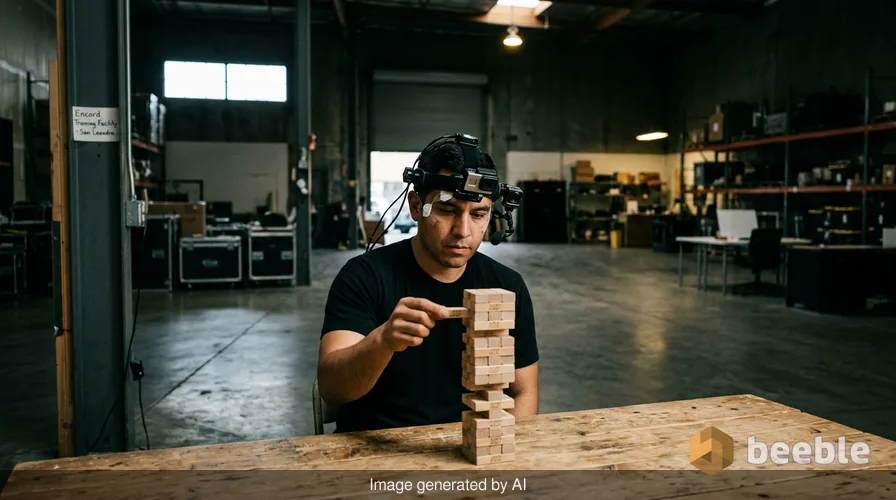
While popular narratives suggest that humanoid robots will soon arrive at our doorsteps thanks to massive supercomputers, the reality is far more grounded. In a quiet warehouse in San Leandro, California, the future of physical AI looks less like a sleek laboratory and more like a game of Jenga. Andrew Ceja, a specialist trainer at the tech firm Encord, spends his days carefully pulling wooden blocks from a tower while wearing a headset equipped with cameras and brain-sensing electrodes. This unusual setup reveals a fundamental truth about modern technology: we have run out of the digital fuel needed to make robots smart.
Silicon Valley has spent the last decade scraping every corner of the internet to train chatbots. If you type a question into an AI, the system answers based on billions of pages of text written by humans. However, there is no equivalent "internet of movement" for physical tasks. A robot cannot learn how to fold a shirt or stack a pallet by reading a Wikipedia entry. It needs data that shows how forces, angles, and intentions interact in the three-dimensional world. This scarcity of physical information is the primary reason your home still lacks a reliable automated butler.
The great physical data drought
The logic behind generative AI is simple: more data leads to better results. This worked for Large Language Models because the web is an endless library of human thought. Robots do not have this luxury. Companies like Encord are now pivoting from managing existing data to manufacturing new data from scratch. They are essentially building a digital factory for human experience.
Vineeth Velmurugan, who leads robot learning at Encord, is a veteran of major labs like OpenAI. He explains that even a massive video library like YouTube is insufficient for a robot to learn complex manipulation. Watching a video of a person pouring coffee is not the same as feeling the weight of the pot or the slosh of the liquid. Velmurugan estimates that the industry needs a data set roughly five times the size of YouTube to achieve a breakthrough in physical intelligence. This creates a massive bottleneck because collecting this information requires real people to perform real tasks in real time. It is a slow, manual process in an industry that usually moves at the speed of light.
Reading minds to teach machines
The most experimental part of this data manufacturing involves neurotechnology. Encord is currently testing headsets from Zander Labs, a German startup, to record what happens inside a human brain during manual labor. When a trainer like Ceja plays Jenga, the headset tracks his brain waves to detect mental states. The sensors look for signals of surprise, error, or intense focus.
Lucas Gehrke, a neuroscientist at Zander Labs, notes that these signals offer clues that video cameras miss. If a human trainer feels a moment of panic because a tower is about to fall, that internal reaction is a valuable data point. It tells the AI model that this specific moment is critical. By tagging video data with brain activity, developers can teach robots not just what to do, but which moments require the most caution. This is like giving an intern a mentor who can share their instincts rather than just their instruction manual.
This approach turns every human movement into a rich, multi-layered file. The data includes the video of the task, the position of the trainer’s arms, and the electrical activity of their brain. This combination creates a high-fidelity map of human skill that a machine can eventually mimic.
Why your screen time cannot train a robot
For the average consumer, it is easy to wonder why we cannot just use the billions of hours of footage from doorbells and security cameras to train these machines. The problem lies in the perspective. Most existing video is "third-person" and lacks the precise spatial data a robot needs to move its own limbs. To solve this, Encord uses "egocentric" video, which is filmed from the perspective of the person doing the work.
In San Leandro, pilots use leader-follower rigs. These are paired robotic arms where a human moves one set, and the robot mimics the motion exactly. As the human plugs an ethernet cable into a server or stacks poker chips, every micro-adjustment is recorded. This is far more precise than simple video. It captures the struggle of the task. Sofia Infante, another pilot at the facility, demonstrates the difficulty of plugging in cables. Even with advanced sensors, robotic pincers lack the dexterity of human fingers. The data collected here records those failures and successes to help future models bridge that gap.
The high cost of manufactured intuition
There is a significant economic hurdle in this new approach to AI. Scraping text from the web is virtually free, but manufacturing physical data is expensive. Encord adds dense annotations to their data, such as labeling a specific movement as "right hand tightens bolt." Velmurugan notes that this high-quality, annotated data is 100 times more valuable than raw video for training specific skills. However, it costs 20 times more to produce.
This shift in economics changes the trajectory of the industry. AI is no longer just a software problem that you can solve with more electricity and faster chips. It is now a logistics and labor problem. The building blocks of future humanoid robots are being handmade by specialized workers in warehouses. This means the transition to physical AI will likely be more expensive and slower than the transition to digital AI. The invisible backbone of the industry is no longer just silicon, but the physical effort of human trainers.
What this means for your future home
Practically speaking, the push for brain-wave data and manual training rigs suggests that specialized robots will arrive long before general-purpose ones. We will likely see machines that are excellent at specific, high-value tasks—like managing data centers or sorting warehouse inventory—before we see a robot that can clean a messy kitchen. The data for data centers is easier to manufacture and more profitable to collect.
Looking at the big picture, this research highlights a return to the value of human touch. Even the most advanced AI companies are realizing that they cannot ignore the complexity of the human body and mind. The "secret sauce" for the next generation of gadgets is not a new algorithm, but a deeper understanding of how humans interact with the world.
Ultimately, the progress of physical AI depends on how well we can translate our own subconscious habits into code. When you see a robot successfully perform a task in the future, it will be the result of thousands of hours of human pilots wearing headsets and playing games. The path to automation is, ironically, paved by intense human labor. For consumers, this means that while the technology is emerging, it remains a premium product defined by the high cost of its education.
Sources: TechCrunch industrial reporting, Encord corporate briefings, Zander Labs technical documentation, OpenAI robotics research archives.



See you on the other side.
Our end-to-end encrypted email and cloud storage solution provides the most powerful means of secure data exchange, ensuring the safety and privacy of your data.
/ Create a free account
