


Forget the reasoning hype -- the real AI revolution is boring and predictable

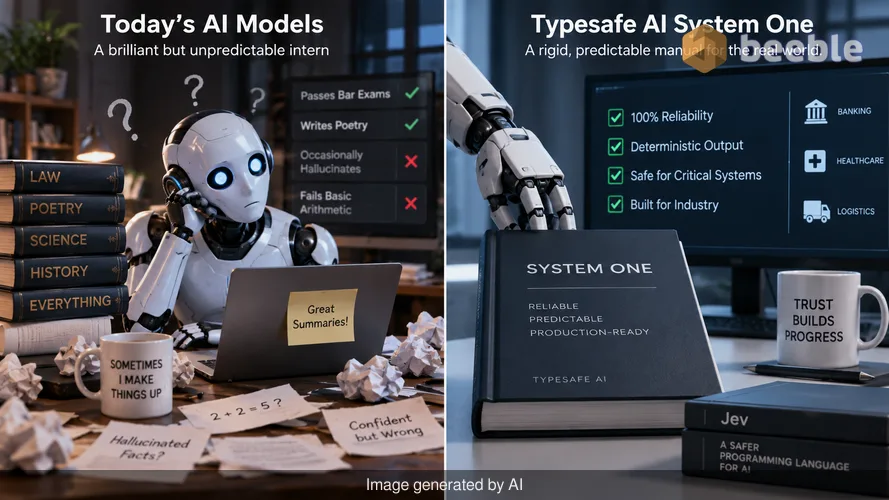
The tech world spent the last three years obsessed with making AI models smarter. We celebrated when they passed bar exams and wrote poetry, even when they occasionally hallucinated facts or failed at basic arithmetic. The prevailing narrative suggests that if we just add more data and more processing power, these digital brains will eventually become flawless. While this bigger-is-better approach sounds logical, the reality of modern software development tells a different story. For a bank, a hospital, or a logistics company, a reasoning model that is right 95% of the time is often worse than a simple script that is right 100% of the time. This reliability gap is where Typesafe AI is positioning its new System One models and the Jev programming language.
Looking at the big picture, we are witnessing a shift from AI as a creative novelty to AI as a foundational industrial tool. Most popular models today, like GPT-4 or Claude, function as a tireless intern. This intern has read every book in the library and can summarize a legal brief in seconds. However, this intern also has a habit of making up answers when they feel pressured or confused. You cannot easily fire this intern because they are integrated into your workflow, but you also cannot trust them to handle your payroll or medical prescriptions without constant supervision. System One models aim to replace this erratic intern with a rigid, predictable manual.
The problem with thinking too much
In psychology, System 1 refers to fast, instinctive, and emotional thoughts, while System 2 is slower, more deliberative, and logical. In the AI industry, we have spent billions of dollars perfecting System 2. We want models that reason, weigh options, and solve complex puzzles. The downside is that reasoning takes time and money. Every time an LLM thinks, it consumes thousands of tokens and significant electricity. From a consumer standpoint, this translates to apps that are slow to respond and subscriptions that cost twenty dollars a month.
More importantly, reasoning introduces uncertainty. When a model reasons, it creates a unique path to an answer every time you ask a question. This variability is a nightmare for software engineers. If an app developer wants a button to turn blue when a user clicks it, they need that behavior to happen every single time. They do not want the app to reason about whether blue is the right aesthetic choice for the current weather. Traditional software is deterministic, meaning the same input always produces the same output. Current AI is probabilistic, meaning it gives you its best guess.
How System One changes the architecture
Typesafe AI is moving in the opposite direction of the general trend. Their System One models are not designed to write essays or debate philosophy. Instead, these models focus on structured, high-speed execution. They are small, specialized, and remarkably fast. They handle the routine tasks that keep the digital world running, such as routing data, checking for errors, and translating user intent into machine code. Essentially, these models act as the nervous system rather than the prefrontal cortex.
Under the hood, these models rely on a specific architecture that prioritizes safety over creativity. They do not wander off-script because they do not have a script to begin with. They operate within narrow lanes defined by the developer. This makes them lean enough to run on local hardware, such as your smartphone or a small industrial sensor, rather than requiring a massive server farm in the desert. This decentralization is a significant win for privacy and latency. When your data stays on your device, it is inherently more secure.
The role of the Jev language
To make these models work, Typesafe introduced Jev. For the average user, the name of a programming language rarely matters, but Jev is the reason System One models are practical. Historically, developers used Python or JavaScript to build AI applications. These languages are flexible, but they are also prone to hidden errors that only appear when the program is running. Jev is a type-safe language. In simple terms, this means the code has built-in guardrails that prevent common mistakes before the software ever reaches the user.
If a developer writes a program in Jev to manage a smart home’s temperature, the language ensures that the "temperature" variable is always a number. It cannot accidentally become a string of text or a piece of code that crashes the heater. By forcing this level of strictness, Jev allows System One models to operate with a level of resilience that standard LLMs cannot match. The language acts as a digital contract between the programmer and the machine. It ensures that the AI does exactly what it is told, no more and no less.
Why predictability is the new luxury
We are currently in a volatile period of AI development where "magic" is the primary selling point. We are impressed when a chatbot generates a photo of a cat in a space suit. However, as the novelty wears off, users will value reliability over spectacle. Think of the microchip as the digital crude oil of our age. We do not need our oil to be creative. We need it to be consistent and clean so the engine does not explode.
| Feature | Standard LLM (System 2) | System One (Typesafe) |
|---|---|---|
| Primary Goal | Reasoning and Creativity | Execution and Safety |
| Response Speed | Slower (seconds) | Near-Instant (milliseconds) |
| Cost | High (per token) | Low (local execution) |
| Consistency | Variable (guesses) | Deterministic (strict) |
| Deployment | Cloud-based | Local or Edge-based |
Practically speaking, this shift means the next generation of AI-powered tools will feel less like a conversation and more like a high-performance tool. Your banking app might use a System One model to detect fraud in real-time without sending your transaction history to a third-party server. Your car might use one to process sensor data locally to avoid a collision. In these scenarios, you do not want the AI to be "smart" in the human sense. You want it to be a robust, specialized component that never gets tired and never guesses.
The bottom line for consumers
For the average user, the arrival of System One and Jev marks the end of the experimental phase of AI. We are moving toward a world where AI is baked into the plumbing of our digital lives. You will likely interact with a System One model dozens of times a day without realizing it. It will be in your thermostat, your email filter, and your car’s braking system. These models will not make headlines for writing novels, but they will make headlines for making the internet faster and more secure.
Ultimately, this is a correction of the market's over-reliance on massive, expensive models. Small, safe, and fast is a winning combination for businesses that need to watch their margins. It is also a win for consumers who are tired of buggy software and rising subscription costs. The AI revolution is finally becoming transparent and functional, which is far more important than being clever.
Instead of looking for the next chatbot that can pass a Turing test, observe how your existing apps become more responsive over the next year. You might notice that your voice assistant stops saying "I'm sorry, I didn't get that" and starts executing commands instantly. This is not because the AI got smarter. It is because it stopped trying to think and started following a better set of instructions. Appreciate the invisible industrial mechanics that allow your digital world to function without drama.
Sources:
- Typesafe AI Technical Documentation
- Industrial AI Safety Standards Report 2026
- Journal of Software Engineering and Deterministic Systems



See you on the other side.
Our end-to-end encrypted email and cloud storage solution provides the most powerful means of secure data exchange, ensuring the safety and privacy of your data.
/ Create a free account
